
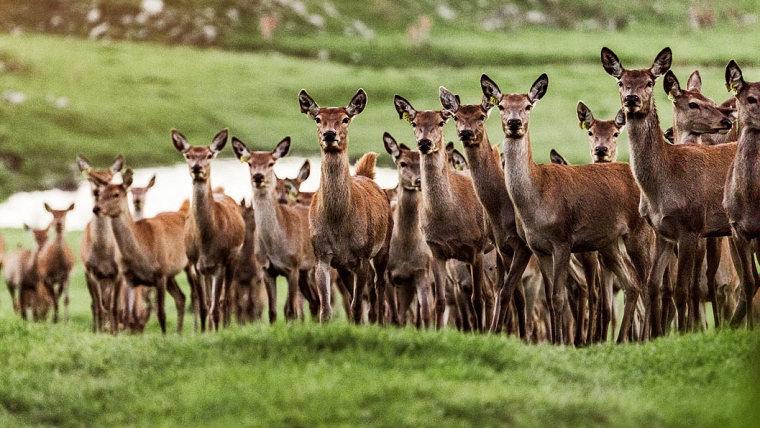
After several years in which New Zealand’s deer sector has faced declining animal numbers, disrupted markets and considerable pressure on farm profitability, there are signs the industry may finally be turning a corner.
Speaking to The Weekly Hotwire, Deer Industry New Zealand chief executive Rhys Griffiths described an industry with two quite different stories. Venison is enjoying historically strong returns and renewed demand, while velvet producers have endured a much more difficult 12 to 18 months.
On the venison side, Griffiths says profitability has improved considerably, with strong schedules supported by demand across Europe, North America and China. More importantly, there are early indications that those returns are beginning to influence decisions back on the farm.
“The latest herd stats that we're getting out of MPI and what have you is that mating hind numbers have really increased for the first time in six years,” he says.
It remains early days, but Griffiths believes the figures suggest the long-running decline in New Zealand’s deer herd may finally be stabilising.
The challenge now is ensuring the industry does not simply respond to stronger prices by chasing volume. Griffiths says any rebuilding of the herd needs to happen alongside growth in demand, particularly in premium markets, so increased production does not undermine the value that has been created.
DINZ has an ambition to double export earnings over the coming years and its modelling suggests achieving that could eventually require a national herd of around one million deer by 2034 or 2035. That would represent significant growth from current levels, but Griffiths is clear the objective is not simply to produce more animals.
“We will need more deer over time,” he says. “It's not because we're chasing volume, but we've just got to make sure we've got product coming through as we look to grow that demand.”
The encouraging part of the venison story is that the industry is becoming less dependent on the markets it traditionally relied upon. The vulnerability of that model became particularly apparent during Covid when restaurants closed almost overnight and venison’s heavy exposure to food service became a significant problem.
The response included the North American Retail Accelerator programme, which helped exporters develop a much stronger presence in retail. Griffiths says that work is now paying dividends, but the next opportunity is to differentiate New Zealand farm-raised venison rather than simply competing against other red meats on price.
New Zealand has a considerable advantage in that it is the only country farming deer commercially on the scale we do. Griffiths believes that uniqueness can be combined with changing consumer attitudes towards health, wellness and nutrient-dense foods.
Venison is naturally lean, high in protein and nutrient dense, attributes that potentially align particularly well with growing interest in weight management, smaller portion sizes and diets designed to maintain muscle while reducing body fat.
“The opportunity for venison is really to become a premium protein that people are searching out because of its health and wellness credentials,” Griffiths says.
DINZ is considering further research to strengthen the evidence around the nutritional qualities of New Zealand farm-raised venison and support exporters telling that story in international markets. Griffiths does not pretend venison is about to become a mainstream global protein. In fact, he sees little reason to be frightened of describing it as niche. The opportunity lies in making that niche increasingly valuable.
That is an important distinction for New Zealand agriculture more broadly. We will never compete with the world’s major food producers on sheer volume. Our opportunity is to extract greater value from what we produce and target consumers prepared to pay for quality, provenance and the attributes associated with New Zealand farming systems.
The velvet story is more complicated.
Griffiths makes no attempt to disguise the disappointment of the past season, with farmgate prices well below where producers would have liked them. Interestingly, however, he says the weakness has not necessarily been at the consumer end of the market.
South Korea remains the world’s major consumer of New Zealand velvet and retail demand has held up, with some customers reporting increased sales while consumer prices remained relatively stable. The problem appears to have been further back through the supply chain, combined with New Zealand producing too much larger Korean-grade velvet into what had effectively become a commodity channel.
The response from farmers has been significant. Around 20,000 heavier velveting stags are expected to have gone to slaughter following last season’s poor prices and DINZ estimates velvet production could fall by about 20 percent this year.
After production approached 1,200 tonnes last season, expectations for the coming season are a little below 1,000 tonnes. Griffiths sees that as an opportunity for the market to reset, although he does not want the industry to rely on reducing supply as its pathway to profitability.
“I don't like us shrinking ourselves back down into success,” he says.
There are reasons for optimism. New health functional food products containing velvet are being launched in South Korea and these products require human clinical studies and approval from the country’s Ministry of Food and Drug Safety before making health claims.
New market access into Vietnam also gives the industry another opportunity to diversify away from its historical reliance on China and South Korea. Griffiths believes targeting food companies and higher-value functional products in markets such as Vietnam could help move more velvet away from commodity channels.
Back on the farm, deer also have to compete for land and capital. Around four out of five deer farmers run other livestock and the strong returns currently available from sheep and beef mean farmers have genuine choices about where they put resources.
Griffiths argues that this is precisely where deer can offer an advantage.
Diversification remains one of the strengths of mixed farming systems. Deer can complement sheep and beef through different seasonal labour requirements, pasture management and animal health considerations, while providing another income stream when another part of the farming business is under pressure.
“When one sector is under pressure, another can help steady that ship within a farming enterprise,” he says.
Looking further ahead, there is no single technology likely to transform deer farming. Genetics, animal health, environmental management and better farm systems will all contribute. Griffiths points to developments through Deer Select and animal health research as areas with potential to improve productivity from essentially the same farm resources.
However, if he had to identify the greatest opportunity over the next decade, it would be increasing the value of the products the industry already produces.
That is significant when DINZ talks about potentially doubling export earnings while increasing the herd to around one million animals. The numbers only work if substantially more value is generated from each animal rather than export growth being achieved simply by doubling production.
“There’s no really silver bullet. Genetics, animal health, system performance and environmental management will all contribute to productivity and profitability. The gains will become quite cumulative.”
New Zealand’s deer industry will also continue operating in an increasingly uncertain international environment. Trade barriers, geopolitical instability, shipping disruption and changing protein supplies are largely beyond farmers’ control. Griffiths believes the industry’s experience through Covid demonstrated why market diversification is so important.
The collapse of food service could have been devastating, but the subsequent development of North American retail created another leg beneath the venison market. The lesson is not that global disruption can be avoided, but that exposure to any single market or channel can be reduced.
For deer farmers, the outlook today is therefore considerably more encouraging than it was 12 to 18 months ago. Venison returns are strong, demand is broadening and the first signs of stabilisation are appearing in the national herd. Velvet still has work to do, but lower production, new market access and development of higher-value health products provide some grounds for optimism.
The opportunity from here is not to rebuild simply for the sake of putting more deer behind fences. It is to rebuild carefully, grow demand ahead of supply and extract more value from a product New Zealand is uniquely positioned to produce.
As Griffiths puts it, New Zealand can only feed a relatively small proportion of the world. The job is to make that production count and ensure as much of that value as possible ultimately finds its way back to the farmer.
We welcome your comments below. If you are not already registered, please register to comment
Remember we welcome robust, respectful and insightful debate. We don't welcome abusive or defamatory comments and will de-register those repeatedly making such comments. Our current comment policy is here.