
New Zealand has a 'missing middle' of large food and beverage export firms, needs to intensify production, and process more primary products before exporting them, a report commissioned by the Ministry of Economic Development says.
The amount of capital invested in the food and beverage industry needed to be trebled over the next fifteen years, as firms needed to make significant increases in investment to transition to selling more packaged goods.
Firms in the industry were generally farmer-owned and hence were under-capitalised for expansion up the value-added chain.
'We need to change'
Minister for Economic Development Steven Joyce said the government wanted the food and beverage (F&B) industry to add more value to primary produce in New Zealand.
Joyce today released a report from research firm Coriolis showing a snapshot of the industry. Demand for high-quality products from a growing Asian middle-class was boosting demand and opportunities for the industry, he said.
“The industry exports NZ$25 billion in food and beverages each year. Much of this is ingredients which others use to make finished products. The report estimates that international consumers pay from NZ$140-200 billion at the checkout counter for food products that are primarily of New Zealand origin," Joyce said.
“It’s not all about producing more. It’s also about capturing more of that value for New Zealand. New Zealand is about the same size as Italy, yet Italy exports twice as much food and beverage by value as New Zealand as well as feeding a population of 60 million,” he said.
Incidentally, Former Economic Development Minister Gerry Brownlee made the same observations in 2010, when he released a Coriolis report on the F&B industry. At the time, Brownlee said many sectors of the industry had failed to forward-integrate along the value chain, and that New Zealand needed to process more primary produce here before exporting it.
Missing middle; Need more capital
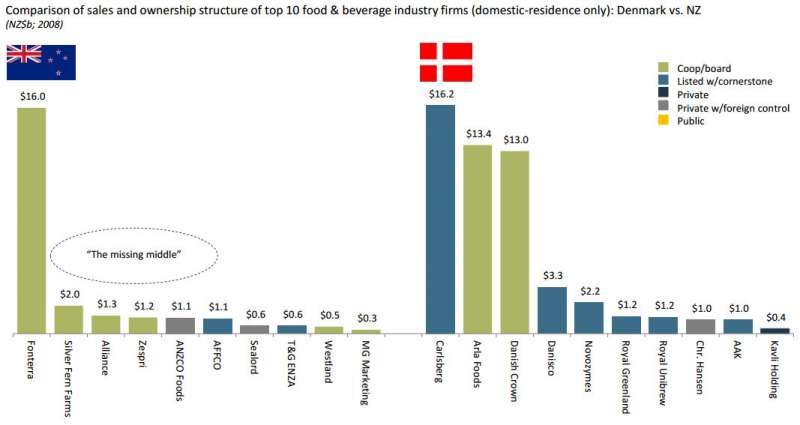
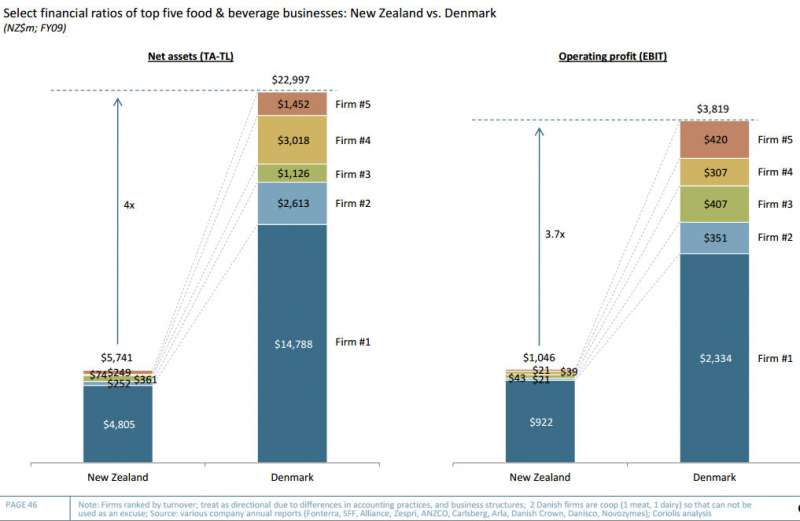
Coriolis highlighted what it called a 'missing middle' of large F&B export firms below dairy-giant Fonterra. It said New Zealand's food and beverage sector was under-capitalised relative to its peers, and as a result was less profitable.
Historically, New Zealand had been a producer of ingredients through farmer-owned co-operatives, Coriolis said.
"Despite media comment, the New Zealand F&B industry is still owned by New Zealanders. Four of the top five New Zealand F&B firms are owned by farmers. There is nothing wrong with farmers owning the food industry. This is a common situation across peer group counties all of whom have a somewhat similar structure of ownership of primary production," it said in the report.
Broadly speaking 50% of what was sold in a supermarket anywhere in the world was fresh perishables (e.g. meat, seafood, produce, dairy) and 50% was consumer-ready packaged shelf-stable products.
"The export mix of peer group countries match these proportions (i.e. 50/50). New Zealand, on the other hand, is 80% weighted toward perishables and only 20% shelf-stable," Coriolis said.
"In the last 10-15 years New Zealand’s F&B industry has begun to transform into a producer of consumer ready packaged goods. Processed/packaged F&B are showing rapid growth, and over the next 20 years New Zealand’s F&B exports will likely come to resemble those of peer group countries," it said.
"The government’s Economic Growth Agenda (EGA) has set a target of tripling New Zealand’s F&B exports over the next 15 years. While this is a clearly a stretch target all of our research suggests it is possible."
To achieve this, the path forward over the next 20 years was about turning ingredients into packaged/processed foods (e.g. infant formula instead of milk powder). This transition would require large amounts of new investment in research, plants and equipment, sales and marketing.
"Conceptually this will require something approaching tripling the amount of capital in the F&B industry. Firms will need to make a significant increase in their investment to make this required transition to packaged goods," Coriolis said.
Producer owned co-operatives strived to maximise returns to members, which limited the availability of capital to fund growth.
"Nevertheless, international investors are providing a large and constant in-flow of capital, particularly in the areas of strong growth potential going forward (i.e. beverages and processed foods)," Coriolis said.
It highlighted the 'missing middle' by comparing New Zealand's F&B industry to Denmark's:
And the under-capitalisation of the industry relative to Denmark:
So how do we get there?
New Zealand had considerable untapped capacity to export more from the food and beverage industry, Coriolis said. It was a country the size of Italy or the United Kingdom, but with the population of Singapore. "However Italy feeds a domestic population of 60m people and exports twice as much F&B as New Zealand."
New Zealand had had a long period of bringing new – often increasingly marginal - land into production. However, this easy growth appeared to have come to an end. Multiple pressures were now coming to a head: The growth of lifestyle blocks and “urban sprawl”; and the drive to continue to increase primary production.
Intensification was therefore the path forward for the industry, the report said.
As a result of these pressures, primary production was moving into a phase of intensification. Examples of intensification included conversion of sheep paddocks into wine grapes, conversion of rain fed beef farms into irrigated dairy farms, and flat wild catch of seafood being supplemented by more aquaculture
"New Zealand can’t ignore these issues. As a country New Zealand has a competitive advantage in pastoral agriculture. It also has strong agricultural science, and research capability in its Universities, private institutes and Crown Research Institutes," Coriolis said.
"At the mega level New Zealand now needs to leverage these capabilities and build on its existing strengths to develop ways to increase production without degrading the land and water," it said.
There was nothing unique with the problems facing New Zealand, and other countries had very similar pressures.
"The experience of high relevant global peers (e.g. Denmark, Ireland, Oregon) strongly suggests intensification will continue going forward and that strong increases in production are possible. These peers clearly have strong lessons available for New Zealand," Coriolis said.
We welcome your comments below. If you are not already registered, please register to comment
Remember we welcome robust, respectful and insightful debate. We don't welcome abusive or defamatory comments and will de-register those repeatedly making such comments. Our current comment policy is here.