

ANZ New Zealand, the country's biggest bank, has seen its annual profit top $2 billion for the first time with income rising 10% and expenses up just 2%.
ANZ NZ's annual profit was also bolstered by a $235 million contribution from economic hedges used to manage interest rate and foreign exchange rate risk, up from just $12 million the previous year.
ANZ NZ's September year net profit after tax rose $380 million, or 20%, to $2.299 billion from $1.919 billion in its September 2021 year., The bank's previous record annual profit was $1.986 billion in the September 2018 year.
Total operating income rose $413 million, or 10%, to $4.545 billion with net interest income rising $357 million, also 10%, to $3.761 billion. Other operating income rose 8% to $784 million.
ANZ NZ says the income increase reflects lending volume growth and net interest margin growth. Parent the ANZ Banking Group says its NZ unit's annual net interest margin rose 14 basis points to 2.47%.
Operating expenses increased $39 million, or 2%, to $1.646 million. The small increase was attributed to higher investment spending and inflation.
The bank booked a $39 million credit impairment charge versus a $115 million release the previous year. ANZ NZ also increased its credit impairment provisions to $751 million from $712 million.
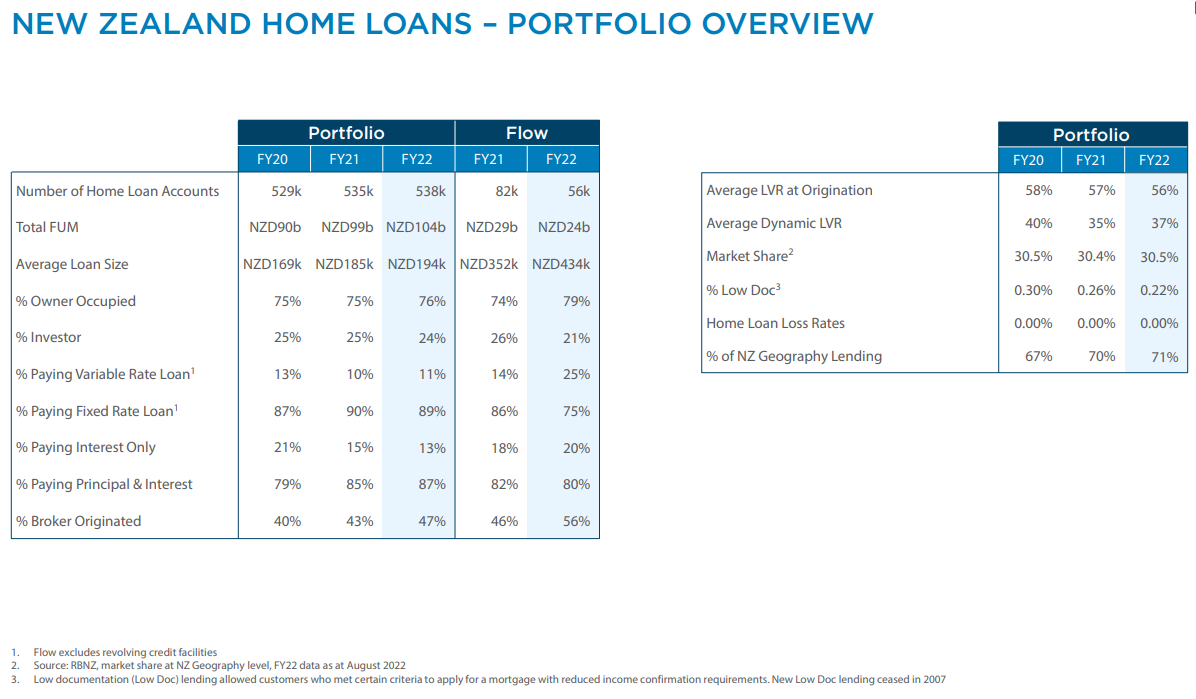
ANZ NZ says housing lending increased $5.3 billion, or about 5.5%, to $104 billion in the September year. Business lending rose $1.3 billion to $19.4 billion, and rural lending fell $700 million to $15.4 billion. Net loans increased 4% to $140.445 billion, and customer deposits increased 5% to $107.957 billion.
"Coming into the the 2021-2022 financial year we didn't anticipate the New Zealand economy would hold up as well as it has," CEO Antonia Watson says.
"While inflation and supply chain problems, particularly for importers and exporters, were an issue for many customers throughout the year, the desire to get back to some kind of normal kept consumers spending."
"Banks are a reflection of the economies they operate in, and New Zealand has been far more resilient than expected," Watson says.
However given an uncertain environment with high inflation, higher costs of living, higher interest rates and global geopolitical issues, New Zealanders need to be cautious, Watson says.
"At the moment, the vast majority of customers are in a sound financial position but we know that many will roll off fixed home loans onto higher rates over the coming year. When that happens some will be under financial pressure," Watson says.
Funds under management fell 12% to $34.3 billion, which the bank attributed to the transfer of KiwiSaver default customers to other mangers, Bonus Bonds wind up distributions, and the market downturn.
In Australia the ANZ Banking Group reported annual cash profit from continuing operations of A$6.515 billion, a 5% increase. Return on equity rose 47 basis points to 10.4%, and the group's common equity tier one capital ratio, as a percentage of risk weighted exposures, came in at 12.3%, down five basis points.
The group's paying a final dividend of A74 cents per share versus A72c, taking total annual dividends to A$146 v A$1.42. That's equivalent to 59.3% of cash profit, down from 65.3% the previous year.
The ANZ NZ press release is here.
The ANZ Group presentation is here.

We welcome your comments below. If you are not already registered, please register to comment
Remember we welcome robust, respectful and insightful debate. We don't welcome abusive or defamatory comments and will de-register those repeatedly making such comments. Our current comment policy is here.