
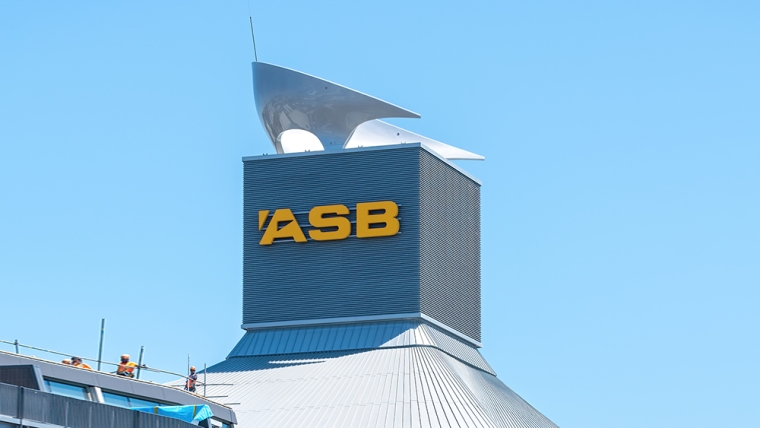
ASB's annual profit dropped 7% from last year's record high as income and its net interest margin fell and expenses rose.
ASB's June-year net profit after tax dropped $104 million, or 7%, to $1.455 billion from $1.559 billion in the 2023 June-year.
The bank's annual net interest margin, which measures the income generated from loans against the money paid to depositors and other lenders to the bank, fell 16 basis points to 2.23%.
Total operating income fell $96 million to $3.393 billion, with net interest income falling $117 million, or 4%, to $2.928 billion. Operating expenses rose $38 million, or 3%, to $1.296 billion, and loan impairment losses rose $6 million to $70 million.
ASB's cost to income ratio rose 300 basis points to 39.8%. Its return on equity fell to 12.5% from 14.7%.
The bank said higher expenses reflected its "continued investment in customer experience initiatives, technology platforms and people, and further investments to prevent fraud and scams and enhance financial crime capability."
'Challenging economic conditions'
ASB Chief Executive Vittoria Shortt says the annual results reflects challenging economic conditions, and the bank's strength to continue supporting its customers.
"We believe fixed term home loan rates have now peaked, which is positive, however we are conscious most of our home loan customers are now on interest rates above 6%. Around 20% of customers are yet to roll off rates below this but we expect increases for the majority of them to be small if interest rates continue to drop," says Shortt.
"The majority of our borrowers are managing in the current environment, although there is no question this is a challenging time for a lot of New Zealanders. We are hearing this in conversations with our customers, whether they are personal banking customers, farmers or business owners. We are seeing an increasing number of our customers needing extra support and our teams are assisting these business and personal customers in a variety of ways, depending on their individual circumstances. I would encourage anyone who is feeling concerned to please call us."
"We have increased proactive calls to business and personal customers, including reaching out to more than 40,000 customers over the past year as they refix their mortgages, and our team is working with thousands of customers on financial wellbeing reviews each month," says Shortt.
Loans at least 90 days past due rise
ASB says its home lending grew 1% over the 12 months to June 30, as did business and rural lending, with total customer deposits up 5%.
Gross lending rose just $584 million year-on-year to $109.629 billion, with housing lending up $448 million to $76.1 billion which is about 69% of total lending.
Individually impaired assets increased $52 million to $373 million, a small slice of ASB's $127.089 billion of total assets. However, loans at least 90 days past due rose $186 million, or 73%, to $442 million. Within the 90 days past due total, the home loan share increased $163 million, or 77%, to $376 million.
Figures from ASB's parent Commonwealth Bank of Australia (CBA) show ASB's loan loss rate unchanged year-on-year at six basis points, below the CBA Group's nine basis points.
Shortt told interest.co.nz despite the rise in past due home loans, they're running at about half the level seen during the Global Financial Crisis. Borrowers' lower debt-to-income ratios and the mortgage servicing test rate ASB used to test borrowers' ability to repay not dropping below 6.45% have helped limit past due home loans, she says.
"Yes, some of our customers are having some difficulty staying on top of their payments. We've got around 600 of our [personal] customers that we're working with who are financially stressed. We've got a lot of different ways we can help them. So we're definitely finding that all of the different ways of supporting customers are making a difference too," says Shortt.
"We also have 3000 of our customers who are stressed for what I describe as life events around illness, divorce or losing jobs."
ASB's test rate is now 8.95%, but will be reviewed if rates go materially lower than they are, Shortt adds.
ASB's total deposits and other borrowings increased $2.735 billion to $92.449 billion, with term deposits up $5 billion, or 13%, to $41.845 billion.
Shortt says combatting fraud and scams is "a real priority for us."
"This financial year we’ve spent around $100 million with the aim of protecting our customers against fraud, scams, financial and cyber crime. We now have a team almost 400 people dedicated to this work and expect to spend at least another $100 million in the year ahead, including advancements to our fraud monitoring system which uses machine learning to spot suspicious transactions," she says.
ASB's paying annual ordinary dividends of $800 million, up $100 million year-on-year.
CBA reported a 2% fall in annual cash net profit after tax to A$9.836 billion. Its annual dividends rose 3% to A$4.65 a share, equivalent to 79% of cash profit. CBA's net interest margin slipped eight basis points to 1.99%, and its cost to income ratio rose 3% to 45%.
CBA's press release is here, and its investor presentation is here.
We welcome your comments below. If you are not already registered, please register to comment
Remember we welcome robust, respectful and insightful debate. We don't welcome abusive or defamatory comments and will de-register those repeatedly making such comments. Our current comment policy is here.