
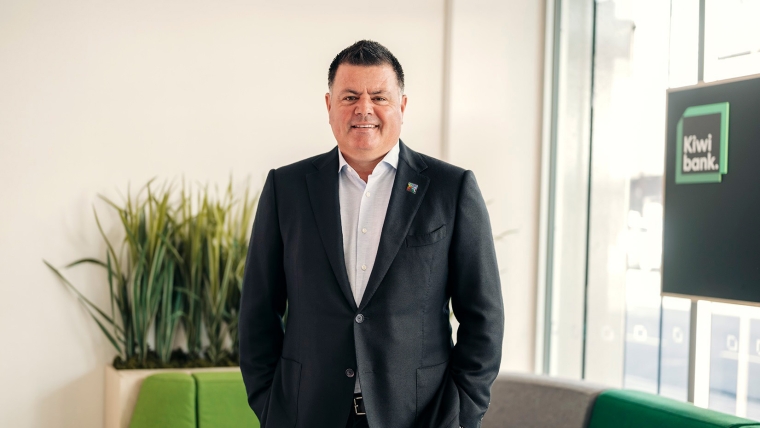
Kiwibank could save New Zealanders $1.5 billion a year if it is able to continue current growth rates for the next five years, chief executive Steve Jurkovich says.
The state-owned bank boss appeared before Parliament’s Finance and Expenditure Committee on Wednesday morning as part of an ongoing inquiry into bank competition.
Last week, Finance Minister Nicola Willis said Kiwibank had been asked to raise up to $500 million from local institutional investors in a private capital raise. This is intended to be the first step to boosting the bank's capital for ongoing growth ahead of a possible share market listing in 2028.
Scaling up Kiwibank was one of the key recommendations in the Commerce Commission’s banking market study, published in August, which found the banking sector lacked competition.
Former deputy prime minister Jim Anderton advocated for the creation of Kiwibank in the early 2000s, hoping it could challenge the big Australian banks. It has been a partial success but has not scaled to anything like the size of its competitors.
It is the fifth largest bank by assets with just $37.4 billion, as of September 2024, lagging far behind Westpac at $123 billion, ASB and BNZ at $130 billion each, and ANZ with $200 billion.
However, Jurkovich told the committee it had been winning 25% of all new home loans in recent quarters and that it would overtake BNZ’s home lending if it could maintain that rate for five years.
If it succeeded in winning that much market share, it could save New Zealand consumers roughly $1.5 billion in the form of lower prices and better products across the sector.
“If we grow like that, over that timeframe, we might be making $400 million to $500 million a year. But if we have saved New Zealanders $1.5 billion, by having more aggressive pricing, better terms and better turnaround, then I think we’ve lived up to Jim’s dream,” he said.
However, if it doesn’t get fresh capital—private or public—it would have to dial back growth and wouldn’t be able to deliver those benefits.
Jurkovich made this argument as a tacit defence against possible opposition to selling off a minority stake in the bank in an Initial Public Offering (IPO) once it has finished upgrading its technology system and lifting its capital levels.
“If you were to IPO, with the capital requirements through to full-year [financial year] 2028, it wouldn’t seem logical to be paying a dividend. So, as an attractive offering that doesn’t make much sense to me,” he said.
Green MP Chlöe Swarbrick was asking whether having private investors might dilute the purpose of the bank and ultimately lead to its complete privatisation, like with BNZ.
Jurkovich said there was no sign from the government that it was considering selling anything more than a minority stake and retaining control of the bank.
“I certainly haven’t seen anything telegraphed to us that it would be anything other than majority-owned by New Zealand, and you can see with some mixed-ownership models that you can have caps on overseas ownership,” he said.
When questioned by National MP Suze Redmayne about why Kiwibank didn’t have an agribanking division, Jurkovich said the small bank needed to focus its resources carefully.
“The biggest opportunity we’ve got in front of us is business banking, because of the [capital] risk weightings and some of the appetite we’re seeing from competitors,” he said.
“If you look at the changes we’ve seen in the market, and the growth rates dropping off for the big competitors, it looks like they don’t want to allocate as much capital to business banking as they have in the past. That gives us a great opportunity.”
We welcome your comments below. If you are not already registered, please register to comment
Remember we welcome robust, respectful and insightful debate. We don't welcome abusive or defamatory comments and will de-register those repeatedly making such comments. Our current comment policy is here.