
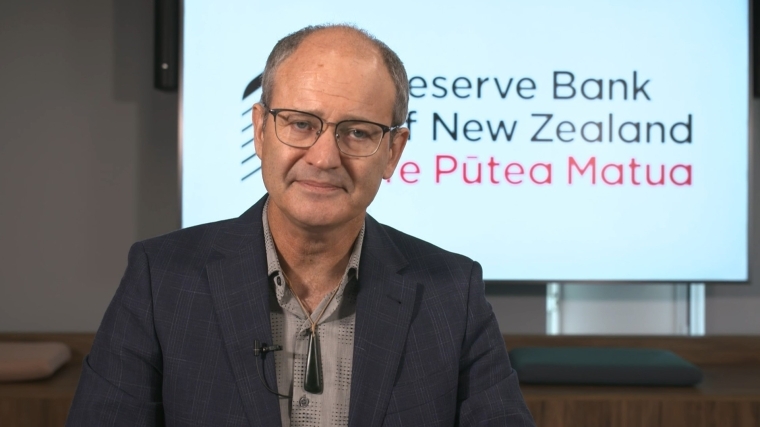
Watching online from the office during Wednesday's post-Official Cash Rate (OCR) review press conference, my attention was drawn to Reserve Bank Director of Economics and Chief Economist Paul Conway. And a thought began to build in my mind. It was along the lines of a penny for his thoughts.
That's because the usually communicative and loquacious Conway didn't utter a single word during the briefing. And nor did Reserve Bank (RBNZ) Governor Anna Breman seek his input. And this after the RBNZ had surprised financial markets by leaving the OCR unchanged, sending the NZ dollar plummeting, in a decision veteran RBNZ watcher and BNZ Head of Research Stephen Toplis said left him "frankly flabbergasted."
This was the second time since the RBNZ Monetary Policy Committee (MPC) vote has been publicly disclosed where there has been a split vote. The first time around, in May, saw the three internal RBNZ members being Breman, Assistant Governor Karen Silk and Conway, vote to hold the OCR at 2.25%. The three external members Carl Hansen, Hayley Gourley and Prasanna Gai voted for a 25 basis points increase. As chairperson Breman used a casting vote to keep the OCR unchanged.
This time around Conway was one of the three MPC members who voted for a 25 basis points OCR increase. Among the four who held sway by voting to hold the OCR at 2.75% were Breman and the RBNZ's new internal MPC member, Rebecca Williams.
As the RBNZ's Senior Manager of Economics, Williams reports to Conway. He's her boss.
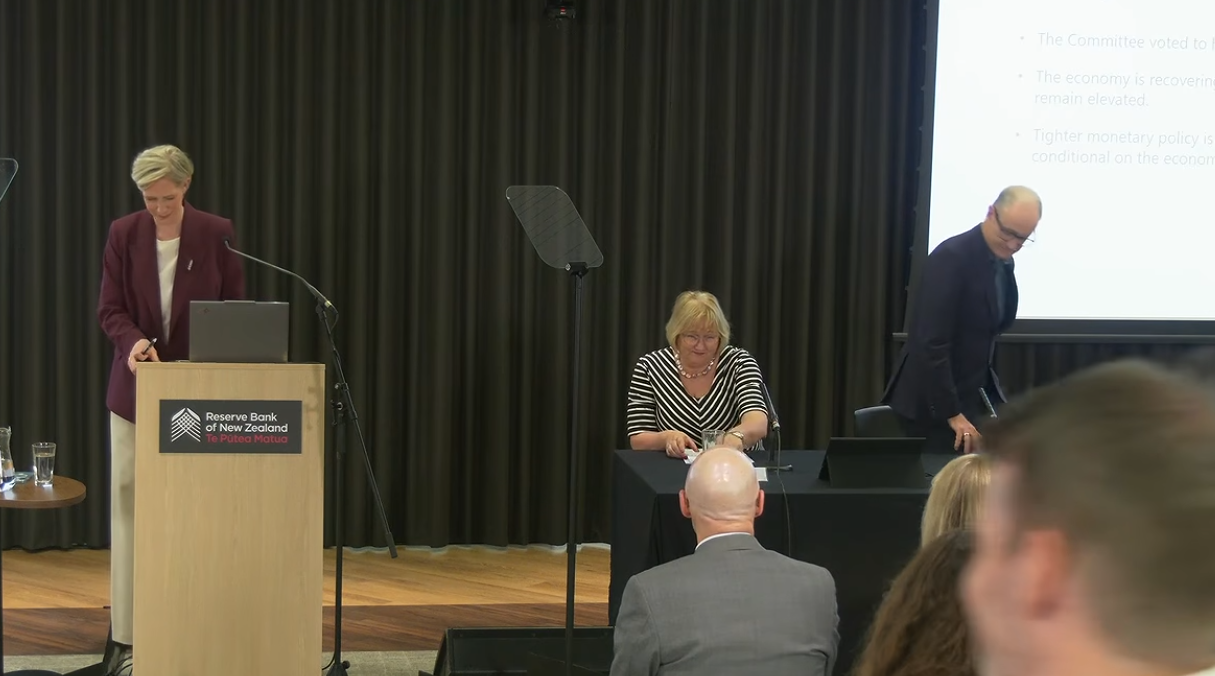
Breman, as Governor, is of course top of the RBNZ heap. And in a RBNZ monetary policy press conference the Governor is the main character, making initial comments and having first dibs on answering the questions. Both Silk, due to leave the RBNZ in December, and Conway, were seated at the front next to Breman. Whilst we heard from Silk, including when Breman sought her input, we heard not a peep from Conway.
Nor did we hear from Williams, Hansen, Gourley or Gai, who were all also present. Albeit they weren't sitting at the front and no questions were specifically addressed to them.
Among the external members Hansen and Gai, hawks in May, were doves this time voting alongside Breman and Williams to hold, while Gourley voted with Conway and Silk for an increase.
Clearly this MPC meeting, where they debated and voted on their decision, would've been a good one in which to be a fly on the wall. Coming just 10 days before an election, and with the RBNZ expecting consumers price index inflation of 4.4% in the December quarter against the backdrop of a global oil shock and concerns over an AI investment bubble, there was plenty to consider.
Once it became apparent Conway wasn't going to say anything, a question should've been specifically directed at him. We're still in the early days of having MPC members' voting records made public. Perhaps both us RBNZ watchers, and the MPC members themselves, are still getting used to this.
Given Conway didn't speak, it would be unfair to speculate on what he was thinking, other than we know he wanted a 25 basis points OCR increase to 3%.
It does, however, seem extraordinary that the RBNZ Chief Economist and MPC member attended a Monetary Policy Review media briefing, sat at the front with his senior colleagues, and didn't utter a single word.
The good news is the RBNZ has offered one-on-one interviews with MPC members including Conway, and Interest.co.nz has requested an interview with him.
*This article was first published in our email for paying subscribers. See here for more details and how to subscribe.
We welcome your comments below. If you are not already registered, please register to comment
Remember we welcome robust, respectful and insightful debate. We don't welcome abusive or defamatory comments and will de-register those repeatedly making such comments. Our current comment policy is here.