
Summary
• Deja vu - global equities weaker, global rates higher and USD stronger
• US 10-year rate cracks the 3% mark
• NZD down to fresh near 2-year low; Hanging in there above 0.64
• RBA (Reserve Bank of Australia) likely to become the latest central bank to kick off a rate hike cycle later Tuesday
Events Round-Up
EC: Economic confidence, Apr: 105.0 vs. 108.0 exp.
US: ISM manufacturing, Apr: 55.4 vs. 57.6 exp.
Good Morning
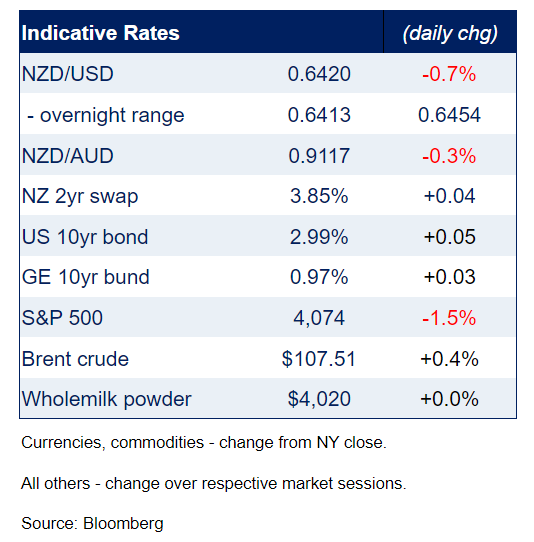
By recent standards it has been a quiet trading session with little news, with the UK and some key Asian markets on holiday. But the new month has begun with the same trends as we saw through April – weaker equities, higher rates and a stronger USD. The NZD has traded at a fresh near 2-year low. The US 10-year Treasury rate cracked the 3% mark for the first time this cycle.
After a horrible April for bonds, equities and all major currencies against the USD dollar, the month of May has begun on an ominous note with more of the same. Media have made a big deal of the US 10-year rate trading at 3% for the first time since late 2018, but a Rip Van Winkle waking up from a 20-year slumber would be wondering what all the fuss was about, given that the 10-year rate has traded above 3% for most of the past 50 years. That’s a reminder that while the rate of change in the yield has been brutal this year, a 3% rate isn’t particularly high.
The yield curve has slightly steepened to start the new week, with the 2-year rate up 1bps to 2.72% and the 10-year rate currently up 5bps to 2.99%. European yields were higher across the board, with Germany’s 10-year rate up 3bps to 0.96%. We’re not expecting much fireworks from the bond market ahead of the FOMC’s next update Thursday morning, NZ time, where a 50bps hike and a signal that quantitative tightening will soon begin are widely expected.
Yesterday the domestic rates market outperformed against the backdrop of much higher global rates. NZGB and swap yields were up “only” 4-5bps across much of the curve. Since the NZ close, Australian 10-yrar bond futures are up about 5bps in yield terms, which implies some further upside pressure to rates on the NZ open today.
Equity markets continue to trade cautiously against the backdrop of higher rates. The S&P 500 is currently down over 1%, adding to near-9% loss last month. The Euro Stoxx 600 index closed down 1.5%.
In economic news, the US ISM manufacturing index unexpectedly fell by 1.7pts to 55.4, its lowest reading in over 18 months. The survey continued to show ongoing and widespread supply-side issues, with a lift in the “supplier deliveries” gauge, and lengthening lead times to source materials. The euro area economic confidence indicator – a mix of business and consumer confidence – fell by slightly more than expected to a 1-year low of 105.
The USD has shown broadly based gains, trading close to the 20-year high on the DXY index seen towards the end of last week. The NZD is down 0.6% to start the new week to 0.6420, having printed a fresh near 2-year low a little below that level earlier this morning. There has been less movement on the crosses, as all majors continue to struggle against the power of the USD. The AUD is down to 0.7040, EUR is trading just below 1.05 and GBP is below 1.25. USD/JPY is just above 130.
With China on holiday, CNY hasn’t traded but USD/CNH starts the week 0.6% higher at 6.68, following the poor set of Chinese PMI data released over the weekend. Traders will be watching the COVID situation in Beijing closely, with restrictions imposed during the holiday period as authorities try to avoid a repeat of what we saw in Shanghai as case numbers got out of control. Given what we know about the transmissibility of Omicron, the signs remain ominous that China will face ongoing lockdown restrictions, with negative Chinese and global growth consequences.
In the day ahead, only second-tier economic data are released. The key focus is the RBA’s policy update. The Bank is widely expected to deliver its first rate hike of the cycle. The consensus is for a small 15bps lift in the cash rate to 0.25%, while a small proportion of economists is picking a larger 40bps lift to 0.5%. The market is well priced for a series of rate hikes through the rest of the year and into next year.
It would be the first RBA official interest rate increase since 2010.
*Jason Wong is Senior Markets Strategist at BNZ. BNZ's full Markets Today report is here.
David Chaston is away on holiday.
We welcome your comments below. If you are not already registered, please register to comment
Remember we welcome robust, respectful and insightful debate. We don't welcome abusive or defamatory comments and will de-register those repeatedly making such comments. Our current comment policy is here.