
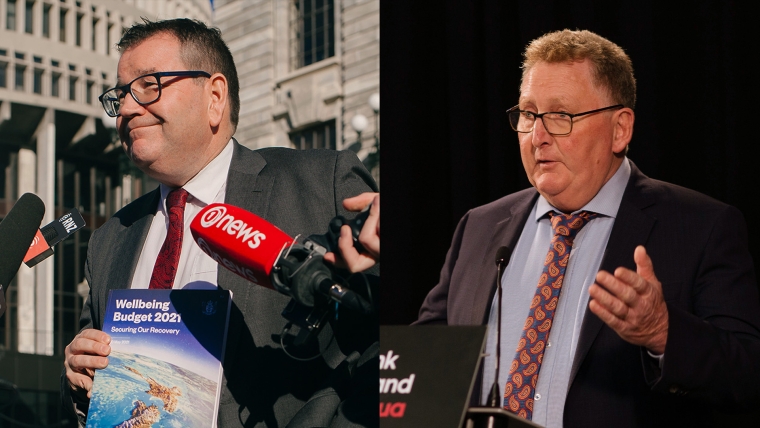
An economics professor and some Treasury staff believe the government and Reserve Bank of NZ should shoulder more responsibility for the inflation crisis, which will likely end in recession.
There has been much debate about who and what to blame for the runaway inflation—expected to still be at 7.2% in Thursday's consumer price index—and the engineered recession required to shut it down.
Pandemic-related shortages, government spending, monetary policy, the war in Ukraine, tight labor markets, and corporate greed have all been identified as suspects.
The Reserve Bank and the Labour government both prefer to emphasize the supply shock and downplay the importance of fiscal and monetary stimulus.
However, a fresh piece of research written by unnamed Treasury staff found both factors had contributed to inflation in roughly equal amounts.
"The surge in inflation from 2021 was initially demand driven by stimulatory monetary and fiscal policy, and rapidly increasing house prices which fuelled economic activity. However, from the second half of 2021, supply-side factors drove the continued acceleration in inflation," it said.
This paper was written by staff members at Treasury and reflects the view of those employees, but not the agency itself.
Some staff research is published to "inform and encourage public debate" but is not considered policy advice or an official opinion of the Treasury.
The authors of the paper said the pandemic disrupted the labour market, which created production bottlenecks, and which the war in Ukraine exacerbated.
However, demand recovered as economies adapted to the new environment while macroeconomic policy boosted demand and helped inflation to broaden into the services sector.
Supply shocks appear to have contributed less to inflation than in the United States and Australia. This may be because NZ was more insulated from energy price shocks and did more economic stimulus than many other countries.
About one-third of inflation was unable to be attributed to either supply or demand by the researchers. The authors also noted that using alternative price data in the model suggested supply shocks were responsible for as much as 60% of inflation.
A snatching defeat
Robert MacCulloch, a professor at the University of Auckland, said New Zealand had "snatched economic defeat from the jaws of covid victory" in a blog post on Monday.
He said NZ was “the envy of the world” in the first two years of the pandemic; we had eliminated covid and were out and about enjoying life.
"As a direct consequence, we enjoyed one of the smallest economic declines of any nation – only 0.7% for the year ended 31 March 2021.
"The UK, by contrast, suffered a decline of over 11% of GDP that year and its virus death toll ended up at nearly quarter of a million."
But policymakers failed to recognise the rebound and kept pumping cheap money into the economy.
Finance minister Grant Robertson set aside almost 20% of gross domestic product for covid relief funding, while the Reserve Bank printed another $53 billion buying bonds.
The great minor depression
These were policies designed to stave off a second Great Depression but they were still in place long after the country had brought the virus under control.
"We now face recession when most nations that did far poorer than us during the pandemic do not," MacCulloch wrote.
ASB Bank economists updated their economic forecasts on Tuesday to predict a deeper recession than previously thought.
Nick Tuffley, the bank’s chief economist, said the economy was experiencing a hangover from excess stimulus during the pandemic.
"It is a year of paying for the central bank and government punchbowl being more potent than anticipated at juicing up the economy,"” he said in a note.
The bank has predicted gross domestic product will have declined 2% by early 2024, which would be roughly half the size of the 2008 recession.
Inflation was expected to remain "stubbornly high" at over 7% year-on-year, even though the economy was stalling, and may not fall back into the target range until 2025.
"We expect the RBNZ will be in a position to start gradually pulling interest rates down to a more neutral level in the first half of 2024, the equivalent of monetary rehydration."
At its half-year economic and fiscal update, the Treasury forecast CPI inflation had peaked in late 2022 and will gradually decline over the coming years.
This was due to supply-side disruptions being resolved and resulting in lower freight costs and reduced pressures on commodity prices. While higher interest rates were reducing consumer demand for goods and services.
We welcome your comments below. If you are not already registered, please register to comment
Remember we welcome robust, respectful and insightful debate. We don't welcome abusive or defamatory comments and will de-register those repeatedly making such comments. Our current comment policy is here.