

By Gareth Vaughan
Off the back of a 24.2% surge in the NZX50 Gross Index last year, dividend yields of 5.5% to 10% on offer, and high profile state owned enterprise floats led by Mighty River Power set to hit the market, investors with a near record high NZ$108.6 billion held in bank term deposits may be tempted to wade into the sharemarket in 2013.
However, whether there'll be much to tempt term depositors into the fixed interest market is another question altogether. Next to the sharemarket's 2012 gains, not to mention a 10.5% annual rise in Auckland house prices, 4.5% to 6.3% annual gains in fixed income indices (see chart below), based on the running yield and capital gain from movement in interest rates, look pretty lacklustre.
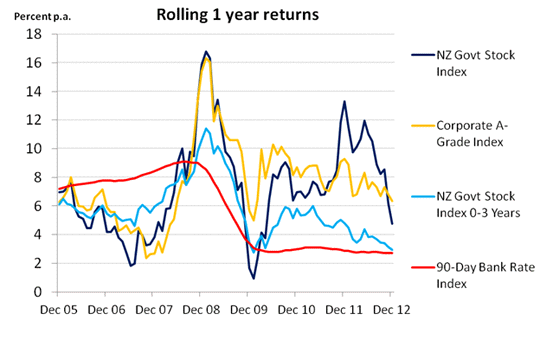
And most market watchers are predicting 2013 will again see returns from bond investments pale in comparison with equities.
"Fixed income will be a poor second cousin to equity markets this year. Equities will outperform bonds," says Grant Hassell, AMP Capital's head of fixed income.
In the lower for longer interest rate environment, where the Official Cash Rate remains marooned at its record low of 2.5% and many major countries around the world have official interest rates at, or near, zero, even a margin of 277 basis points over the five year swap rate recently only gave a coupon of 5.80% on a Kiwibank "junk" bond issue. Then there was Auckland Council's 4.41% coupon on its NZ$125 million inaugural retail bond issue and ASB's 4.48% coupon on a NZ$400 million bond issue.
ASB's 5-year term deposit rate higher
That ASB rate comes with the same bank advertising a five-year term deposit rate of 5%, for a minimum deposit of NZ$10,000 with interest paid monthly. And banks are advertising six-month term deposit rates of up to 4.40% with new bank Heartland, based on a minimum NZ$1,000 deposit and with interest paid quarterly, leading the way. See all advertised term deposit rates here.
And in a sign of the times, holders of French bank Credit Agricole's NZ$250 million of bonds, which were issued in 2007, saw their coupon halve to 5.04% after the rate was reset at 190 basis points over swap just before Christmas. See more on the Credit Agricole issue here.
Nonetheless, interest rates on local bonds in the 4% and 5% ranges, whilst low compared with the recent past, look attractive when compared with many on offer overseas. Witness Auckland Council's CHF100 million (about NZ$130 million) 11-year bond issue this month, which has a coupon of just 1.125%.
'Mental break made'
Christian Hawkesby, head of fixed income at Harbour Asset Management, reckons a "mental break" was made by traditionally yield hungry retail investors last year enabling domestic bond issues offering interest of as low as 4% to be acceptable. And Hawkesby also points out that part of the reason for holding fixed income securities as part of an investment portfolio is as a hedge for more risky investments in your portfolio such as equities. If, as he puts it, "the world blows up" in 2013, those bond holdings should serve you well, whereas if 2013 turns out to be - what many pundits are picking - a year of global economic recovery, bond performance will trail in the wake of equities.
A total of NZ$10.1 billion of debt was issued through domestic bond issues last year, slightly below the NZ$10.2 billion in 2011. The biggest slice of the total, at about 43%, came from bank issues, although this was slightly down from 44% in 2011. Corporate issuance was down to about 18% of the the total from 24%, local authority issuance was steady at about 17%, despite the NZ$1.5 billion issued by the Local Government Funding Agency in its first year of operation, and supranational, or kauri debt issues, rose to about 23% of the total from 17%.
More new bond issues seen in 2013 than 2012
In terms of likely new domestic bond issuance in 2013, one senior market source suggests there'll be more than last year, where a famine of corporate issuance - banks excluded - was offset to some degree by a late flurry of issues including from Auckland International Airport and Christchurch International Airport. This source suggests more entities are in the "reasonably likely to do a bond deal category" than a year ago. Further issues are tipped from Auckland Council and Transpower, but perhaps just one or two deals from each of the big four banks during 2013 given soft lending growth and strong funding positions.
And Hawkesby describes the corporate bond market as a "flood and famine type of market" with it often only taking one corporate to issue bonds and provide a reference point for others.
Meanwhile, Hassell says with more debt maturities scheduled this year than last, there will be more capital markets activity. And although borrowers may look for increased tenor - both the airport bond issues in December were for seven-years - investors' interests will be better served by holding shorter-term bonds.
"Short-term bonds are better for investors because when interest rates go up, the capital loss is much less on shorter-term bonds than long-term ones. Interest rate sensitivity is far less on short-term bonds," says Hassell, who expects New Zealand interest rates to "slowly drift up."
No chart with that title exists.
This article was first published in our email for paid subscribers. See here for more details and to subscribe.

We welcome your comments below. If you are not already registered, please register to comment
Remember we welcome robust, respectful and insightful debate. We don't welcome abusive or defamatory comments and will de-register those repeatedly making such comments. Our current comment policy is here.