

The week after next, both the RBNZ and RBA will review monetary policy settings and review official interest rates.
The flurry will be kicked off on Tuesday May 7 at 4:30 pm (NZT) with the RBA announcing its rate decision.
On Wednesday May 8 at 2 pm, the RBNZ will announce its decision and release its Monetary Policy Statement.
Then on Friday May 10 at 1:30 pm (NZT), the RBA will release its Statement on Monetary Policy.
This time around no-one is quite sure what will happen - except that there won't be any increase in rates. The choices for both central banks is to either hold or cut.
The 'cut' option is on the table because inflation remains low, and below the mid point of each regulator's contractual commitment.
The 'hold' option is on the table because employment is strong in both countries and current growth is at good levels.
To 'cut' when things are trucking along ok is to use up some firepower ahead of when it is actually needed - when the end of the current business cycle actually arrives. That doesn't seem likely in 2019, from the vantage point of May 2019 at least.
Despite that, an increasing number of (self-interested) commentators are calling for cheaper money in the presumption that is will help them (sell more houses, make more mortgages, encourage consumers to spend more, make government borrowing cheaper and more palatable to increase, etc. etc.).
And an interest rate cut will almost certainly bring a fall in the exchange rate, so those self-interested in higher local export prices (for them) and higher costs of imports (for others) will be wanting that as well.
Overseas, other central bank colleagues are growing gloomy. The central bankers in Sweden, the EU, Japan South Korea, and Singapore have all recently issued analysis that is on the dour side. Following them - even if our local situation is relatively healthy - might seem the safe, go-with-the-crowd thing to do.
Speaking of the crowd, financial markets are pricing in cuts for both the RBA and the RBNZ.
In Australia, the RBA's own monitoring of market interest rates is clear and dramatic, especially since the pre-Easter Aussie CPI undershoot.
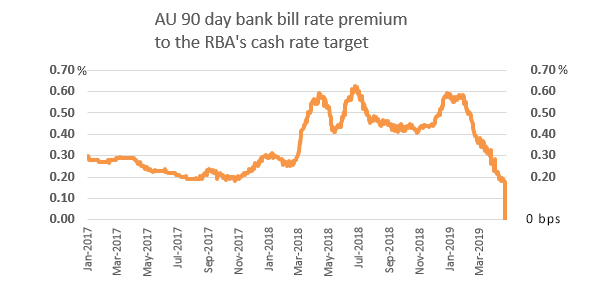
This chart records the difference between the RBA's official cash rate target and the 90 day bank bill rate (to be precise, "Bank Accepted Bills/Negotiable Certificates of Deposit-3 months" in their series FIRMMBAB90D). The average premium in 2017 was +24 bps, in 2018 it was +45 bps and until the AU CPI in 2019 it was +41 bps. Now it is zero, and that suggests a May 8 cut from the current 1.50% by -25 bps to 1.25%. Expect the AUD to fall, even if you think this cut is priced in already.
In New Zealand, the situation is less certain and over the recent years less volatile. Still, market signals here are also fairly clear, if not quite so dramatic - perhaps 'chronic' is a better description.
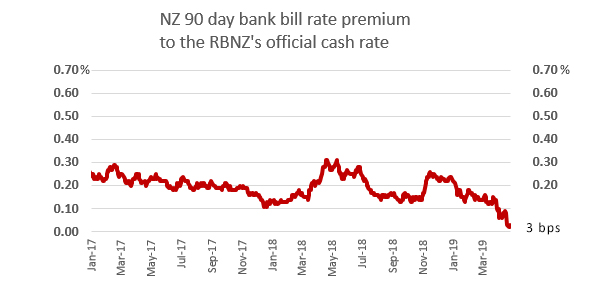
This chart records the premium of the 90 day bank bill rate in the RBNZ daily series over the Official Cash Rate. In 2017 this premium average +21 bps, in 2018 the premium averaged +20 bps, while in 2019 it has fallen from +21 bps at the start of the year to just +3 bps today in a fairly regular discounting. Money market traders (mainly banks?) are betting real money an OCR cut will happen soon.
And almost all that bet is because Q1 CPI came in at +1.5% (and falling) when the mid-point of the contract the RBNZ has with the Government is +2%. Markets are ignoring economic growth, high employment, and the need to keep monetary policy powder dry. They think the big gun should be used now.
And of course, the RBNZ now has its own 'crowd' - a Monetary Policy Committee to make a collective decision (and no longer the sole responsibility of the Governor). There are now seven people on this committee, the Governor and three subordinates (Geoff Bascand, Christian Hawkesby and Yuong Ha), plus three outsiders. They are Professor Caroline Saunders of Lincoln University who represents the interest of the rural export sector, Professor Emeritus Bob Buckle at Victoria University and a long-time Wellington insider, and Peter Harris who until recently was the Council of Trade Unions' chief economist. But at their first group decision, it seems very unlikely any of them will promote their independence to rock the Governor's boat. Anything but a unanimous first committee decision would be a huge surprise.
If the RBA cuts and the RBNZ doesn't, the NZD will rise against the AUD. But the NZD will likely fall against the USD in a collateral effect.
If the RBA cuts and the RBNZ does as well, the currencies of both countries are likely to depreciate against the USD.
Ahead of all of this however, is what the US Fed will do. They also have meeting soon and it is this coming week with a decision to be announced Thursday, May 2 (NZT). Their previous dot-plot had indicated two more rate hikes in 2019 and the stronger-than-expected US Q1 GDP result should have given that impetus. They had shown a desire for 'normalisation' and a need to build monetary policy reserves ahead of a natural business cycle downturn. But markets are picking no change from the current 2.50% Fed rate this time, partly because the Fed is under pressure from the Trump Administration with the threat of a Trump sycophant (or two) to be appointed on to their board.
The next US Fed review is not until June 20 (NZT).
We welcome your comments below. If you are not already registered, please register to comment
Remember we welcome robust, respectful and insightful debate. We don't welcome abusive or defamatory comments and will de-register those repeatedly making such comments. Our current comment policy is here.