
By David Mahon*
China is returning to work more swiftly than its people or trading partners anticipated.
With an annual manufacturing output of US$4 trillion, the value of the goods China produces exceeds that of the United States, Japan and Germany combined. In the last five years, China’s net exports contributed little to its GDP growth. Driven predominantly by consumption of its own manufactured goods and services, the Chinese economy will recover significantly toward the end of this year, and could be a catalyst to a global recovery. The only caveats may be China’s trading partners’ reduced abilities to supply it with components and raw materials, or another outbreak of COVID-19 in the Autumn.
Many observers of China have long been concerned about the accuracy of its data and statistics. With the news that Wuhan tried to hide the COVID-19 epidemic in early January, international scepticism of China’s transparency increased. But since the central government took control of the crisis, the data has been as good as the imperfect processes of its collection have allowed. The disclosure that over a thousand more people died in Wuhan than had been previously reported is not a surprise to those with friends and relatives there, or to the millions of Chinese people following the early, exponential spread of the virus in that city on social media. Wuhan’s healthcare system was overwhelmed in the first month of the crisis. Many people died at home, and the identification and registration of the critically ill and dying was chaotic.
Although the government coerces and censors China’s social networking systems, platforms like WeChat have ensured vast amounts of anecdotal evidence are available to the populace. The government cannot obscure the numbers who have fallen seriously ill, and they cannot, and do not intend, to hide the dead. The Chinese Government will need to offer not only reliable public health data in the coming months, but accurate data reflecting the state of the economy.
Recovery
China’s first-quarter economic performance was predictably dire. In January and February year-on-year, retail sales fell 24%, industrial value added fell 14%, and fixed assets investment declined 25%. China posts weak numbers in the first quarter of each year due to the hiatus in the economy caused by the long Chinese Spring Festival holiday, but these declines show that this year the economy almost ground to a halt.
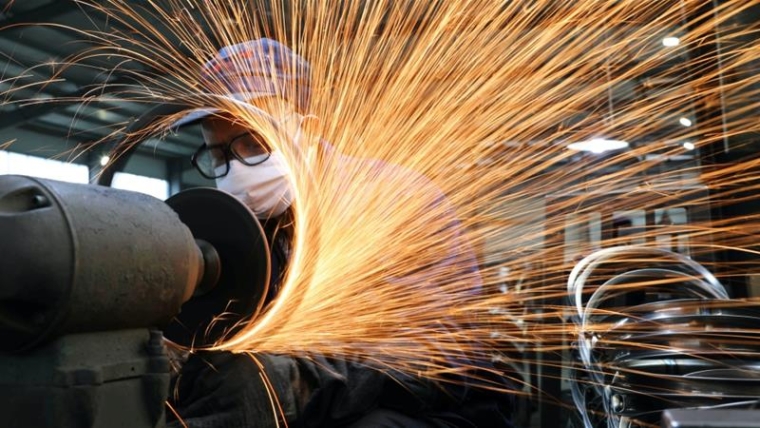
Patronage of restaurants is slowly increasing; migrant workers have returned in considerable numbers to factories and are also appearing on building sites in coastal cities. A significant minority of migrant workers, whose coastal employers closed their businesses, simply stayed back in their villages and are working locally. As more generations settle permanently in cities, this local refuge for migrant workers in times of economic difficulty will diminish, but it will help keep unemployment figures down this year.
Students are returning to their schools but numbers vary from province to province and city to city. Travel between cities has begun to recover, but people are still reluctant to sit with others on aircraft, or in bullet train cabins. Full economic recovery will be difficult as long as people cannot travel more freely.
Some in the Chinese Government have reacted to America’s suggestions that the coronavirus had ‘escaped’ from a biological weapons or viral research facility by making the similarly ill-founded claim that COVID-19 started in the US. While the outbreak in Wuhan’s animal market seems to be the main impulse for the rapid spread of COVID-19 in China, its specific source is still uncertain. Research by Cambridge University geneticist Dr Peter Forster suggests that the virus possibly transferred to humans in 2019, and further south than Wuhan.
It is too early to conclude who acted wisely, have been negligent, or overacted around the world. There is not yet enough data, and the demographic, economic, and climatic factors vary considerably. Comparisons based on the performance of national health systems and competitive mortality rates in this crisis are motivated by a nationalistic desire to deflect criticism or ascribe blame, and will only impede the development of treatments and shared economic recovery.
Qualified recovery
The Chinese economy will pass through a deep, narrow trough, but need not enter a sustained recession. If the government can avoid overstimulating the economy in an attempt to generate a face-saving GDP growth rate, and instead continue supporting SMEs in key sectors, while reducing the influence of state-owned and private monopolies, it may use this crisis to correct existing market imbalances.
In late February, China looked as though it may lose 0.5% to 1% of is forecasted 2020 GDP growth of 6%. On reflection, this was a poor prediction. The government shut the economy down so abruptly that even with the prudent stimulus of key sectors, China is unlikely to recover swiftly enough to generate more than 2% or 3% GDP growth in 2020.
The Chinese Government has the fiscal and financial means to weather the downturn better than many countries. Chinese households save 35% of their disposable income (compared to US households’ 7%), household debt-to-GDP is 54% (compared to 75% in the US), and household bank deposits are equivalent to roughly 80% of GDP . Chinese banks have been deleveraging for three years and interest rates are higher than those in most Western economies, so Beijing can lower lending rates and loosen credit.
The banks must be bold in lending to the private sector in particular, and the government needs to lower the administrative costs and social levies on private companies. Small and medium sized enterprises are the dynamos of China’s economic growth and foundation of employment, as they may be in the global economic recovery. The fundamentals of the Chinese economy are strong enough that it may well return to healthy growth in excess of 6% in 2021.
As Chinese consumers pay increased attention to strengthening their immune systems, demand for all varieties of fresh food will be strong this year, as it will for health supplements, for which China is the world’s largest market. The ongoing effects of African Swine Flu have already resulted in increases in meat, particularly pork, imports. COVID-19 is accelerating a decades-long trend of China’s dependence on the rest of the world for food and many other resources.
Despite Western politicians predicting that China will lose markets as multinationals seek to reduce their dependence on China, commercial realities will prevail. Investors will avoid incurring costs during a global downturn and manufacture in the world’s most cost effective and efficient regions. China will be more important than ever to the global economy after this crisis.
An era of fragmentation
It is clear that most regions of the world will go into recession this year, but the length and depth of these downturns will depend upon the degrees of unity or disunity among major economies. Governments need to support employment and productivity without dampening entrepreneurialism, and manage the difficult, age-old balance between state funded stimulus and vital market forces.
There is no need relive the Great Depression. Developing countries will suffer gravely, if not from the virus then certainly from the economic fallout, but they will suffer less if the West can put aside the protectionist trends of the last decade and work toward a new global trade consensus. It will need a greater shock than COVID-19 to bring about meaningful unity in the West.
Most global institutions have not only failed to show leadership, but their member states have reacted fearfully and selfishly. The United Nations and the World Health Organisation are only as principled and effective as their constituent nations, and they are underfunded and weak. The United States has demonstrated that it is no longer the global arbiter it once was, but more a powerful and negative disruptor. The European Union is fragmented, and Brussels is a cockpit of recrimination and nationalism. China has considerable global influence, but it is not the global leader of this era. It may become one in time, but it is presently absorbed in managing the needs of its population, one-fifth of the world’s total.
Only individuals and communities can bring about real change, and the current shock provides them with opportunity to motivate their political leaders to fund public health adequately, pay health workers properly, and value and support those providing ‘essential services,’ such as in sanitation, police, education, key trades and the harvesting and distribution of food. This is crucial in the West, but also in China, where healthcare workers, teachers and police are paid poorly for their labours.
Irrespective of a weaker or stronger global economy, China will be a patchwork of marginal growth and recession in the coming months, before coming back to a fuller economic life later this year and into 2021. How sustainable this will be depends much on the global economy rebalancing itself.
*David Mahon is the Executive Chairman of Beijing-based Mahon China Investment Management Limited, which was founded in 1985. This article is re-posted here with permission.
We welcome your comments below. If you are not already registered, please register to comment
Remember we welcome robust, respectful and insightful debate. We don't welcome abusive or defamatory comments and will de-register those repeatedly making such comments. Our current comment policy is here.