
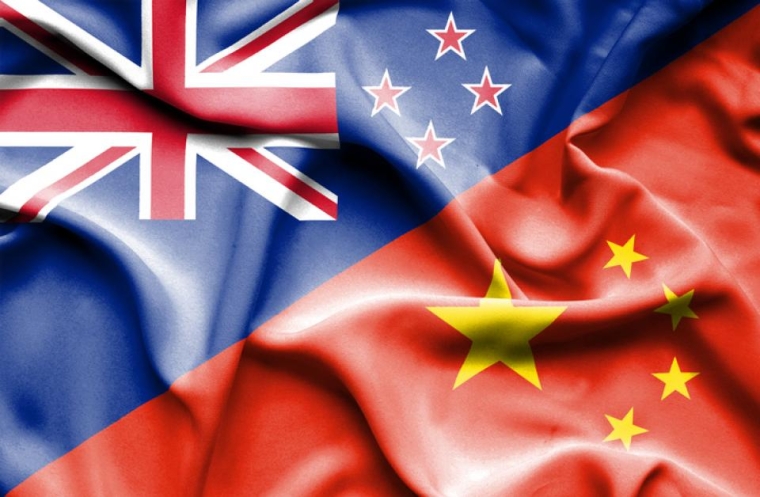
Trade experts believe there is a low risk New Zealand’s business relationship with China will be hurt by the Government calling it out for conducting malicious cyber activity here.
Those interest.co.nz spoke to acknowledge there are geopolitical risks associated with trading with China - particularly for companies heavily reliant on China.
But, they are looking through the fiery statement the Chinese Embassy in New Zealand released in response to the Government being more public, and using more forceful language than usual, in calling out China.
Saunders Unsworth partner Charles Finny said he would be “really surprised” if China retaliated, as New Zealand is one of a number of countries complaining about its conduct.
“But we have to monitor that very closely,” he said.
Wigram Capital Advisors principal Rodney Jones told interest.co.nz: “China needs a network of different countries that it can work with on different issues. And so, they can huff and puff, but in the end, their interests demand not being offside with everybody.”
Dairy Companies Association of New Zealand executive director Kimberly Crewther hoped the relationship was “sufficiently mature and constructive to enable concerns and points of difference to be aired when they arise, without spilling over to the trade relationship”.
“This has been the case to date, and we see no reason why it shouldn’t continue to be so,” she said.
New Zealand International Business Forum executive director Stephen Jacobi said New Zealand wasn’t “picking sides” by speaking out.
“This is about protecting New Zealand’s interests and choosing to align with others at this time,” he said.
Strong language from Little
The New Zealand Government late on Monday night joined the United States, United Kingdom, European Union, Japan, Canada, Australia and the North Atlantic Treaty Organisation (NATO) in “strongly condemning” malicious activity undertaken by the Chinese Ministry of State Security in New Zealand and abroad.
The Government Communications Security Bureau (GCSB) confirmed Chinese state-sponsored actors were responsible for exploiting Microsoft Exchange vulnerabilities in New Zealand earlier this year.
Minister Responsible for the GCSB Andrew Little said: “We call for an end to this type of malicious activity, which undermines global stability and security, and we urge China to take appropriate action in relation to such activity emanating from its territory…
“The GCSB’s National Cyber Security Centre (NCSC) has provided direct support to New Zealand organisations that have been affected by this malicious cyber activity. For both national security and commercial in confidence reasons, these organisations are not identified publicly.”
‘Mock outrage’
A spokesperson for the Chinese Embassy in New Zealand responded by saying the accusation is “groundless and irresponsible”.
“We urge the New Zealand side to abandon the Cold War mentality, adopt a professional and responsible attitude when dealing with cyber incidents, and work with others to jointly tackle the challenge through dialogue and cooperation, rather than manipulating political issues under the pretext of cyber security and mudslinging at others,” the spokesperson said.
Finny characterised the statement as “mock outrage”.
“I think it’s just something they have to go through. I would be very surprised if it moved beyond words. If it did, it would be a very serious development,” he said.
Similarly, Jones said: “Anything the Chinese Embassy says in New Zealand is directed at Beijing, not at Wellington. It’s performative.”
Can foreign affairs and trade be separated?
Jones believed China didn’t want to be seen domestically as being offside with New Zealand.
He maintained that when dealing with New Zealand, China needs to keep foreign affairs and trade distinct, as it can’t afford to get offside with too many countries.
“How isolated does China want to be? China is turning inwards and is more isolated, but it doesn’t want to end up with a rump of countries it has good relations with,” Jones said.
He maintained China would rather get offside with “middle-sized powers” like Australia, with military and security alliances with the US, than New Zealand.
Jacobi believed keeping foreign affairs and trade distinct was becoming more difficult.
“But what choice do we have?” he said.
“I think in this very complicated geopolitical world, you’d be rather naïve to think politics and business are completely apart.”
‘Friends don’t conduct cyber attacks on their friends’
“You can never exclude the risk there may be some effect [associated with New Zealand calling China out],” Jacobi said.
“But on the other hand, I don’t really think you can stand aside and do nothing when cyber security interests are being put at risk.”
Finny agreed the Government made the right decision, speaking up about China’s cyber activity.
“We want to be friends [with China], but friends don’t conduct cyber attacks on other friends,” Finny said.
He said he would be surprised if New Zealand businesses weren’t thinking about the geopolitical risks associated with trading with China, and maintained it was prudent to think about other markets.
The relationship evolves as China evolves
Finny believed New Zealand’s relationship with China had evolved over the years.
He noted the approach from the Ministry of Foreign Affairs and Trade, echoed by government ministers, had become more US-centric.
“I’m not sure what the bigger factor is - whether it’s a desire to develop the relationship with the US more fully. Or, is it actually just a reaction to continuing change on the part of China?”
We welcome your comments below. If you are not already registered, please register to comment
Remember we welcome robust, respectful and insightful debate. We don't welcome abusive or defamatory comments and will de-register those repeatedly making such comments. Our current comment policy is here.