
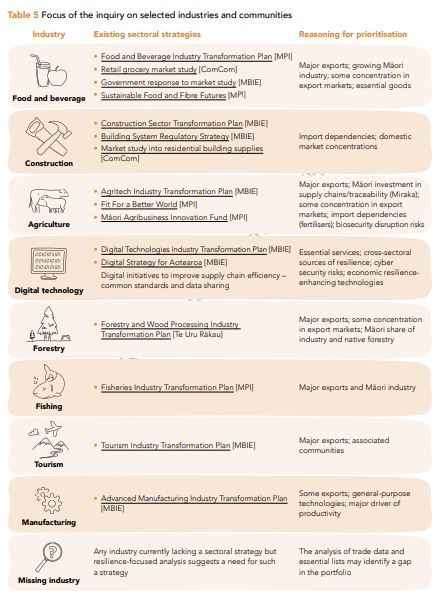
A Productivity Commission inquiry into improving the resilience of the New Zealand economy to persistent supply chain disruptions is to focus on eight industries.
The eight are; food and beverage, construction, agriculture, digital technology, forestry, fishing, tourism and manufacturing.
The Commission says it will, however, remain open to suggestions to narrow or broaden this list.
"A range of major societal challenges that impact economic resilience - such as social inequality, climate change, or security - will be discussed largely within the context of the selected sectoral strategies," the issues paper says.
"This approach reduces potential duplication with major cross-sectoral instruments such as the National Adaptation Plan, Emissions Reduction Plan, international trade and security work, or child poverty reduction and wellbeing legislation. At the same time, the Commission will strive to align its recommendations on economic resilience with broad policy goals stipulated in the major cross-sectoral strategies and broader government objectives, such as creating a high wage, low-emissions economy."
The Commission's inquiry comes after Cabinet asked it to identify policies and interventions that can enhance the resilience of NZ’s economy and living standards to persistent supply chain disruptions.
It also comes at the same time the Ministry of Transport is working on a national supply chain strategy. A draft of this is expected to be released for consultation in April or May. (Also see: Can NZ have a national supply chain strategy?)
The issues paper notes the disruptive impact of the Covid-19 pandemic and Russia's invasion of Ukraine on global supply chains. Productivity Commission Chairman Ganesh Nana says these massive disruptions mean supply chains are now featuring more in economic conversations.
"The concept of economic resilience to potential supply chain disruptions has, for some time been relatively invisible compared to the push for efficiency, cost savings, and production gains alongside increased trading opportunities. However, with recent influences gathering momentum at home and abroad, the concept of economic resilience to supply disruptions has come to the fore," says Nana.
"It is possible to under-invest or over-invest in economic resilience. Under-investment exposes a society to adverse impacts of disruption. Over-investment wastes valuable resources that have better uses. With a more volatile and uncertain future on the horizon, now is a good time to examine if the country has the mix right," adds Nana.
The Commission's issues paper is accompanied by reports commissioned from economists Brian Easton and David Skilling. (See more here).
Submissions are sought by April 17. Ultimately the Commission plans to provide the Government with a final report in February 2024.
We welcome your comments below. If you are not already registered, please register to comment
Remember we welcome robust, respectful and insightful debate. We don't welcome abusive or defamatory comments and will de-register those repeatedly making such comments. Our current comment policy is here.