

Here are the key things you need to know before you leave work today (or if you already work from home, before you shutdown your laptop).
MORTGAGE RATE CHANGES
None today so far. But we are awaiting responding reactions from ASB, BNZ and Kiwibank. Meanwhile, Heartland Bank raised its floating rate by +50 bps to 7.49%.
TERM DEPOSIT/SAVINGS RATE CHANGES
BNZ raised some TD rates to 1 year, and cut 3-5 year rate offers. Noting they did was notable however. A review of the bank changes so far is here.
HAVE RENTS TOPPED OUT?
Landlords are seeing some warning signs as median rents eased back in February. There are signs that rents are stabilising or even starting to decline in some areas of the country.
RETURNING, BUT IN FEWER NUMBERS
Prior to the pandemic, it was usual for visitor arrivals to rise in February from January. They did again this year but the change was tepid. It's a stagnating recovery. In fact, overseas visitor arrivals are only running at two thirds the pre-pandemic levels. That means 418,000 visitors arrived in February this year according to the latest Stats NZ data release. More than a third were from Australia (37%) 15% were from the US and 11% from the UK. Just 2% were from China. Pre-pandemic that was 12% from China.
BANK CREDIT RATINGS SAFE
Fitch Ratings says in its Special Report “What Investors Want to Know: Australian and New Zealand Banks” that rapid rate hikes to address inflation will result in a more challenging environment for banks in Australia and New Zealand through the remainder of 2023. But they conclude "solid underlying fundamentals, thorough management, and robust regulatory oversight leave banks well placed to withstand these challenges, underpinning ratings".
PENT-UP DESIRE TO LIVE & WORK HERE
Stats NZ also released immigration data. Westpac economists have taken a look at that detail and report: "As New Zealand reopened its international border in 2022, net migration flows turned from modestly negative to strongly positive. That trend has taken a further step up in recent months, with a net inflow of over 11,000 people in February alone. Over the last year we’ve seen a net inflow of more than 50,000 people, taking it back to around the levels we saw in the few years before Covid. But even that understates the recent strength: taking the last four months, we’re running at an annual-equivalent pace of around 100,000 people." H/T MG.
MORE CRANES
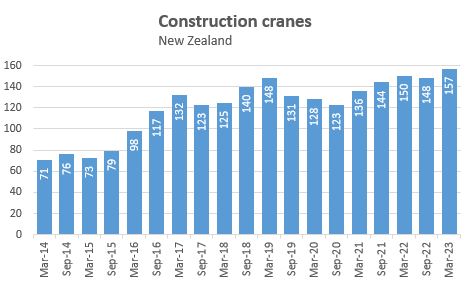
According to the Q1 2023 RLB Crane Index®, a record 157 long-term cranes were sighted on construction sites nationally in March across the main centres, "with resilience being shown by most sectors", says RLB. The report counted 157 long-term cranes on construction sites across the seven main centres. 103 cranes in Auckland, 9 in Wellington, 14 in Christchurch, 15 in Queenstown, 5 in Tauranga, 6 in Dunedin and 5 in Hamilton. They noted a slight dip in the residential count, which they expect to become more pronounced in future survey due to financial lending constraints and residential market conditions. Infrastructure repairs from Cyclone Gabrielle may also influence long term crane numbers in the future. RLB expects continued capacity pressure in the civil sector across the upper North Island.
FACTORIES RECORD A GRIMER MARCH
The local manufacturing sector experienced a decline in activity during March, according to the latest BNZ-BusinessNZ Performance of Manufacturing Index which transitioned from an expansion in February to a contraction in March. New orders sagged. And if it wasn't for central North Island recovery activity, the results would have been much worse.
FEWER DEATHS
In Australia, updated data for 2020 and 2021 shows a sharp drop in their death rate, caused by "chronic lower respiratory diseases". They are attributing this to the public health measures surrounding the COVID-19 pandemic. These declines were enough to notably drop their overall death rates. It will be a year before the data is in for 2022. The expectation is that these lower death rates will linger.
COMMERCIAL PROPERTY STRESS SIGNAL?
The international business media has increasing numbers of stories warning about the expected struggle commercial property is expected to have in 2023 and 2024 with rising interest rates and debt loads. The impact in New Zealand is much harder to track as industry insiders won't talk. But perhaps one way to witness the pullback here is to watch Syndex's secondary market where investors offer to sell their fractionalised shares in illiquid commercial property investments. There has been a recent swelling of offers from sellers. The count for commercial property is up to 33 parcels, for rural investment parcels up to 22. (Of course, some of this may just be because the Sydnex platform is gaining wider use and traction.)
SWAP RATES LEVEL OUT
Wholesale swap rates are probably little-changed today. However, the real action in swap rates comes near the close. Our chart will record the final positions. The 90 day bank bill rate is up +1 bp at 5.54% and 29 bps above the OCR. The Australian 10 year bond yield is now at 3.33% and up another +3 bps from yesterday. The China 10 year bond rate is unchanged at 2.84%. And the NZ Government 10 year bond rate is now at 4.15%, and that is up another +6 bps from this time yesterday, and still above the the earlier RBNZ fix at 4.09% which is up another +7 bps and in catch-up mode. The UST 10 year yield is now at 3.44% and back up +3 bps from this time yesterday, although that masks some extended volatility in between. A week ago it was at 3.37%.
EQUITIES MIXED
On Wall Street the S&P500 rose +1.3% for the day on growing expectations the Fed may be near a rate-rising pause. The NZX50 is down -0.2% in later trade here and heading for a weekly rise of +0.4%. The ASX200 is up +0.3% in mid afternoon trade and heading for a +1.9% weekly rise. Tokyo has opened up +1.0% today and if that holds it will be up +2.8% for the week. But Hong Kong opened today unchanged in mid-morning trade. If that holds it will be unchanged for the week. Shanghai has opened up a very minor +0.1% and heading for a weekly loss of -0.3%.
GOLD FIRMER
In early Asian trade, gold is up +US$18 from this this time yesterday, now at US$2046/oz. It closed in New York earlier at US$2040/oz and in London at US$2048/oz. We are getting closer to its all-time high of US$2067/oz in August 2020.
NZD REGAINS WEEKLY DIP
The Kiwi dollar is up a full +1c against the US dollar from this time yesterday to just over 63.1 USc. But this is just back to where we left it on the Thursday before Easter. Against the Aussie we are back up +40 bps to 93 AUc. And against the euro we are up +½c to 57 euro cents. That means the TWI-5 is now at 70.4 with a +60 bps gain from this time yesterday, but not quite back to its pre-Easter level.
BITCOIN RISES
The bitcoin price has jumped +2.2% since this time yesterday, now at US$30,771. Most of this rise was at 12:30pm today (NZT). But volatility over the past 24 hours has stayed low at +/-1.4%.
Daily exchange rates
Select chart tabs
Daily swap rates
Select chart tabs

This soil moisture chart is animated here.
Keep abreast of upcoming events by following our Economic Calendar here ».
We welcome your comments below. If you are not already registered, please register to comment
Remember we welcome robust, respectful and insightful debate. We don't welcome abusive or defamatory comments and will de-register those repeatedly making such comments. Our current comment policy is here.