

Overall spending on cards slumped by 0.9% ($85 million) last month on a seasonally-adjusted basis, according to new figures from Stats NZ.
It's the second fall in three months, with the rise in spending that was seen in June (a revised rise of 1.2%) having been largely due to a rush of customers gassing up their cars to beat the excise duty rise at the end of the month. That rise in fuel spending was matched by a big drop in July. Overall spending fell by a revised 2.2% in May.
The latest figures therefore provide further evidence of a downturn occurring in the economy.
Westpac senior economist Satish Ranchhod said, digging under the surface, the latest card figures point to "underlying softness in spending appetites".
"Looking at spending over the July month, the only area to record an increase was the groceries category. Food prices have been rising rapidly in recent months, and much of the increase in spending is because households are having to spend more on their weekly shop (rather than taking more items home)."
ASB senior economist Kim Mundy said the Reserve Bank will be relieved "to see the consumer demand balloon continuing to deflate".
She said a slowdown in consumer spending is consistent with the ASB economists' view that the current 5.5% Official Cash Rate (OCR) is likely to be the peak.
"But inflation is still high and, as a result, it’s too premature to be thinking about OCR cuts."
Looking at spending specifically in the retail industries, this was unchanged during July, while spending in the core retail industries (excluding fuel and vehicles), was down by 0.1%, or $4.8 million. These figures are all seasonally-adjusted.
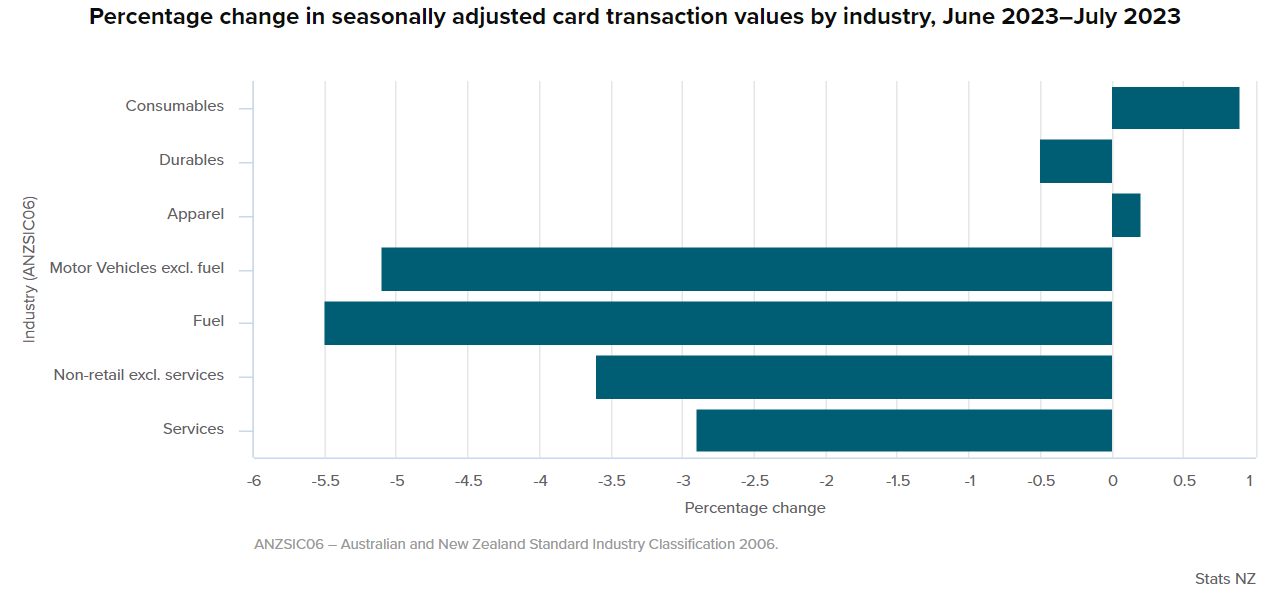
Stats NZ said the non-retail (excluding services) category decreased by $78 million (3.6%) from June 2023. This category includes medical and other health care, travel and tour arrangement, postal and courier delivery, and other non-retail industries.
The services category was down $11 million (2.9%). This category includes repair and maintenance, and personal care, funeral, and other personal services.
In terms of retail spending, some specific movements were:
- consumables, up $22 million (0.9%)
- apparel, up $0.7 million (0.2%)
- durables, down $8.7 million (0.5%)
- motor vehicles (excluding fuel), down $11 million (5.1%)
- fuel, down $30 million (5.5%).
All those figures are seasonally-adjusted.
Stats NZ says that due to the effect of Covid-19 on tourism, it is unable to release seasonally adjusted figures for the hospitality industry.
"As such, we are focusing on the actual hospitality values for this release. We will continue to monitor this approach as more data becomes available."
Spending in the hospitality industry increased 6.3% ($75 million) between July 2022 and July 2023.
In actual terms, cardholders made 161 million transactions across all industries in July 2023, with an average value of $55 per transaction. The total amount spent using electronic cards was $8.8 billion.
Westpac's Ranchhod said the overall card spending results "were also disappointing given the boost to demand from spending related to the FIFA World Cup events over the past month".
"With international visitor numbers trending higher, that points to softness in domestic spending appetites."
He said taking a longer-term perspective, retail spending levels are up 4% over the past year.
"However, the past year has seen a sharp rise in population growth, while consumer prices have risen 6%. Those conditions mean that, even though households are splashing out more cash, the amount of goods they’ve been receiving has been going backwards.
"Looking ahead, we expect that ongoing price rises and increases in interest rates will continue to weigh on household spending volumes."

We welcome your comments below. If you are not already registered, please register to comment
Remember we welcome robust, respectful and insightful debate. We don't welcome abusive or defamatory comments and will de-register those repeatedly making such comments. Our current comment policy is here.