
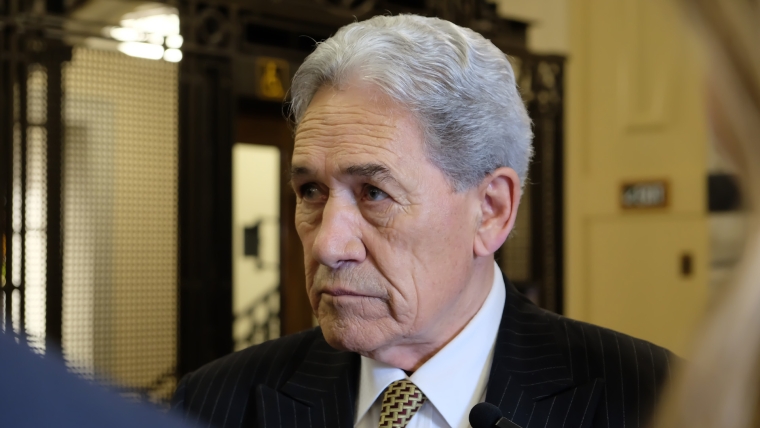
The political scrap over the India free trade deal continues with NZ First leader Winston Peters accusing National of "covertly" changing its course in terms of the the agreement's immigration settings.
But Trade Minister Todd McClay said NZ First, National's coalition partner, is wrong about this and should "stop promoting misinformation for the sake of gaining votes."
The latest clash surrounds a briefing that Peters, during the first reading of the India Free Trade Agreement Bill on Thursday, said could impact New Zealand's bilateral relationship with India and reputation as a place to do business, as well as open NZ up to legal challenge or retaliation from India.
Interest.co.nz has requested this briefing from NZ First, McClay's office and Immigration Minister Erica Stanford's office. It has not been provided. Instead, Stanford's office is considering this briefing request under the Official Information Act.
'Immigration policy settings are being made more restrictive'
NZ First has not shied away from its opposition to the India Free Trade Agreement (FTA). The India FTA Legislation Amendment Bill passed its first reading with support from National, Labour and the ACT Party (93 votes in support). Alongside NZ First, the Greens, Te Pāti Māori, Tākuta Ferris and Mariameno Kapa-Kingi opposed the Bill (29 votes opposed).
During the first reading, Peters, who is also Foreign Affairs Minister, said he had recently received; “evidence in the form of a briefing from officials of the consequent decisions made by the Minister of Immigration.”
“Their officials have even discussed the importance of not announcing these changes for the fear of the Indian reaction. This is bad faith ... Immigration policy settings are being made more restrictive in a way which targets India, and India alone."
Peters said officials had warned Ministers that these changes could impact the country’s bilateral relationship with India and reputation as a place to do business, as well as open NZ up to legal challenge or retaliation from India.
'Stop promoting misinformation'
But McClay hit back, saying "NZ First is wrong about this."
"They’ve consistently failed to support important trade agreements that are in the best interests of NZ."
"Whilst they are free to differentiate themselves in respect of the FTA [Free Trade Agreement], they should stop promoting misinformation for the sake of gaining votes," McClay said.
'Be transparent with India'
In a NZ First statement following the first reading, Peters claimed Indian citizens would be treated in a "discriminatory matter" under the agreement's immigration settings.
He said this includes “imposing on Indian citizens a labour market/economic needs test that doesn’t apply to citizens of other relevant FTA partners.” And "precluding Indian citizens from applying for a temporary employment entry visa from within New Zealand, an option available to citizens of other relevant FTA partners.”
Peters also said Indian citizens would be; “worse [off] than the citizens of other relevant FTA partners when it comes to their partners and children." And Indian citizens would be precluded; "from counting work experience on a temporary employment entry visa towards residency requirements, a right extended to citizens of other relevant FTA partners.”
“New Zealand First would have preferred that the India FTA not include any migration concessions whatsoever," he said.
“But if the Government has negotiated such commitments it is only fitting and proper that it be transparent with India about how it intends to apply them - and in what respects it intends to treat Indians worse than Chinese, Thais, Koreans and nationals from other New Zealand FTA partners.”
He said if additional restrictions were being applied to Indians travelling to New Zealand under the FTA, “the only consistent and principled step would be to apply these restrictions to citizens of all FTA partners.”
“We urge the Prime Minister, the Trade Minister and the Immigration Minister to make clear to India, before the FTA legislation is passed into law, about the ways in which they intend to implement this FTA differently from our previous relevant FTAs.”
'India represents a major opportunity for NZ businesses'
Following the first reading of the Bill, McClay said the India FTA would level the playing field for NZ businesses in the India market; “because it will reduce or eliminate tariffs on 95% of New Zealand’s exports to India, when fully implemented.”
“India is one of the world’s largest economies and is the fastest-growing economy in the G20. With a GDP equivalent to seven trillion New Zealand dollars and an average growth of 8.25% since 2021, India represents a major opportunity for New Zealand businesses.”
The deal would “unlock new opportunities” to grow the country’s goods and services exports into India “and contribute to achieving the Government’s goal of building the future by doubling the value of exports by 2034”, he said.
McClay said the Bill will now be considered by the Foreign Affairs, Defence and Trade Select Committee, and the public could make submissions.
“We are working towards ratification later this year, after the select committee has completed its process and the implementing Bill is passed.”
We welcome your comments below. If you are not already registered, please register to comment
Remember we welcome robust, respectful and insightful debate. We don't welcome abusive or defamatory comments and will de-register those repeatedly making such comments. Our current comment policy is here.