

Business confidence bounced up in July due to heightened optimism around New Zealand’s economic outlook, according to ANZ’s latest Business Outlook Survey.
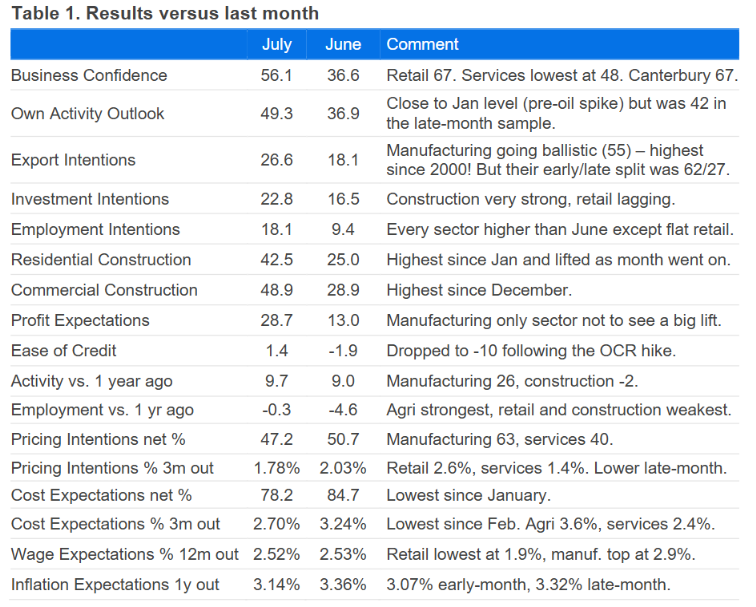
The net percentage of those expecting/reporting improvement and those expecting/reporting deterioration jumped from 36.6 in June to 56 in July, while expected own activity rose 12 points to 49. Reported past activity rose 1 point to 10.
ANZ’s chief economist Sharon Zollner said the theme of July’s data was “more optimism” as business confidence and expected own activity were at “historically solid levels.”
Confidence in agriculture in July was at 81.0, services at 48.1 and retail at 67.3. Confidence in construction was at 54.0 in July.
The survey found inflation expectations had eased from 3.36% in June to 3.14% in July and cost expectations fell from 85 to 78 in the same period.
Pricing intentions fell 4 points to a net 47% of survey respondents expecting to raise their prices in the next three months, Zollner said.
In survey responses received later in the month, business confidence activity indicators came in lower and inflation indicators higher.
Zollner said between the survey’s early and late responses, oil prices had “turned north” and the Reserve Bank (RBNZ) also raised the Official Cash Rate (OCR).
“It feels like we need a weekly business confidence survey at the moment,” she said.
“Oil prices continue to leap and plummet as the headlines roll in. The key question for the economic outlook is: how will people respond? Any thought that calm ‘normality’ will soon make a comeback is likely fading fast.”
Westpac senior economist Michael Gordon said the ANZ survey was consistent with Westpac’s view that the Middle East conflict is acting as a headwind to an economy that was otherwise gathering momentum.
“It remains the case that the pricing measures in the survey are elevated compared to pre-Covid levels, and as shown in last week’s CPI report, core inflation is running on the higher side of the RBNZ’s inflation target,” he said.
The Reserve Bank (RBNZ) is charged with keeping inflation between 1% and 3%, with a target point of 2%. The Official Cash Rate (OCR) is the RBNZ's main tool it uses to keep inflation on target.
“That’s not an ideal starting point for the RBNZ as the economy starts to regain momentum, and underscores the case for removing some of the policy stimulus that was put in place last year. Following the increase in the OCR in early July, we expect further hikes in the coming months, but at a gradual data-dependent pace,” Gordon said.
Back in the black
The construction sector showed some of the biggest improvements in overall confidence for a second month in a row, with residential construction confidence rising from 25 in June to 42.5 in July, while commercial construction confidence rose to a net 48.9 in July from 28.9 in June.
“Construction lifted and is almost back in the black,” Zollner said.
Activity compared to a year ago was at 9.7, while agriculture was at 19.0, manufacturing was at 26.1 and the construction sector was at -2.0.
Zollner said in terms of past activity, manufacturing is highest – though it dipped – while agriculture saw a marked fall and is back in the pack after years of outperformance.
The survey reported that export intentions rose 8.5 points to 26.6 in July, with Zollner noting that manufacturing intentions had gone “ballistic” and were up to 55, the highest result since 2000.
Investment intentions were up 22.8 from the previous month’s 16.5 and employment intentions had almost doubled, up from 9.4 in June to 18.1 in July.
“Will businesses decide to just get on with their required investments and hiring? Will households get on with their normal lives? Or will the uncertainty see many batten down the hatches and go into survival mode?” Zollner said.
“Time will tell; the consequences could be long-lasting.”
We welcome your comments below. If you are not already registered, please register to comment
Remember we welcome robust, respectful and insightful debate. We don't welcome abusive or defamatory comments and will de-register those repeatedly making such comments. Our current comment policy is here.