
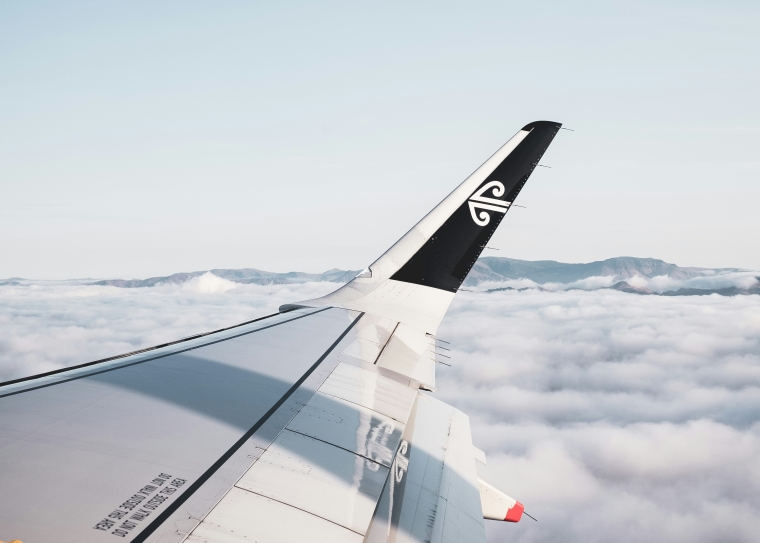
Air New Zealand’s chief executive says the airline is seeing “encouraging” inbound international demand into NZ but weaker momentum on the domestic front as the national carrier navigates the fuel crisis fallout from the Middle East conflict.
But according to Air NZ’s departing chief financial officer Richard Thomson, domestic customers are becoming more accustomed to the higher domestic prices the airline is rolling out to help combat increased cost pressures.
The national carrier, which is 51% owned by the NZ Government, reported its annual results for its June 2026 financial year on Friday, posting a loss before taxation of $336 million and a net loss after tax of $242 million.
Air NZ CEO Nikhil Ravishankar told analysts in a call after the results were released that the company was seeing “encouraging inbound demand with strong forward bookings into NZ.”
“This is a positive signal for tourism and for the country more broadly, and it is pleasing to see the work we've been doing to stimulate demand in our key international markets contributing to that momentum,” he said.
It was a less encouraging story for Air NZ’s domestic customers. Before the Middle East conflict began, Thomson said the airline was seeing some “encouraging signs” domestically.
“The Middle Eastern crisis put a pause on that,” he said.
In the early stages of the fuel crisis, Thomson said Air NZ had raised prices in immediate response to the fuel price increases and in some cases, domestic volumes dropped off “as fast as we were putting prices up.”
Domestic flight prices have started to stabilise since May.
“We are starting to see customers become accustomed to the sort of domestic airfares we need to charge to recover,” Thomson told analysts.
Statistics New Zealand’s latest Selected Price Indexes figures show domestic airfares rose 21% and international fares climbed 11% in July. Statistics NZ said this was the largest monthly increase in domestic airfares in a July month since it began collecting monthly prices for domestic airfares in 2015. On an annual basis domestic airfares rose 14% and international airfares rose 3.5%, Statistics NZ said.
Middle East conflict casts doubts over when the airline will return to profit
Ravishankar was supported by not just one but two chief financial officers in the analyst call, joined by the departing Thomson as well as new CFO Kris Cudmore.
Friday marked Thomson’s last day, ending his five-year term at Air NZ that began in 2021. Cudmore was previously Air NZ’s infrastructure, planning and commercial lead and started as the airline’s CFO in early August.
Ravishankar told analysts the airline’s financial performance in the June 2026 year “was significantly and adversely impacted by high fuel prices.”
The Middle East conflict increased Air NZ’s fuel costs by an estimated $328 million compared to what the company originally expected going into the second half of its 2026 financial year, and by $205 million after hedging. Increased fuel costs had an estimated $135 million impact on the pre-tax result after fare adjustments and capacity reductions.
Jet fuel prices averaged US$111 per barrel in the 2026 financial year, compared with US$88 per barrel in 2025, according to the airline.
“While fuel prices declined 4% in the first half of the financial year compared to the same period last year, this was more than reversed by a sharp 58% increase in the second half compared to the same period last year,” Air NZ said.
Cudmore said in the analyst call that prior to the Middle East conflict, Air NZ had expected to return to profitability in the 2027 financial year, reflecting the underlying improvements in the business.
“Given the continued uncertainty surrounding the conflict, the volatility of jet fuel prices, and with jet fuel currently in the region of $140 to $150 per barrel, the airline is not in a position to provide earnings guidance for the 2027 financial year at this time,” he said.
‘Continuous discussions’ with engine partners
Engine issues impacted Air NZ’s annual result by an estimated $190 million due to lost capacity, additional lease and engine costs, lower fleet utilisation and operating inefficiencies. The engines affected were the Rolls-Royce Trent 1000 and Pratt & Whitney PW1100.
Ravishankar said at the peak of the engine disruption, five of Air NZ’s 14 Boeing 787s and six of its Airbus A320 and A321neo aircraft were grounded, which is almost 20% of Air NZ’s total jet fleet.
"This created disruptions for our customers, operational complexity and significant financial cost. We carried the fixed cost of aircraft, people, infrastructure, and systems and we incurred additional costs through leased aircraft and engines to protect the network and schedule,” he said.
“We missed out on the cost-per-seat efficiency of these newer aircraft types, which are about 10% to 20% lower than the older generation aircraft, despite incurring the costs of owning these new aircraft.”
While Air NZ received some of the compensation from engine partners, Ravishankar said this wasn’t enough to offset the financial costs incurred.
“Today, the picture is very different. The last 787 was returned from long-term storage in June, an incredible milestone, and a huge thank you to our teams around the business who persevered to make this happen sooner than expected. And on the narrow-body fleet, we expect the last of these to return to service during calendar year 2027,” he said.
“There are still residual risks to availability through 2027, and we're still carrying the cost of temporary leased aircraft and engines in the system. It takes time to bring returning aircraft fully into the selling and operating schedule.”
The airline was in “continuous discussions” with both Rolls-Royce and Pratt Whitney on extending compensation, according to Ravishankar.
“While risk remains, the fundamental point is that the fleet constraint which has shaped this airline over the last few years is materially reducing, and the airline enters 2027 in a considerably more reliable fleet position. This gives us more options around capacity, network deployment, and operating efficiency,” he said.
Thomson told analysts the “biggest single challenge” Air NZ has to battle going into the 2027 financial year is that compensation from engine manufacturers for grounded aircraft “will now abate quite quickly” as engines become serviceable.
“We are exiting some of the additional costs that we've incurred on engines and dry-leased aeroplanes as quickly as we can,” he said.
According to Thomson, one of the three dry-leased aeroplanes is out of service now, about to be returned to the lessor, as well as two dry-leased 777s and a “handful” of commercially leased Pratt Whitney 1100 engines that will take another 12 or 15 months to “extract from the system.”
“It was $190 million of headwind this year, net of compensation. We expect there still to be a $70 million to $90 million headwind in the [2027] year ahead as we progressively retire some of those residual costs,” he said.
Air NZ’s total revenue in the 2026 financial year was $7.0 billion, up 3.9% on the prior year, while passenger revenue came to $6.1 billion, rising 4.8% on 2025. Cargo revenue edged down 0.6% to $484 million.
Operating cash flow fell 12.9% to $819 million, compared with $940 million the year before.
The airline is not paying a dividend. It paid a 2.5 cents per share dividend in the June 2025 year.
We welcome your comments below. If you are not already registered, please register to comment
Remember we welcome robust, respectful and insightful debate. We don't welcome abusive or defamatory comments and will de-register those repeatedly making such comments. Our current comment policy is here.