
The increased cost of oil and diesel imports pushed New Zealand's trade deficit to a record monthly high in August.
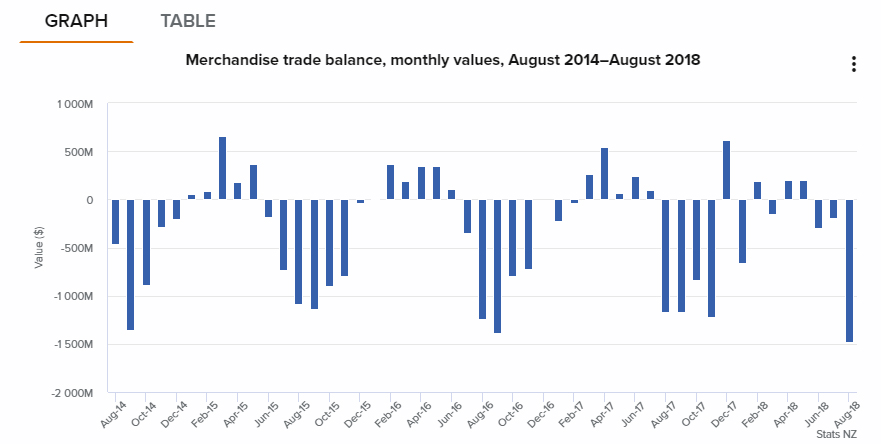
Statistics NZ says the August trade deficit was $1.5 billion, equivalent to 37% of exports. The average monthly deficit in August over the last five years was $1 billion. The annual trade deficit widened to $4.8 billion in August, the highest in nine years.
Imports rose $675 million, or 14%, in August versus August 2017 reaching $5.5 billion, the third-highest total on record. Exports increased $366 million to $4.1 billion.
The biggest contributor to the rise in imports was petroleum and products, Statistics NZ says, which climbed $186 million, or 50%, year-on-year. This increase was led by $98 million increase in crude oil, and a $73 million rise in diesel import costs.
Below is Statistics NZ's full release.
Monthly trade deficit widest on record – Media release
26 September 2018
A rise in goods imports to near record levels in August 2018 has contributed to the largest-ever monthly goods trade deficit, Stats NZ said today.
The trade deficit in August 2018 was $1.5 billion (37 percent of exports). The average monthly deficit in August over the last five years was $1.0 billion.
“This month’s rise in imports to near record levels occurs at the time of year when exports are typically at a low point,” international statistics manager Tehseen Islam said.
“The high values for total monthly imports in the last four months helped push the annual trade deficit to a nine-year high of $4.8 billion.”
In August 2018, imports rose $675 million (14 percent) on the same month last year to reach $5.5 billion, the third-highest total on record. Exports were up $366 million to reach $4.1 billion.
Petroleum and products lead imports rise
The leading contributor to the imports rise was petroleum and products, up $186 million (50 percent) from last year. This increase was led by crude oil (up $98 million) and diesel (up $73 million).
Imports of crude oil and other petroleum products tend to fluctuate from month to month. The quantity of crude oil imported in August 2018 fell 13 percent from August 2017, but prices rose by about 60 percent.
The latest unit price for crude oil remains 31 percent lower than the most-recent series peak in May 2012.
Imports of vehicles, parts, and accessories also rose in August 2018, up $55 million. Imports of buses, cars, and trucks all had similar contributions to this rise.
Meat leads exports rise
The value of total exports was $4.1 billion in August 2018, up $366 million (9.9 percent) from August 2017.
The leading contributor to the rise was meat products and edible offal, up $137 million (43 percent). This increase was led by sheep meat (up $83 million or 55 percent) and beef (up $45 million or 31 percent).
“New Zealand is exporting more beef and lamb, and getting better prices too,” Mr Islam said.
Dairy products were up $80 million (17 percent), led by an increase in butter and other milk fats, up $63 million.
Forestry products rose $74 million (18 percent), led by a rise in untreated logs, up $58 million.
ASB's economists said the August deficit compared to market forecasts for a $925 million deficit and their $900 million deficit pick.
"Moreover, the August deficit was the largest monthly deficit on record. Note though that August is normally the weakest month of the year for trade as agricultural production slows over winter. Also, note the more modest seasonally-adjusted deficit ($434m) was similar to recent deficits. For example, the average seasonally-adjusted monthly deficit over 2018 has been $474m," the ASB economists said.
"Export values were weaker than expected, falling 4.7% mom in seasonally-adjusted (s.a.) terms. Falling dairy export volumes accounted for much of the surprise; these were down 27% over the month. Dairy export prices also fell a touch so that dairy export values plunged 28.4% in seasonally-adjusted terms."
"However, we expect the decline in export values to prove temporary. In particular,agricultural production has started the new season on positive note on the back of favourable growing conditions and supportive prices in NZD terms. Dairy production is up over 5% on a season to date basis. As a result, we anticipate that dairy export volumes (and values) will rebound over coming months," the ASB economists said.
"There are no implications for our OCR view. We expect the annual trade balance to narrow over the remainder of 2018 as agricultural production rebounds with the new season. However, higher oil prices (and a widening ‘oil deficit’) will keep the lift gradual."
We welcome your comments below. If you are not already registered, please register to comment
Remember we welcome robust, respectful and insightful debate. We don't welcome abusive or defamatory comments and will de-register those repeatedly making such comments. Our current comment policy is here.