

The New Zealand dollar is 22% overvalued on a current account basis, according to the Institute of International Finance (IIF).
The Kiwi dollar, trading above US57 cents at the time of writing, should be below US45c, according to the IIF's calculations. (That's an example, without factoring in the IIF's view on the greenback, which is mentioned below).
The current account records a nation's transactions with the rest of the world, specifically its net trade in goods and services, its net earnings on cross-border investments, and its net transfer payments over a defined period, such as a year or a quarter.
According to Statistics NZ, NZ's annual current account deficit for the year ended June 30 was $27.8 billion, equivalent to 7.7% of gross domestic product (GDP). That was $16.3 billion wider than in the previous June year, when it was 3.4% of GDP. NZ's biggest annual current account deficit prior to the COVID-19 pandemic was $14.7 billion in the December 2008 year, which was 7.8% of GDP.
The IIF, which describes itself as the global association of the financial industry, highlights the NZ dollar in an update of its exchange rate fair values. Its approach is based on a cyclically adjusted estimate for the current account, compared to an equilibrium concept of where the current account can sustainably be.
"The exchange rate misalignments we derive are the moves in the trade-weighted real exchange rate that are needed to close this gap, which we calculate using standard export and import elasticities with respect to the exchange rate," the IIF report by its Managing Director and Chief Economist Robin Brooks, Economist Jonathan Fortun and Associate Research Analyst Jack Pingle, says.
"Usually, our focus in this exercise is on emerging markets, but Russia’s invasion of Ukraine has upended that. The war constitutes a large, adverse shock to the terms-of-trade for Europe, leading to unprecedented worsening in the current accounts of many countries. Although the euro and the British pound have already fallen substantially, we estimate that they will need to fall further in order to converge to their new fair values."
They note that Russia’s invasion of Ukraine has seen unprecedented US dollar strength with the bulk of that strength coming against currencies from Group of 10 (G10) economies such as the euro, yen and British pound, with emerging markets more resilient.
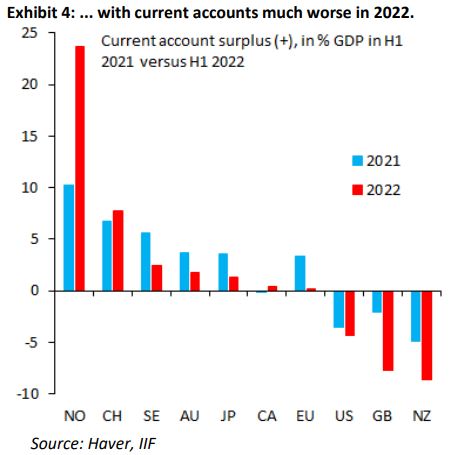
"The underlying driver of dollar strength against the G10 is the energy price shock, which has caused sharp deteriorations in European trade balances, including for the UK. Indeed, while Norway is reaping a large windfall from the rise in energy prices, the UK and New Zealand are seeing pronounced widening in their current account deficits," the IIF says.
It goes on to map these current account deficits into what they mean for exchange rate fair values. The IIF estimates NZ's current account deficit for 2202 with be equivalent to 8.7% of GDP.
The IIF says, based on its methods and calculations, the Kiwi dollar is 22.4% overvalued. It sees the Euro as 11.6% overvalued and the beleaguered pound as 18% overvalued, with the US dollar 4.2% overvalued.
The Aussie dollar, meanwhile, is viewed as 13% undervalued, with the yen 5.8% undervalued, the Norwegian krona 47.1% undervalued, and the Saudi Arabian riyal 23.5% undervalued.
We welcome your comments below. If you are not already registered, please register to comment
Remember we welcome robust, respectful and insightful debate. We don't welcome abusive or defamatory comments and will de-register those repeatedly making such comments. Our current comment policy is here.