

By Christian Hawkesby*
 The New Zealand trade weighted index (TWI) reached a post GFC high today of 77.0, and is now only slightly below an all-time high.
This move is part of a wider trend in global financial markets, which will have a significant impact on the mix of economic conditions in New Zealand, and increases the chance of the RBNZ using macro-prudential tools.
In recent months, movements in foreign exchange markets have caused tensions to rise globally.
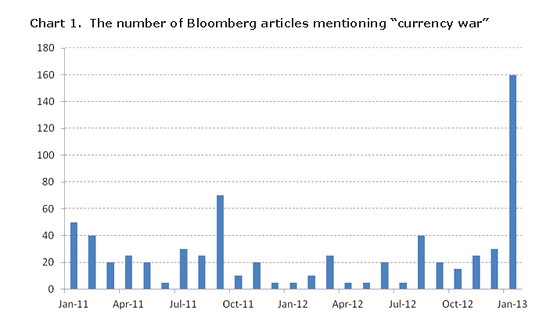
The number of articles in Bloomberg mentioning “currency war” have increased exponentially, totalling 160 in January compared to 10 or 20 on average through 2012 (Chart1).
Earlier in the week, the G7 published a joint communiqué aimed at calming tensions, but it only resulted in even greater volatility, confusion, and embarrassing clarifications.
The foreign exchange market will undoubtedly be a hot topic this year.
Put simply, these tensions have arisen from countries pursuing economic policies to meet domestic objectives within their domestic mandates.
In particular, the US and UK have been attempting to generate a sustained economic recovery using an increasingly inventive combination of zero interest rates, commitment to keep rates low for longer, and unprecedented balance sheet expansions (Quantitative Easing).
Whether deliberate or not, these actions will most likely devalue their currencies relative to other countries not undertaking these exceptional measures.
So New Zealand and Australia (and a number of vocal developing countries) have found their currencies strengthening sharply against the US dollar, GB pound, euro, and yen.
It has been a powerful global force to stand in the way of, and it is understandable when Bill English is quoted on Bloomberg saying there is very little that can be done to stop the NZ appreciating.
So New Zealand is left to live with the consequences of these global trends, whether it is a currency war or not.
i. A higher NZ dollar suppresses inflation on traded goods and hurts export and import competing industries.
ii. All else equal, that means there is more scope for NZ interest rates to be kept lower for longer to help the domestically-focused part of the economy to grow faster and take up the slack.
In other words, the mix of economic conditions is forced to change in favour of consumption and investment, and it seems that the NZ domestic economy is accelerating.
With the RBNZ already nervous about life remerging in the housing market, that may be an uncomfortable consequence to life with. It may act as a further catalyst for the RBNZ to introduce macro-prudential tools to head off the housing market overheating.
-----------------------------------------------------
Christian Hawkesby is a director of Harbour Asset Management and head of their fixed interest division. You can contact him here »
36 Comments
Just think of what you could buy if you sold your overpriced, NZ, leaky cardboard house and moved to the USA or Europe/ UK when our currency gets to parity. This is going to be a 'once in a lifetime opportunity', dont miss it.
Andrew you'll have to keep posting real estate details on this site too whet the appetites. I do know of a few Kiwis over there who having been buying in the US since the GFC hit and they are all doing pretty well.
I was thinking of France ,Tuscany or a special part of Spain.
http://www.rightmove.co.uk/overseas-property/property-39759695.html
Andrew - hmmmm........and the food is so good over in France.
AJ. So what of the beloved dairy farm.
Would you stay or would you go.
We're a liitle reflective at present
We have someone talk to us about how we were really dealing in US dollars given all the farm production ends up as milk powder sold in US$, and that if big should think of some type of dollar hedging (you can imagine eyes glaze at this point....). But putting 2 & 2 together, with milk powder round $3,500 ish (its not like going to double) all we can see is NZ$ income capped or downward and costs (ag inflation) going up..
We had another johnnny run through and say the place is more in bits than run as an operating farm (esp. where the F share price is now) - its always been like that, its just the numbers seem to get bigger now. The come back was well you go and find a cash buyer/s for scale ....
We've had another try and get us into a dairy farm in SW Victoria (Oz). $AUD 6,000 an acre. But if the locals aren't buying we're not sure we are that much smarter... (any way Oz $ not somewhere to escape to, we'd have thought). They said diversify poistion and still supply asian export markets (we though diversify meant double)...
Its just to state the obvious its dairy (milk powder) or nothing...
Its always like this until super rugby starts...
I dont know if the locals are always smarter but if farmers can afford a farm they will buy it. I always thought I was smarter than the new guy's buying farms around us so I sold out. So far so good.
Im living a life I couldn't afford in NZ, I can afford for my children to be in the school ski team, I can afford to go on holiday, I can afford my rates and electricity bills. My fuel is half price and a ride on mower that sells in NZ for 7k costs $1200. In NZ we are getting shafted by a group of people making extrordinary profits out of working class kiwis. I just got a new bulb for my Maxima main front light, $9. Everything here is more competitive than home. The costs of doing business in NZ are out of line and going to be a huge problem in the near future.
National need to stand on a few mates toes.
Do factor in the foreign resident ownership of land taxes, Spain may be a good deal after theirs in fully introduced, pick a community where the property values have started to stablise....
Good advice Speckles.
You could sell a cardboard box in AKL and buy this.
http://www.zillow.com/homedetails/3252-S-St-NW-Washington-DC-20007/4565…
Tell me what it would be worth in NZ?
Is that fair dinkum ?
House area 3500 sq ft
Land area 167,000,000 sq ft
Which is 1500 hectares.
Is that a bargain at $3m ?
It sold for just under 3 million USD, still nudging high threes in NZDs, which cardboard boxes are selling In AKl for high threes? :-)
You do love taking things to extremes...such a typical case :-)
Well its not everyday you get a chance to buy 1500 acres in Georgetown.
from the photo of the lot further down the page the lot size is about 1500sqm plus washing dc is sort of the crime capital of the USA.
Nice house though
speckles,
My life was once so simple. I remember when I left school working on the farm, lying on my swandry, watching the sun come up with a cup of sweet coffee from my thermos and my horse and dogs . Life just looked so easy, learn my trade, get married have lots of children and take over the family farm.
I knew I would never have a ritzy lifestyle, no sports cars or parties wearing a tux 3 nights a week but I loved my life. Three weeks at the beach house in the summer and feeding hay with the children in the winter, hay in spring, a couple of days hunting in the fall and big time duck shooting with all my friends in May. It was about family and we were rich in what really counted. Smoko with my wife every day and lunch too. Docking with lots of people, boiling billies and cooking lunch, chasing escaped lambs.
Those were the days when the rural bank was lending %80 loans to new farmers, then Douglas screwed them over with market interest rates. Thats what made our farm worth millions when it never should have been, those were the days when many farmers had a wool cheque bigger than their lamb cheque.
Then some how it all went wrong, my father couldn't visualize the changes coming and we got a bit of a hammering but survived Ok.
So how come I hardly have any friends farming now, Ive a great friend in Chile, one in Melbourne, one in Holland, one living in my cottage while he sorts his life, a couple in the States and a handfull in NZ.
I bailed from farming in 2007 unable to make the money I felt i needed too, and the risks were dispropotionate.My brother sold the family farm last year after a messy divorce . Now we dont have a single child on a farm.
From 2003 on every Tom and Dick could get a loan to buy a farm and worse they could get credit to buy stock too,so margins got hammered.
I hated watching the farm debt compound and compound how the hell were we ever going to pay it back, in the end I realised that the plan was to get us to where we couldn';t pay it back what else could be the' raison d'etre'.
History has always been a hobby and I think that Sheikh Zaki Yamani was right about the 73 oil crisis being concocted in Wall Street, the money from oil being washed back though the big banks in London and the USA, they then lent the money to the third world at high interest rates and when the third world couldn't pay the IMF came in with the backing of the USA and the Uk and cut off their pound of flesh.
Look what happened after the Colombo Non-Aligned meeting or when Russia defaulted, the savings and loan debarcle, and now the housing bubble.
The banks will lend us as much as we want because they know that if we try and default the IMF will collect on their behalf. We dont have an escape route no magic carpet. We are idiots trying to live beyond our means and there is no happy outcome I can foresee.
We are run by halfwits or people with vested interests, Its the only reason I can see for going full speed ahead into the devils corner.
I now live in California, who would thave thunk it. I now see where we were getting screwed in NZ, my 56k rate bill, my electricity my phones, I was getting ripped at every turn and the government endorsed it, just like they are the %15 return from Wellington airport.
Im happy living here, looking at driving 900 miles to Phoenix to pick up a boat with a friend, ( its really cheap) im not living in a bubble Ive friends from all walks of life and I know energy is our archilles tendon, but I cannot do much about it, so im living my life well,the American dream, with a high NZ dollar and good income from my investments in NZ, if it 'turns tail' I can come home.
The government is not here to save us, no bloody way.
Mist42, if you want anything sent out from the States just get my email of Bernard, I pass a post office every morning, would be no trouble.
Andrew
No problem, as long as it doesn't go bang I can post it.
As you say living the american dream..the place has a lot to offer. I spend a third of my time in US, specfically LA, third in Europe and a third in NZ. Materially the US is just great and has a lot to do and see, I actually like the american entrepreneurial spirit..don't you stumble on it much?
I prefer NZ for my downtime with family thou. Europe is just work these days..it was where I aspired to be when really young..how things change.
'living the American dream''
What is the American dream and how many people are living it.
If it's watching policemen shoot other policeman,burmese pythons and alligators eating your pets,disgruntled ex workers shooting former friends or sending your kids off to school not worring about road accidents but getting shot then you can keep the dream.
doublepost
I dont live in Detroit or Chicago. Loads of people live the American dream ,Im just not sure how many can actually aford it.
The school is big but very middle class around here. The Education standard is top rate. The sun has shone every day since Jan the 7th with highs in the low 20's.
Tax on petrol is 9c a liter, rates are insignificant, electricity and gas are affordable by the average worker. Most people have two cars on the street and a garage full of toys.
%70 of the people have jobs, and the healthcare is a bit of a worry,as are the pensions but if you just keep looking forward its pretty damm good.
Thanks for sharing your thoughts and feelings, I did read what you expressed. Look up washington state rather than DC and that may interest you. ;-)
Thanks for sharing your thoughts and feelings, I did read what you expressed. Look up washington state rather than DC and that may interest you. ;-)
I think that down deep, really deep down, I have a lot of anger about the route NZ has chosen, the short term thinking and the incompetence, the race issues, the welfare the corporate greed and the selfishness.
A lot of farmers in NZ need to go to the wall, they have too much debt and the interest they are paying is the difference between a vibrant rural community where I live, and the train wreck we are getting at present. Yet the BNZ is pushing a irrigation scheme that does not stack up financially but guaranteed by the rate payer, so who cares, its the privatisation of water, its the destruction of our rivers, all for a dairy industry heading of a cliff anyway, so lets do it quick before it folds, the debt will stay and the BNZ will get paid either way. While the regional council CEO, gets massive pay increases. Way more than in my opinion he is worth, which is f all, infact his value is negative as he is going to destroy so much of what really is beautiful, but as he spends most of his week in Wellington, I’m sure he has the right friends.
The debt isn't going be dealt with because the Politicians are in bed with the banks.
I look at our leaders and I think how the hell did we deserve Bolger, Lange, Douglas Clarke/Cullen, Key. What did we do so wrong that we deserved this quality of leadership?
John Key, I think, is here to control our demise to make sure that the %1 get their pound of flesh and get out before the majority realise what’s happened.
The banks are monsters, let’s stop kidding ourselves they have a kind caring side. They don’t never have, never will, they run on greed . Its why they get Norris on the Board of Treasury, their man on the inside.
Its what I love about the USA, here they all go and buy an AR-15, eventually the politicians will get to a place where self preservation becomes more important and the thought of a well armed angry crowd, supported by a majority puts one of ones breakfast.
Andrewj - deep down we probably all have the very same anger. None of us deserve the treatment dished out by the Politicians. The 1980 reforms were horrendous farmers were the porns on the chess board sacrificed for the ego's of those sauntering around the beehive. We all know the system is wrong and what the problems are but there is no-one ready to step up and make the changes.
Socialism is the root of all evil as far as I'm concerned. The redistribution of wealth by those who earn to those who don't creates the most dispicable of situations. Everyone becomes a loser.
As we are all stuck in the system the ony thing that anyone of us can do is to protect ourselves as much as possible and ensure that risk is minimised and try to make as much profit as we can off our investments. The easiest way I know to do that is by not having emotion attached to the investment.
NZ is in a very tricky situation, we are only a small country and our eocnomy is tiny. Many people suffer from entitlement mentality and will not get off their proverbials. Others get off their proverbials and borrow from the bank. The ones borrowing heavily from the bank end up getting taxation relief from their so called investments while the first group have their hand out for everything they can get. Both are scamming the system.
Then there are the Bureaucrats who are onto the biggest scam of the lot. The deadwood of society justifying their existence by so-called services to the poor and needy.
The banks play in the middle meeting the demands of the market that the idiots in Parliament create knowing that if the screw up they have a fall back position.
Clark and her coalition team created this fiasco by encouraging the engorgement.
Clark and her coalition team created this fiasco by encouraging the engorgement.
Rubbish - the voters are responsible - they vote for what they wish to see happen - they want asset sales so they give Key the well signalled right through their vote - we always get the politicians we deserve and we remain responsible for the outcomes. There is no one else.
Stephen H - The people who generate the wealth and ultimately the taxes and other revenues any political party needs are the minority of voters. People vote for what handouts they can get. Market fundamentals get completely distorted in the process.
Ultimately it is all voters who are responsible but it will be the same minority who foot the bill for the incompetence of those abusing the system on many levels.
Mist has summed it up very well as usual.
"Still trying to work out why the taxes & other revenues are required for government, and why they need to create funds via banks."
Two completely different questions Mist, I will leave aside the second. On the first, depends on your definition of "required" and "government".
The number of things that governments need to do, because they won't be done at all if government doesn't do them, is actually fairly minimal.
Then there are the things which could be done in a free market, subject to the protection of individual property rights and the enforceability of contract, but are likely to be better done by Governments benefiting from scale economies etc.
And finally there are things which we vote for Government to do even though it's neither efficient nor (arguably) fair - because we are all lazy and greedy at heart, and prefer to get stuff without effort at somebody else's expense rather than go to the trouble of earning it ourselves. This is where the analogy of "two wolves and a sheep voting on what to have for dinner" comes in, and George Bernard Shaw's comment that a Government proposing to rob Peter to pay Paul can always count on the support of Paul. Governments therefore have every incentive to create as many Pauls as possible to keep themselves getting elected.
Have you read this, I don't belive he right about everything but a lot
http://www.amazon.com/Century-War-Anglo-American-Politics-World/dp/1615…
Throw me a few hundred million dollars and I would be "accelerating" too.
A good look at our Macro datas show that we are borrowing more and more to fuel a bigger and bigger farm and property bubble. Even farmers have grown tired of all this...Borrow a few million to buy a farm in order to see their returns shrink from a high exchange rate (caused by the same borrowing ) and struggle to repay the bank (caused by the same borrowing)
A residential investor finds that his investment (started by the same borrowing) has low returns because renters has less ability to pay his rent because of the tired economy (caused by the same borrowings) struggles to repay his bank for the loan (caused by the same borrowing) he took to buy his "investment".
Meanwhile the politicians find this all very good for their future reelection as the economy is "accelerating"....perhaps they should load up a little on their "borrowings" too inorder to "accelerate" the economy still further........
Wonder how all this will end .........
Here we go again
Currency wars are really bad for the middle classes we will have to have more globalisation and fewer currencies blah, blah blah
http://www.macrobusiness.com.au/2013/02/hsbc-australia-coming-last-in-t…
Has a pretty chart of which currencies are over and under valued with flags on it. Includes NZ.
Mist, thanks.
Is it too early to think about what follow on effects a TAF price on shares has on shared suppliers?
1. We undertsand your thinking on a tax bill from unrealised gain.
2. We see from today on the livestock report: new conversions are avoiding joining Fonterra due to the heavy cost of Fonterra shares which appear to be over priced at $7 + a share for new entrants.
3. From what we see existing farmers talk more of looking to supply Westland / Synlait and cash shares out. Esp. several that coverted 3 - 5 yrs ago that used $7 as the base price.
4. Theoretically makes the land of a farm supplying Westland/Synlait worth more than land supplying fonterra (would fonterra rather loose suppliers than supply other processors vis DIRA?). Though nothing with scale has sold round here post TAF to see whats really happening...
Where in the article does it say to buy gold and silver? That's the bit *I'm looking for. If a currency war is imminent then where are the gold and silver articles? There is no inertia by people to be active in their finances.
CNBC admits We're all SLAVES to CENTRAL BANKERS Bankers http://www.youtube.com/watch?v=lbrr16zwUl4
We welcome your comments below. If you are not already registered, please register to comment
Remember we welcome robust, respectful and insightful debate. We don't welcome abusive or defamatory comments and will de-register those repeatedly making such comments. Our current comment policy is here.