

Kiwis' confidence in being able to get another job has plummeted in the past three months and is now approaching levels seen at the height of the pandemic.
According to the survey for the June quarter employment confidence fell by 13 points to 91.4 in the June quarter, reaching its lowest level since 2020.
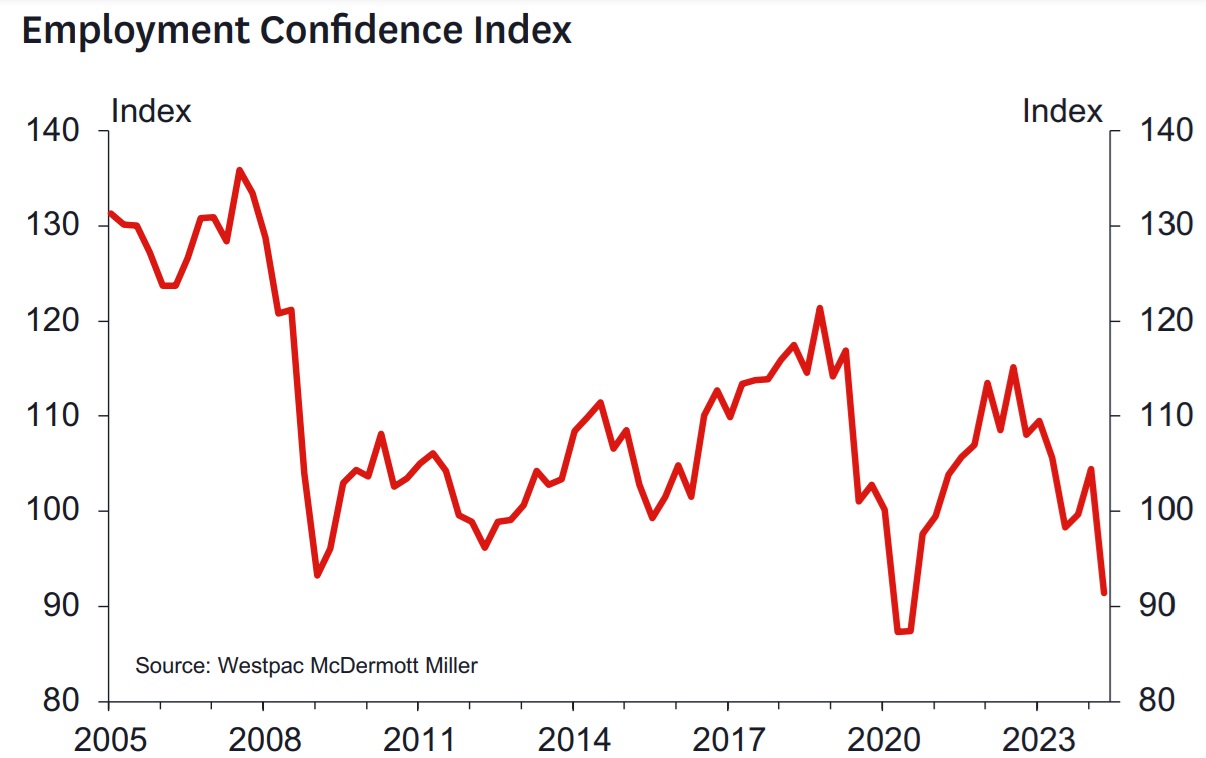
(Westpac notes that In the September 2019 quarter the survey was shifted from phone to online interviewing, which improved the quality of the survey, but does mean there is "a structural break" in the survey, specifically in the first two questions on job availability.)
The sharp decline in confidence levels in this survey appears consistent with other indicators coming out in the past month. Confidence among the public generally seems to have taken a real dip - evidence that the Reserve Bank's efforts to rein in inflation by use of high interest rates are really beginning to bite hard.
Electronic card transaction data for May showed the fourth consecutive monthly drop in retail sales - and this was the biggest drop of the four.
According to the latest BNZ-SEEK job ads report job ads fell 4.8% in May. This follows a similar sized drop in April, taking job ads’ annual decline to 30.5%. Aside from Covid lockdown periods, job ads are at their lowest level since February 2016.
The BNZ – BusinessNZ Performance of Services Index (PSI), which has been going since 2007, recorded the lowest level of activity for a non-COVID lockdown month since the survey began.
GDP figures for the March quarter released last week showed the economy eeked out a 0.2% expansion in the quarter, following four falls in the previous five quarters. However on a per capita basis GDP has now shrunk 4.3% since late 2022, which is a bigger per capita fall than the 4.2% seen after the GFC.
According to Statistics NZ the rate of unemployment increased to 4.3% in the March quarter from 4.0% in December. The increase was actually a little bit more than the Reserve Bank (RBNZ) had forecast. It saw unemployment rising to 4.2% in the March quarter.
The RBNZ is expecting to see unemployment continuing to rise - from what had previously been very low levels - to 5% by the end of this year.
Westpac senior economist Michael Gordon said New Zealand households "have taken a much dimmer view of the jobs market over the last three months".
"The Westpac-McDermott Miller Employment Confidence Index fell by 13 points to 91.4 in the June quarter survey, bringing it down to its lowest level since 2020 when the country was in the midst of the Covid pandemic. A reading below 100 indicates that more New Zealanders are pessimistic about the state of the labour market than are optimistic."
Gordon said the biggest decline in the survey was seen in people’s perceptions of current job opportunities, which fell by almost 24 points to a net -36%.
He said this was of particular interest as this particular indicator has had "a close correspondence" with the unemployment rate over time.
"The latest result suggests that the rise in unemployment, which began gradually in 2022 and 2023, is now gaining some momentum."
A lift in the unemployment rate had been long anticipated, as part of the Reserve Bank’s efforts to tame inflation pressures, Gordon said.
"If anything, it’s taken longer than expected to arise – perhaps due to employers looking to hold on to workers during the economy’s slowdown, having been burned by the difficulties of finding workers a couple of years back.
"We haven’t seen evidence of a significant rise in layoffs to date, but that may change as the slowdown progresses."
McDermott Miller market research director Imogen Rendall said confidence among employees in both the public and private sectors "has taken a real knock this quarter".
'For employees in the private sector, confidence has dropped 19.1 points down to 89.5, and for those working in the public sector, confidence has dropped 11.1 points down to 94.6.
"Both private and public sector employees have taken a particularly pessimistic view on the current availability of jobs, together with future job opportunities in a year’s time.
"Private sector employees are also indicating a real concern regarding their future job security. It will be interesting to see how this plays out over the months to come," Rendall said.
The survey was conducted from June 1 to June 12, 2024, with a sample size of 1,553. The margin of error of the survey is 2.5%.
We welcome your comments below. If you are not already registered, please register to comment
Remember we welcome robust, respectful and insightful debate. We don't welcome abusive or defamatory comments and will de-register those repeatedly making such comments. Our current comment policy is here.