

An influential survey conducted for the Reserve Bank (RBNZ) shows further significant falls in the level of expected future inflation - therefore giving a green light to interest rate cuts.
Across all the timeframes surveyed from one year's time to 10 year's time the expectations of future inflation have dropped markedly - and indeed are now converging on the RBNZ's explicitly targeted 2% level.
What the survey tells you is that key influencers think the inflation battle is being won - and also that low inflation will be here to stay.
The survey is the last significant piece of economic news for the RBNZ ahead of its next review of the Official Cash Rate on Wednesday, August 14.
While this result, I think, should not be viewed as a game changer in terms of overall considerations about just when interest rates should be coming down, the news will certainly encourage the RBNZ as its Monetary Policy Committee sits down to decide whether or not the OCR, currently at 5.50%, might be changed as soon as next week. It's not a decisive input into the interest rate debate. But it helps.
The key results of the latest Survey of Expectations, carried out quarterly for the RBNZ, show the level of inflation in two years' time is expected by respondents (mean measure) to be 2.03% - just above where the RBNZ wants actual inflation to be - and down from a reading of 2.33% in the last survey.
The two-year figure is the one that carries the most clout in the survey. And for it to have come down to - as near as darn it - the figure the RBNZ explicitly targets, is a big moment for the RBNZ. People believe the central bank has inflation in the bag.
Westpac senior economist Satish Ranchhod said expectations for inflation two-years ahead are now below the average seen since 2002 (when we shifted to a 1 to 3% target range for inflation).
"Notably, this measure has not typically fallen to these sorts of lows except at times when actual inflation has fallen below 2%," he said.
For one-year-out the expected inflation figure has dropped to 2.40% from 2.73% in the previous survey.
The five-year figure is 2.07% compared with 2.25% in the previous survey while the 10-year figure is 2.03% from 2.19%.
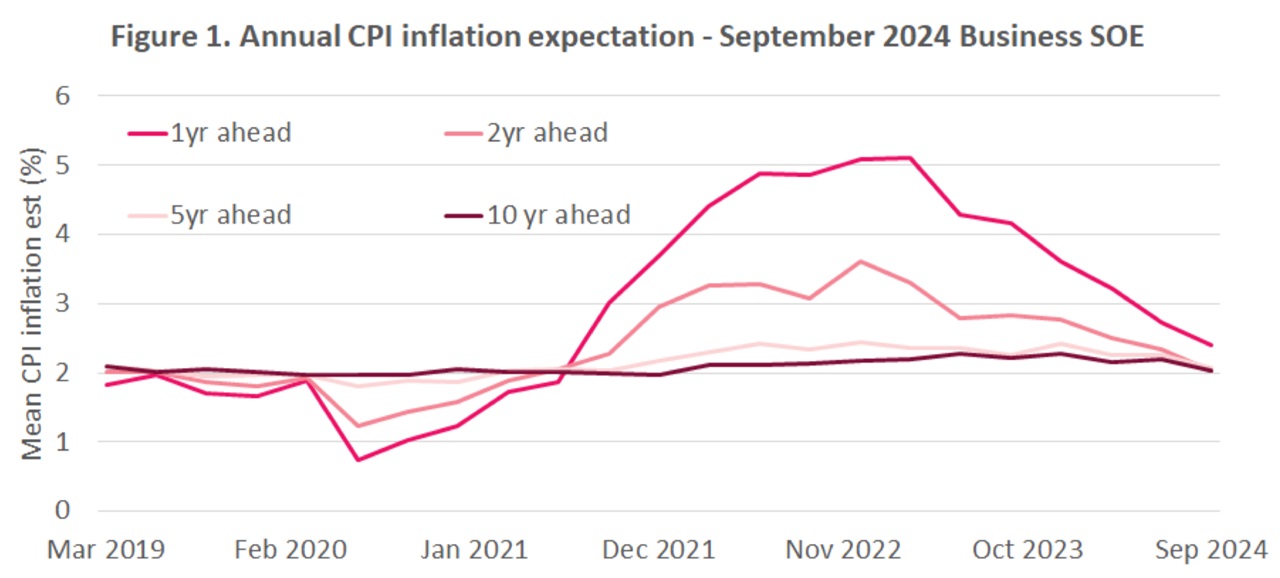
These results are highly significant. The RBNZ targets achieving inflation in a 1% to 3% range, with an explicit aim of 2% - but annual inflation has been outside of that 1% to 3% range since June 2021.
Actual annual inflation was 3.3% as of the end of the June quarter 2024, down from 4.0% in March.
The RBNZ's current official forecast (but made in May so now quite dated) is for inflation to get back under 3% in the fourth quarter of this year, but bank economists expect inflation will go under 3% by the end of the September quarter we are now in.
It's important from the RBNZ's perspective that inflation expectations among the public are tempered. Inflation expectations are a big enemy. If people expect prices to be more expensive in a year they will start increasing prices and push for higher wages etc. And it all becomes self-fulfilling. And after the initial post pandemic global price shocks that followed the breaking of supply chains, we have seen the dreaded inflation expectations in evidence in New Zealand.
Now, according to this survey, and others such as the ANZ Business Outlook, the signs are positive that price rise expectations are being dampened.
The latest survey of expectations is the first time since the survey for September 2021 that all the inflation expectation results have come in under 3%.
This survey has in the past carried quite a bit of weight with the RBNZ (possibly not so much these days) ahead of making its OCR decisions, so these results will certainly be front of mind for the RBNZ's Monetary Policy Committee as it assembles to make the call on the OCR on Wednesday, August 14.
Will these specific results have an influence on the RBNZ's decision in the next week? In themselves, probably not, but they all help to build a picture of the battle against inflation being won - and therefore that interest rates can be dropped. It's then up to the RBNZ to decide just when it wants to pull the trigger. It could be next week, it could be later.
The RBNZ said the data for this quarter was obtained from 33 business leaders and professional forecasters by Research New Zealand – Rangahau Aotearoa on behalf of RBNZ. Field work for the survey was run between July 18 and July 26.
We welcome your comments below. If you are not already registered, please register to comment
Remember we welcome robust, respectful and insightful debate. We don't welcome abusive or defamatory comments and will de-register those repeatedly making such comments. Our current comment policy is here.