

Banks will likely soon be "constrained" in how much they drop their mortgage rates, Reserve Bank (RBNZ) Assistant Governor Karen Silk says.
Silk, who is also General Manager of Economics, Financial Markets and Banking, and sits on the RBNZ's Monetary Policy Committee (MPC) told a Citi Australia & New Zealand Investment Conference in Sydney on Wednesday that "reversion to pre-covid funding conditions" is under way for banks.
"...All else being equal", this will constrain how far lending rates will fall "as banks seek to preserve their net interest margin" she said.
Banks are currently engaged in a furious mortgage rate cutting battle as they fight for market share. Traditionally popular one-year fixed mortgage rates are now pushing under 6%, while the Official Cash Rate (OCR), set by the RBNZ's MPC is currently at 4.75%. This is an unusually small gap.
Silk said that in the current "low credit growth environment", home loan rates have responded to falling wholesale rates as markets have pre-positioned future OCR cuts.
"Likewise, borrowers have been fixing interest rates for shorter terms, which all else being equal, should reduce the time it takes for lower interest rates to be reflected in household and business cashflows.
"Our latest New Credit Flows survey shows that around 75% of new home loan flows currently carry interest periods of one-year or less and circa 70% of existing home loans will be repriced within the next nine months."
Bank funding spreads, however, have gradually increased this year, Silk said.
"And this is expected to continue as excess liquidity is drained from the banking system with the progressive wind down of additional monetary policy tools.
"Over time this is likely to influence the amount of the decline in bank lending rates, even in the face of lower wholesale rates, as banks seek to maintain their net interest margins."
Silk said the banks' funding spreads - reflecting the difference between the rates that banks pay for retail deposits and wholesale funding versus wholesale rates - "experienced a major shift from mid-2020" as a result of a higher volume of low-cost deposits within the bank funding mix.
"This shift has had meaningful implications for the pass-through of policy rate changes to home loan rates."
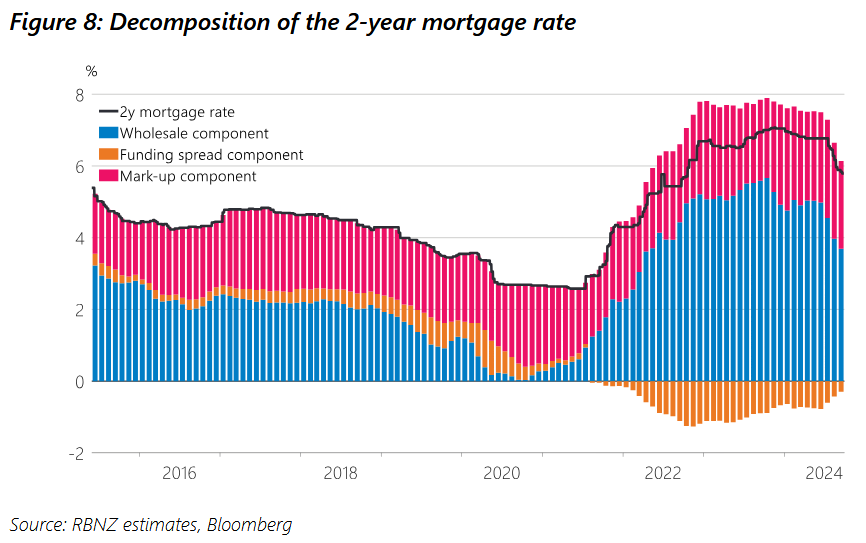
Silk said through the OCR tightening cycle [in which the OCR was raised from 0.25% to 5.5%], the trough-to-peak increase in the New Zealand wholesale two-year swap rate was 570 basis points.
"However, the lower cost of funding experienced through that period by banks, as represented by the funding spread, meant that this increase was not fully passed- through to home loan rates, with a trough-to-peak increase in the two-year mortgage rate of 450 basis points."
Silk said the RBNZ estimate of the average bank mark up on a two-year mortgage through the same period increased from around 2.0% to 2.8%.
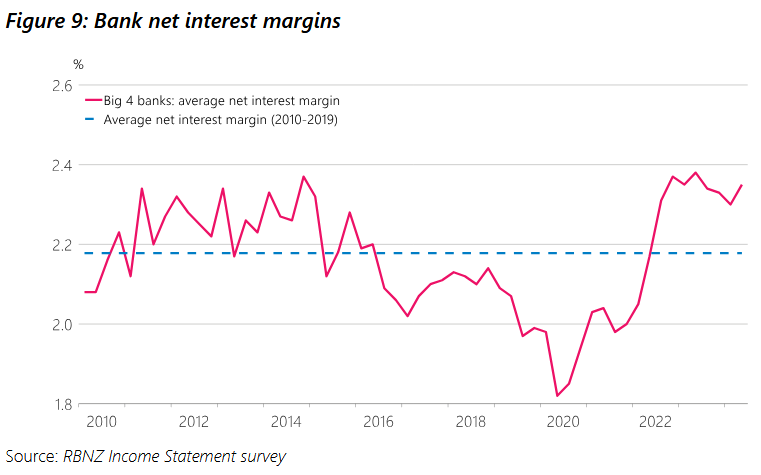
"As home loans account for a large proportion of total bank assets (currently around 50% on average), this contributed to an increase in the net interest margin generated by banks through this period."
From the first OCR increase in October 2021 to the last one in May 2023, the biggest four banks in New Zealand, on average, saw their net interest margins increase by about 35 basis points to 40 basis points, she said.
"The upshot of this is that financial conditions were less restrictive during the recent tightening cycle for the same level of the OCR when compared with previous cycles.
"However, through ongoing monitoring we have been able to identify and factor this into our decision-making to ensure that financial conditions have been where we needed them to be to achieve our monetary policy objectives.
"The OCR, and wholesale rates, have been slightly higher than they otherwise would have been to account for this."
Silk said, however, that given bank funding spreads have already begun to normalise, the offset required as the OCR comes down will likely be much smaller than was the case during the tightening cycle, "which will reduce the need to factor this into OCR decisions to the same degree in the years ahead".
The speech on Wednesday was given a short time after release of NZ Consumers Price Index (CPI) figures for the September quarter that showed annual inflation moving (at 2.2%) back into the RBNZ's 1% to 3% target range for the first time in three-and-a-half years and towards the RBNZ's explicit target of 2%.
Silk didn't comment on the figures, but said monetary policy is working, "and we have confidence that inflation is moving back to its target level".
"Over recent meetings the Committee [MPC] has become increasingly confident that monetary policy has had the desired effect, and that economic conditions are supporting the convergence of CPI back to the target mid-point of 2%."
Silk said, however, the RBNZ was are also "conscious of the broader set of economic conditions required to manage inflation back to target".
"We will continue to assess and respond to risks, on both sides of the ledger."
We welcome your comments below. If you are not already registered, please register to comment
Remember we welcome robust, respectful and insightful debate. We don't welcome abusive or defamatory comments and will de-register those repeatedly making such comments. Our current comment policy is here.