

I think this is what we could call 'starting the year with a bang'.
We are going straight into 2025 with the biggie - inflation.
The Consumer Price Index (CPI) inflation figures for the December quarter to be released by Stats NZ on Wednesday, January 22, will give us a very early indication of whether our current assumptions about the (lower) path interest rates will follow this year are correct or not.
The inflation figures will be the most important, though by no means only very significant influence, on the Reserve Bank's thinking ahead of its first review of the Official Cash Rate (OCR) for the year on February 19.
We've already had in the past week the influential and long-running NZIER Quarterly Survey of Business Opinion (QSBO) and the (I think) increasingly important monthly glimpse of inflation provided by the Selected Price Indexes, which contain about 45% of the ingredients in the CPI.
Then, to come, there's the inflation figures on January 22.
Then there's ANZ's monthly Business Outlook (ANZBO) Survey on January 30.
Then there's Stats NZ's suite of labour market figures - including the unemployment number - for the December quarter on February 5.
On February 13, there's the RBNZ's Survey of Expectations in which business leaders and forecasters give us their views of where inflation's going to be in a year, two years, five years and 10 years. And then there's another inflation sneak peak with a further Stats NZ Selected Price Indexes release on February 14.
So, that's heaps of useful stuff for the RBNZ to consider, and perhaps worry about, ahead of its February 19 decision.
Of course, I say the RBNZ's 'decision'. A really interesting point to consider about the forthcoming review is the extent to which the RBNZ has already pre-empted itself. A decision to all intents and purposes seems already to have been made.
Governor Adrian Orr commented after the last OCR decision on November 28, that the forecasts contained in the latest RBNZ Monetary Policy Statement (MPS) were "consistent" with another 50 point OCR cut in February.
In the veiled world of RBNZ-speak that's as close as you are ever going to get to hearing the central bank say in advance "yes, we will cut 50 points". I can't readily recall the RBNZ ever being as explicit before in its forward guidance ahead of an OCR decision.
All of which means that it would be reasonably awkward if some of many data releases outlined above before the February 19 OCR meeting have results that run counter to the logic of a 50-point cut.
Here is an abridged version of those most recent RBNZ forecasts. Bold numbers on a shaded background indicate figures that are forecasts. The full version can be seen on page 49 of the MPS.
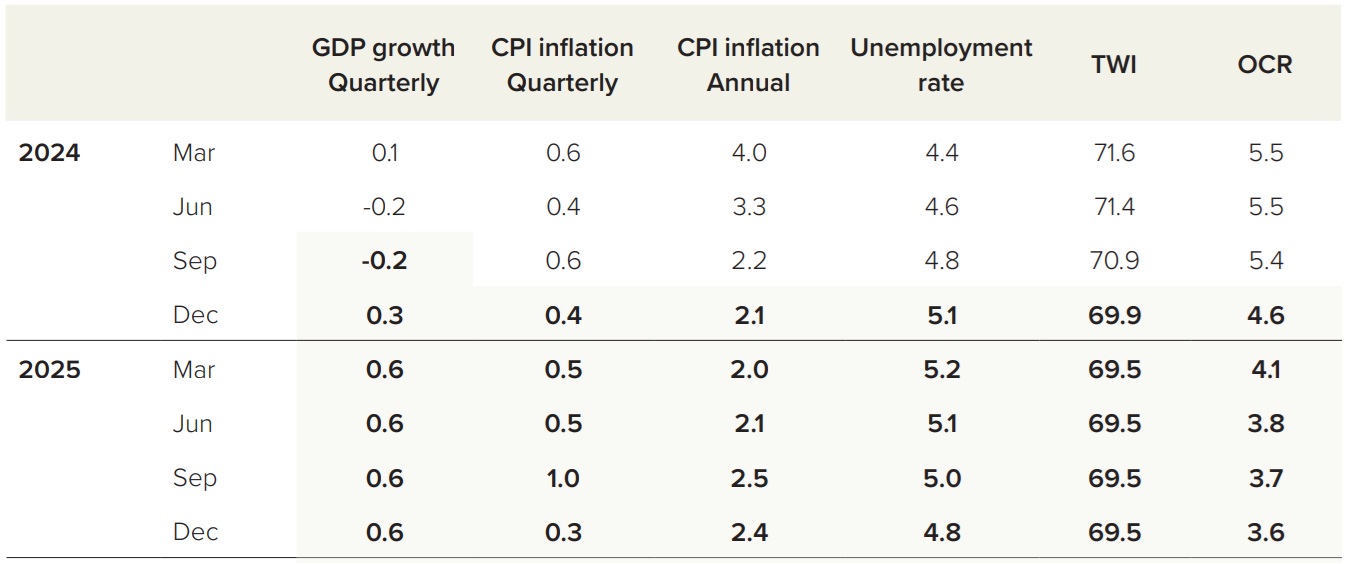
As you can see, the RBNZ is forecasting that the annual rate of inflation will have dropped to 2.1% as of December, down from 2.2% in September.
The RBNZ is charged with achieving inflation between 1% and 3% with an explicit target of 2.0%. There is therefore some possibility these latest figures to be released on January 22 will see the central bank hit its target bang in the middle.
It's all a far cry from June 2022 when the CPI hit 7.3%. Indeed, inflation was outside of the 1%-3% range from mid 2021 till September 2024. That's a long time.
So, having achieved the holy grail of low inflation once more, can it be maintained? Obviously, that's the key to seeing interest rates continuing to come down and staying down.
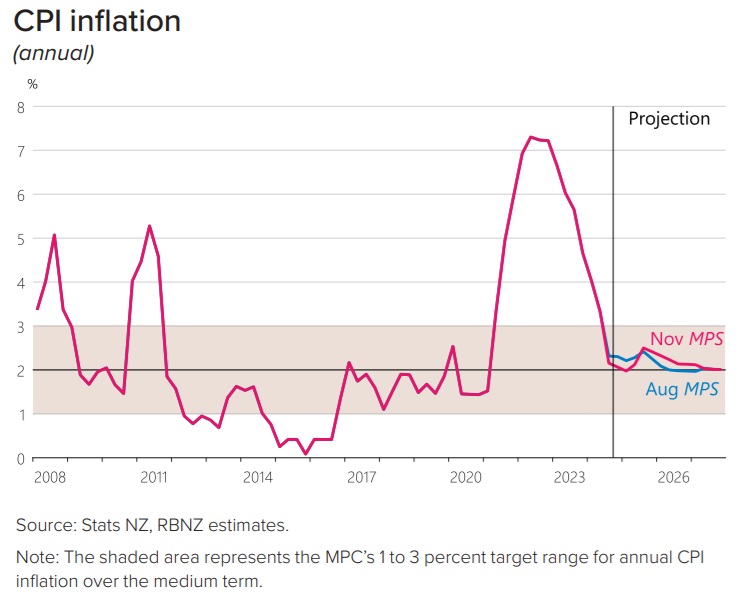
Both the NZIER QSBO and the Stats NZ Selected Price Indexes out in the past week appeared to suggest there'll be no nasty surprises in short term inflation. The RBNZ's pick that annual inflation will be 2.1% therefore seems reasonable enough. That means there's probably going to be no obstacle to the RBNZ going ahead with its planned 50-point cut on February 19, taking the OCR down to 3.75%.
But we can always find something to be concerned about. The RBNZ's expecting domestically sourced, or 'non-tradables' inflation to remain relatively high. The main source of the sharp falls we've recently seen in overall inflation levels has been overseas, with things such as lower oil prices.
However, what comes down can go back up again. And oil prices are now very much on the rise. Compounding this is the fact our brave little kiwi dollar is getting killed by the American juggernaut currency while international bond yields, particularly those of longer durations, have been rising.
The RBNZ is forecasting that domestic, 'non-tradables' inflation will have been 4.7% as of December, down from 4.9% in September.
The RBNZ further forecasts than annual non-tradables inflation will be 3.7% by June and 3.2% by December this year. 'Tradables', overseas-sourced inflation, is forecast to have been at an annual rate of -1.5% as of December and is forecast to still be in the minuses, at -0.2% by June 2025, before going positive at +1.1% by December.
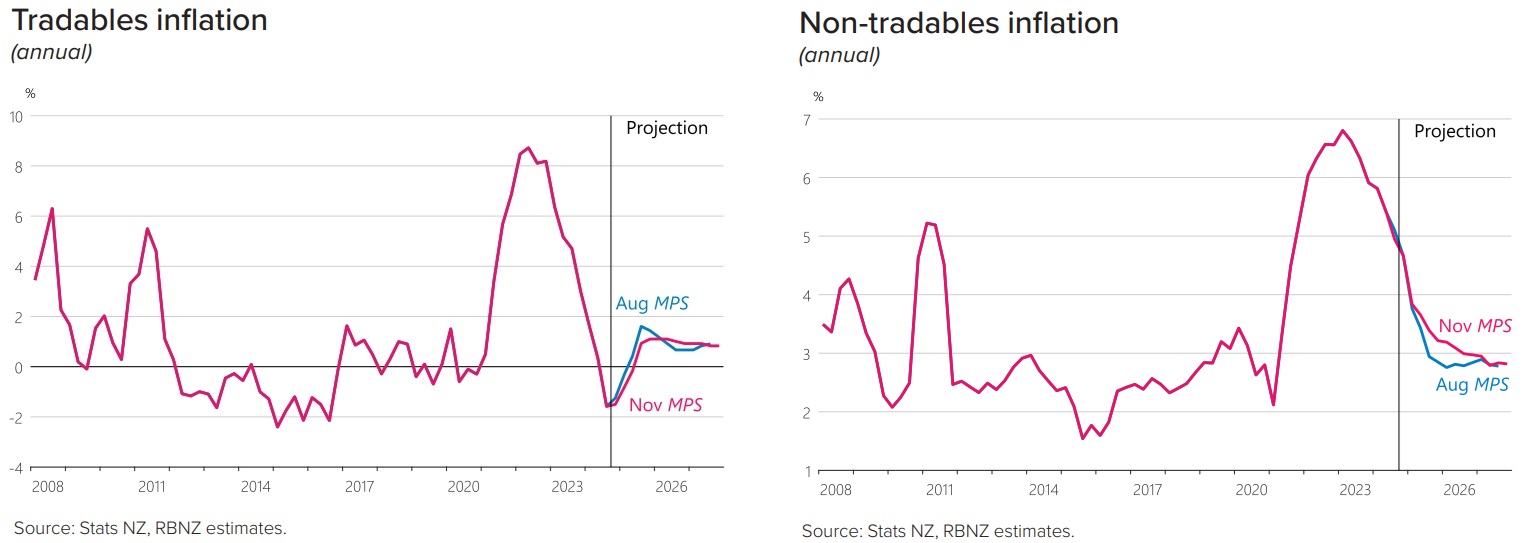
Clearly though, there is some risk to the inflation outlook if our domestic inflation does remain somewhat 'sticky' and more particularly if there are some shocks that start to come through from what's - let's face it - a very volatile global situation.
It appears that the forthcoming January 22 inflation figures will be satisfactory and that therefore the light will stay green for the projected 50 point OCR cut next month. Beyond that though is where it all gets a bit tricky.
The RBNZ's latest forecasts indicate an OCR of around 3.5% or a little lower by the end of this year. Taken at face value that forecast would suggest that after next month, when we can expect to see the OCR at 3.75%, most of the easing of interest rates will have been 'done'.
Various economists are suggesting rather more will need to be done with cuts to revive an economy that fell into a big hole in the middle of last year and is struggling to get out - notwithstanding the now rising business confidence we are seeing.
Inflation holds the key. Things appear to be looking okay for now - but there's plenty that could go wrong this year. If for any reason inflation begins to surprise on the upside in the next few months, interest rate reductions may stall. And that in turn could delay the hoped-for economic recovery.
We welcome your comments below. If you are not already registered, please register to comment
Remember we welcome robust, respectful and insightful debate. We don't welcome abusive or defamatory comments and will de-register those repeatedly making such comments. Our current comment policy is here.