
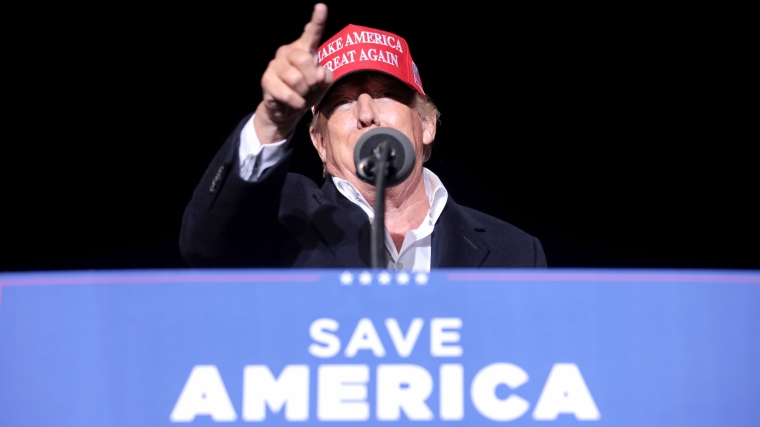
The United States will impose a 10% import tax on New Zealand products as part of a sweeping tariff plan announced at the White House on Thursday morning, NZ time.
President Donald Trump said America had been “looted” by foreign countries who had stolen the country’s jobs and ransacked its factories.
“For decades, the United States slashed trade barriers on other countries, while those nations placed massive tariffs on our products and created outrageous non-monetary barriers to decimate our industries and in many cases, the non-monetary barriers were worse than the monetary ones”.
Trump displayed a chart showing his administration's assessment of the tariff and other trade barriers faced by American exporters, and a “discounted reciprocal” rate to be imposed in response.
These reciprocal rates are roughly half the Trump team estimates in most cases. For example, China was said to impose a 67% barrier and has been hit with a 34% retaliation rate.
'Not correct'
However, the administration has decided to charge a minimum tariff of 10% on all foreign imports including those from NZ, which the US incorrectly claims imposes a 20% tariff on US products.
Trade Minister Todd McClay said this number was not correct and officials were seeking to clarify how that number had been calculated. US products face an average tariff rate of 1.9% when entering New Zealand, which would only be 17% even if GST was included.
Despite the miscalculation, the Minister said this was still “the best possible result” as Kiwi exporters would not be any worse off than those from other countries.
“Every country in the world faces a minimum of 10%, some as high as 30% or 40% and a worse outcome from New Zealand would be that we have higher tariff rates than some of the countries we compete against”.
However, he said the tariffs would still have an impact on international trade, inflation, global demand, and many currency exchange rates which could be difficult for businesses.
The back-of-the-envelope estimate is that it would add $900 million of costs to the $9 billion in exports to the US, but there was “pretty clear evidence” much of this would be paid by American consumers and not Kiwi exporters.
NZ would not retaliate against these tariffs as that would only increase costs for consumers and put pressure on inflation, he said.
Economic logic ‘doesn’t stack up’
John Ballingall, a trade economist at Sense Partners, agreed it was a better than expected outcome for NZ, but also said it was worse than hoped for the global economy.
“The fact that we are facing a 10% tariff, when some of our competitors are facing a lot more, is not the worst outcome in the world. But some of the tariffs that he's imposing on other countries are absolutely enormous, and that points to a pretty significant impact on global growth,” he said.
Many competitors, such as Brazil, Australia, and the United Kingdom, have also received the 10% flat rate while others are facing higher rates. For example, the European Union at 20%.
The White House told CNBC the new 34% tariff on China would be added to previous measures, bringing the overall rate to 54%. McClay said he was seeking clarification about whether that would be the case for NZ tariffs as well.
Ballingall said GST would have to be included as a trade barrier to get anywhere near the 20% rate the Trump administration claims NZ imposes on imports.
“The math doesn’t really stack up and the economic logic absolutely doesn’t stack up. So yeah, it's hard to know exactly how they got to those numbers”.
While NZ won’t be disadvantaged relative to other exporting countries, it will be relative to domestic US producers.
The US has been NZ’s fastest growing export market. Kiwi businesses sold $14.6 billion into the States in the year ended March 2024, making it the second largest export market ahead of Australia and behind China.
Independent global economic researchers Capital Economics (CE) said the tariffs turned out to be "bigger than expected".
Chief economist Neil Shearing said CE's calculations pointed to an import-weighted average tariff of 19.1%.
"...That means the effective tariff rate on all imports will rise from 2.3% last year to around 26%, leaving it at a 131-year high. In very general terms, Canada and Mexico have got off lightly, while those in Asia, particularly China and Vietnam, have been hit hard," he said.
Trade war launched?
Tim Groser, a former NZ trade minister, said the reactions of other countries were at least as important as the tariffs themselves. “That reaction will start to shape itself over the coming days,” he said in a text message.
If other countries retaliate it could spark a trade war which would rock global markets.
Australian Prime Minister Anthony Albanese said the tariffs were unjustified but it was US consumers who would pay the biggest price.
“This is why our government will not be seeking to impose reciprocal tariffs. We will not join a race to the bottom that leads to higher prices and slower growth," Albanese said.
But Canadian Prime Minister Mark Carney said his country would respond: "it’s essential to act with purpose and with force, and that's what we will do”.
Some European leaders also hinted at possible retaliation, while China said last month it was ready for “any type of war” with the US.
Sabrina Delgado, an economist at Kiwibank, said she was also worried about the trade war between our two largest trading partners escalating.
“We’re now awaiting retaliation, if any … China has been hit with a 54% tariff rate. That’s steep,” she said in an email.
“An escalation of the tariff trade war could stall the Kiwi economy’s expected recovery, requiring the RBNZ to do more. It is a scenario that’s certainly not outside the realms of possibility, yet one the market has not priced”.
Sharon Zollner, chief economist at ANZ, said it was unlikely that people were taking today’s announcement as “the final word” on tariff policy.
“It appears that part of the Trump administration’s plan is to sow so much uncertainty that firms decide the only safe option is to manufacture in the US.”
Some firms will do that but others will decide to stop making new investments altogether, which would dampen global economic growth, she said
Financial markets hit
Already financial markets are reacting negatively to the news. S&P 500 futures dropped 3%, while Nasdaq futures fell almost 4%. Trump’s speech was timed to be after market close, to avoid an embarrassing crash mid-announcement.
In NZ, the benchmark NZX index dropped more than 1.5% at market, open but later recovered some of those losses.
A major reason was a sharp slide in the value of market heavyweight Fisher & Paykel Healthcare, a big provider of products to the US market. It was down at one point more than 7%, but after the company put out an announcement the losses were pared back. At the time of writing the share price was down about 1% on the day.
In a statement to NZX the company said it still expected to reach its gross margin target but US tariffs may add costs and delay the timeframe for that goal.
The NZ dollar dropped almost 1% against the American currency and only recovered half of those losses. It has fallen 5% against the US in the past year, but has been trending higher since the start of the year.
The price of precious metals immediately rallied after the announcement but then started to fall. Gold, went up, then down, and then strongly up again to a new record high of US$3,160 oz, in very choppy trading. But other metals fell.
Bitcoin fell about 4% in the hour after the announcement and at time of writing was below US$83,000, down around 3% in the past 24 hours.
We welcome your comments below. If you are not already registered, please register to comment
Remember we welcome robust, respectful and insightful debate. We don't welcome abusive or defamatory comments and will de-register those repeatedly making such comments. Our current comment policy is here.