
Here's our summary of key economic events over the weekend that affect New Zealand with news ships are slowly exiting the Strait of Hormuz, and over the four months since the start of the conflict about a quarter of the ships trapped initially have now transited out. It is an open question whether their owners will want to go back for more cargoes, until the issue is resolved. But the US keeps changing the rules, and Iran isn't buckling, so far at least. In fact in the face of Trump's change demands, they have now added their own.
The bottom line; there is no resolution to the core crisis. This is in large part because Trump has not signed off on the tentative negotiated US-Iran deal. He seems to distrust his own negotiators as much as Iran. Markets are assuming he will eventually. They may be waiting a while. Already it is clear the the Obama deal way back when was a better deal for the US than what is now on the table.
But first locally, there won't be a lot of significant economic data released this coming week. We will get April building consent data, loan data, Barfoot's and other housing results for May, and some Q1-2026 trade and building work data too. And a full dairy auction on Wednesday.
In Australia, it will be trade, building permit data, and the Q1-2026 GDP outcomes.
Elsewhere there will be a raft of PMIs released for many countries.
That will include the two key ones for the US. And their week will end with the May no-farm payrolls report, preceded by a number of other labour market indicators. Payrolls are expected to have risen less than +100,000 in the month.
In India, they will be reviewing their official interest rate settings (no change expected). They will also released industrial production and GDP data.
Trade and inflation data will come from many other Asian countries as well along with PMI results.
In China, the key releases include their two PMIs with the official one out already. That shows their factory sector slipped back slightly to a steady state, neither expanding nor contracting. It also shows their services sector no longer contracting, now with a very modest expansion.
In Australia, their long-needed house price correction is underway - tentatively and only in some cities. Higher mortgage rates, crimped affordability, and the recent Budget changes relating to how CGT is to be applied have all combined to see prices dip again in some of their biggest markets. Transaction volumes are retreating too and recent auction volumes are now at six-year lows. Sydney average prices dipped -0.9% in May to be -2.1% lower over the past three months. For Melbourne it was a -0.8% May dip for a -2.3% quarterly fall. For Brisbane, Adelaide and Perth however the upward pressure remains.
And staying in Australia, they now expect 2.5 mln people will enter retirement over the next ten years, heightening concerns about their resources. A recent survey indicates savers there now think they need A$1 mln to be comfortable. But for those in the 60-65 age group, average current balances are only A$400,000 for males and A$315,000 for women. This is resulting in some deep anxiety for many.
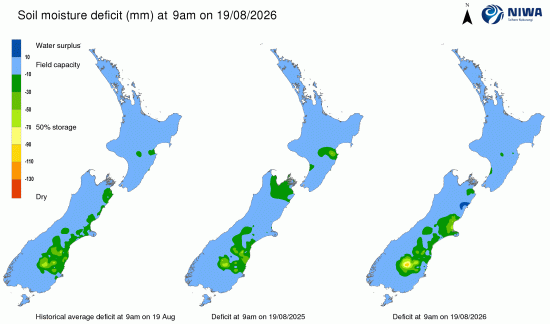
Even though it originates in the Pacific, a global stress is looming with rising chances of a 'super' El Niño on the way and it will build its impact later this year. According to NIWA/Earth Sciences, during El Niño, New Zealand tends to experience stronger or more frequent winds from the west in summer, which can encourage dryness in eastern areas and more rain in the west. In winter, the winds tend to blow more from the south, causing colder temperatures across the country. In spring and autumn, southwesterly winds are more common.
The UST 10yr yield is now just on 4.45%, up +1 bps from this time Saturday, down -12 bps for the week. The key 2-10 yield curve is now at +44 bps (no change). Their 1-5 curve is now at +36 bps (unchanged) and the 3 mth-10yr curve is at +76 bps (+1 bp). The China 10 year bond rate is up +1 bp at just under 1.72%. The Japanese 10 year bond yield is unchanged at 2.66%. The Australian 10 year bond yield starts today at 4.84%, down -1 bp from Saturday, down -8 bps for the week. And the NZ Government 10 year bond rate is unchanged at 4.55%, down -17 bps for the week.
The price of gold will start today down -US$17 at US$4538/oz, up +US$23 for the week. Silver is down -50 USc at just over US$75/oz.
Oil prices are softish just under US$87.50/bbl in the US, while the international Brent price is now on US$91/bbl and down -50 USc. A week ago these prices were US$96.50 and US$103.50/bbl respectively.
Urea prices are falling back with the oil price, but this is not the case for sulphur, which remains close to its record highs.
The Kiwi dollar is unchanged from Saturday at this time at 59.9 USc, up +130 bps for the week. That is its highest since the Middle East conflict began. Against the Aussie we are up +10 bps at 83.4 AUc. Against the euro we are firmer at just under 51.4 euro cents. That all means our TWI-5 starts today at just under 63.4 which is up +10 bps from Saturday, up +130 bps for the week.
The bitcoin price starts today at US$73,514 and up +0.3% from this time Saturday, but down -4.0% for the week. Volatility over the past 24 hours has been low at just under +/- 0.6%.
Daily exchange rates
Select chart tabs
The easiest place to stay up with event risk is by following our Economic Calendar here ».
24 Comments
"The buffers and the shock absorbers are being steadily drawn down, and the ability for the market to absorb this imbalance is drastically diminished today versus where we started," he said at a Bernstein conference on Thursday.
"Over the next few weeks, we're likely to see those pressures flow through more directly to physical prices and there's more upwards pressure that I would expect as we get into June and certainly into July."
https://oilprice.com/Energy/Oil-Prices/Supermajor-Warns-Oil-Prices-Coul…
Baked in
Yes higher prices and even rationing likely before oil flows again.
How can Trump claim a win while they hold the urainium? and control the SoH
It feels like the world has moved on and expects everything will return to 'normal' now regardless off what's happening in the SoH. I'm surprised it has taken this long but reality may well hit very very hard. Iran clearly know this and are just drawing things out until the real pain for the west sets in and gives them a ton of leverage.
This is true but this also gives countries like Saudi and UAE time to make place orders of billions in drone technology...
IRAN has made some very rich counties angry, it will not just be interceptor drones they will fight back.
The United Arab Emirates (UAE) has placed a major order for 5,000 Ukrainian interceptor drones
designed to shoot down incoming loitering munitions, such as Iranian-made Shahed drones.
The UAE-Ukraine drone agreement and related contracts focus on the following details:
- The Interceptor Systems:
The UAE specifically requested low-cost P1-Sun interceptor drones from the Ukrainian firm Skyfall and systems from TAF Industries.
- The Cost-Efficiency:
At roughly $$\(2,500 to\)$10,000 per unit, these systems are a highly cost-effective alternative to multimillion-dollar surface-to-air missiles.
- The Strategic Partnership:
The UAE and Ukraine signed a broader 10-year defense agreement covering counter-UAS (Unmanned Aerial Systems) expertise, technology sharing, and the potential for establishing joint production lines in the Gulf.
5000*$10,000= $(5*10^3)*(10*10^3) =$50*10^6= $50 million max., not a lot for a wealthy oil exporting nation.
5000*$10,000= $(5*10^3)*(10*10^3) =$50*10^6= $50 million max., not a lot for a wealthy oil exporting nation.
From the look of it Iran, or at least those calling the shots in Iran, don’t really care what anybody else thinks about them, that includes their neighbours and , obliquely if you like, much of their own population. This is a result of the forward thinking of the two Ayatollahs, 1979 onwards. Suggest what is going to be really fascinating, should it eventuate, is the extraction of the stockpile of suspect uranium. Worthy of a Hollywood script - you want it, you buried it, you go get it, oh couldn’t find it? Sorry forgot to say we had moved it before those two big bombs.
lost it in a boating accident
But the US keeps changing the rules, and Iran isn't buckling, so far at least. In fact in the face of Trump's change demands, they have now added their own.
Ask yourself, beyond the rhetoric, how likely are negotiations between two unreasonable parties likely to actually succeed ?
Iran will have to cave sooner or later won’t they?
Why ?
And even more so when you add the third wheel (Israel) to the party
Yes, you're absolutely correct.
Over the ditch, One Nation has moved ahead of Labor in at least one new national opinion poll, with a primary vote around 31% versus Labor’s 28% - a first in modern Australian federal polling history. ON's support seems to be galvanized by the recent federal budget and broader dissatisfaction with the govt’s handling of cost‑of‑living pressures.
No doubt the Ponzi has contributed to the downfall of the mainstream political parties. In Labor's defense, they at least want to be seen to be doing something about it. But in terms of strategy and policy, it's all a little shallow and tinkering.
https://www.abc.net.au/news/2026-05-31/pauline-hanson-preferred-prime-m…
The RBA doesn’t seem to want to do anything about it
About what? Using open-mkt operations to demotivate the sheeple from betting on the Ponzi?
That's because they know if the Ponzi goes, she all goes. Even if they can't explicitly use those words.
You can have all the fancy pants modelling in the world, but the underlying human behavior is crucial.
Cost of living. Even before the war Aussie inflation was quite high and the RBA held the OCR. They left themselves very open to an inflation shock.
That's very significant.
Could be wrong, but I haven't seen much about ON on NZ mainstream media?
Naturally. I would expect ON to be more despised by the Aotearoa urban elite compared to their distaste for NZ First.
The irony is that they appear to have some support from 2nd / 3rd-generation migrant communities. It's not like these people don't also feel the pressure from Albo crush loading their cities with new migrants. They also run small businesses who have been punished by the budget.
Watched a podcast with a pollster and he said a lot of people felt that the 2 main parties have saisd one thing and done the other over 20 years. They relly don't know what On polices are. They are just tired of people lying to them.
Bingo!
any one but them
Watched a podcast with a pollster and he said a lot of people felt that the 2 main parties have saisd one thing and done the other over 20 years. They relly don't know what On polices are. They are just tired of people lying to them.
Populism in a nutshell
Pauline Hanson the Aussie battler.
Proudly brought to you by Gina Rinehart.
We welcome your comments below. If you are not already registered, please register to comment
Remember we welcome robust, respectful and insightful debate. We don't welcome abusive or defamatory comments and will de-register those repeatedly making such comments. Our current comment policy is here.