
By Barry Eichengreen*
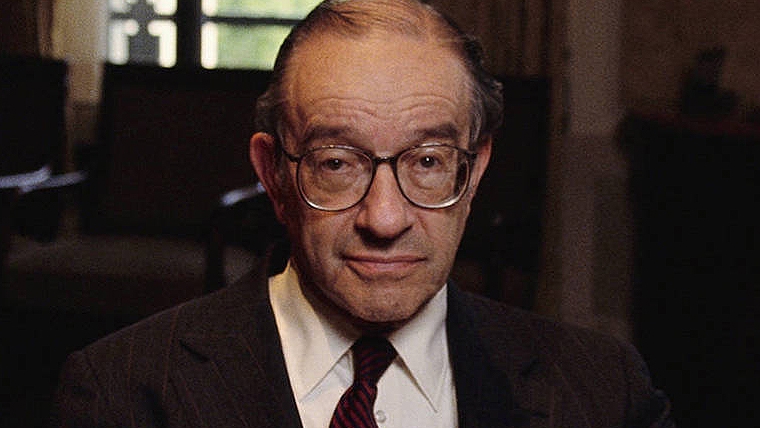
Alan Greenspan, who died this week at the age of 100, was one of the most consequential chairs the Federal Reserve Board has had in its 112 years of existence. But consequential does not mean faultless. One might say that his tenure—the second-longest in Fed history—ultimately vindicated much of what he had opposed.
The young and even middle-aged Greenspan did not seem destined to lead the world’s most powerful central bank. Born in 1926 and raised in New York by a single mother, Greenspan had not anticipated a career in economics and finance at all. His passion was jazz clarinet and saxophone, a career he pursued professionally, although he distinguished himself mainly by keeping the books for his touring big band.
With music offering less than a stable income and career path, Greenspan enrolled in 1945 at New York University, earning B.A. and M.A. degrees in economics. He worked as an analyst at the National Industrial Conference Board while pursuing a Ph.D. at Columbia University but dropped out after being approached in 1953 by William Townsend to become a partner in the consulting firm subsequently known as Townsend-Greenspan. At the Conference Board, itself a kind of economics consulting and research firm, Greenspan acquired a reputation for pouring over economic minutiae and assembling a coherent picture of the economy. He stayed at Townsend-Greenspan, with only one interruption, for 32 years.
Along with a reputation for scrutinizing data on freight car loadings and other obscure economic time series, Greenspan became a member of the intellectual salon run by the objectivist philosopher Ayn Rand. How profoundly he was influenced by Rand’s views of limited government, and whether those views shaped his staunch opposition to financial regulation and other forms of government intervention, which came back to haunt him in the 21st century, is uncertain.
What is clear is that Greenspan’s views evolved with the times or perhaps shifted with the political winds. Contacts in the Republican Party led to his advising Richard Nixon’s 1968 presidential campaign and to Nixon nominating him to chair the Council of Economic Advisers in 1974, where Greenspan positioned himself as a pragmatist. He chaired the CEA for three years before returning to Townsend-Greenspan. Besides working as a consultant, he served on corporate boards, appeared on network news programs, and chaired President Ronald Reagan’s Commission on Social Security Reform, bringing him to the attention of the president, who elevated him to the Fed chairmanship in 1987.
If Reagan thought he was getting a more compliant inflation fighter than the departing Paul Volcker, he was disappointed. Greenspan cemented the view that maintaining low and stable inflation should be the Fed’s highest priority; if a central bank failed to deliver price stability, its other goals would remain out of reach. In the mid-1990s, he moved the Fed decisively toward the adoption of a formal inflation target. On his watch, consumer price inflation averaged 3%, low by late-20th-century US standards. Improved price stability was accompanied by improved overall economic stability in the period that came to be known as the “Great Moderation.” Whether this happy outcome was due to good policy or good luck is disputed to this day.
As Fed chair, Greenspan made two controversial bets. First, he bet that the economy was undergoing a structural transformation due to the internet and new information technologies that promised faster productivity growth and lower inflationary pressures. No productivity surge was yet evident in the data, but Greenspan’s reputation as an oracle who could parse economic statistics lent authority to his views.
Starting in 1996, Greenspan used that authority to argue that the Fed’s models were overestimating the risk of inflation and to push back against interest-rate hikes, to the delight of the White House. When inflationary pressures remained subdued and the country’s economic expansion continued for another five years, Greenspan was vindicated. That we currently have talk of another productivity surge due to AI, and another prospective Fed chair with sensitive political antennae and a preference for low interest rates, attests to Greenspan’s enduring influence.
Greenspan’s other bet was that a lightly regulated banking and financial system could fend for itself—that the decisions of self-interested bankers would benefit not just their institutions but the financial system, the economy, and society as a whole. Greenspan’s appeal to his original Reagan administration patrons may have been precisely that, unlike the departing Volcker, he favored light-touch regulation of banks and financial derivatives markets. He advocated deregulating over-the-counter derivatives and opposed stricter controls proposed by the Commodity Futures Trading Commission. He oversaw administrative changes lowering reserve requirements on bank liabilities and favored repeal of the Glass-Steagall Act, the Depression-era law separating commercial and investment banking.
In 2006, after more than 18 years, Greenspan stepped down from the Fed. No sooner did he do so than the presumption that banks and financial markets could safely self-regulate was discredited, and spectacularly so, by the subprime mortgage meltdown in 2007 and the global financial crisis of 2008-09.
The low interest rates Greenspan favored as a result of his bullish views of productivity may have had more than a little to do with the frenzy of risk taking that fed the subprime boom. But more directly implicated was his supreme confidence that financial institutions could be trusted to self-regulate. As he put it in Congressional testimony in 2008, “I made a mistake in presuming that the self-interest of organizations, specifically banks and others, were such that they were best capable of protecting their own shareholders and equity in the firms. … Those of us who have looked to the self-interest of lending institutions to protect shareholders’ equity (myself especially) are in a state of shocked disbelief.”
In his autobiography, The Age of Turbulence, Greenspan again attributed his shock to a “flaw in the model.” It is tempting to see the model in question as the self-regulating free-market economy of his objectivist youth, although this explanation for his deregulatory fervor may be facile. Greenspan himself also blamed his inaccurate forecast on inadequate data on risky lending practices, though that is hard to credit coming from someone renowned for his skill at parsing obscure economic statistics.
Another explanation of this lack of foresight is that there had been several earlier episodes of financial excess on Greenspan’s watch, but none had seriously damaged the US financial system and the economy. When the stock market crashed in 1987, Gerald Corrigan of the Federal Reserve Bank of New York moved quickly to inject liquidity into the financial system. During the Mexican Debt Crisis of 1994, the US Treasury, led by Robert Rubin, tapped its Exchange Stabilization Fund until permanent finance was arranged. In 1997, when the Asian financial crisis erupted, both the Treasury and the International Monetary Fund, with leadership from the economist Stanley Fischer, stepped into the breach.
From these earlier episodes, Greenspan inferred that self-interested markets, while prone to excesses, could right themselves sufficiently to avoid imperiling the financial system and the economy. The correct lesson would have been, first, that markets require strict regulation, and, second, that it is essential to have competent technocrats at the helm. Today, in 2026, these are timely lessons to recall.
*Barry Eichengreen, Professor of Economics at the University of California, Berkeley, is the author, most recently, of In Defense of Public Debt (Oxford University Press, 2021). Project Syndicate, (c) 2026, published here with permission.
We welcome your comments below. If you are not already registered, please register to comment
Remember we welcome robust, respectful and insightful debate. We don't welcome abusive or defamatory comments and will de-register those repeatedly making such comments. Our current comment policy is here.