

Here are the key things you need to know before you leave work today (or if you work from home, before you shutdown your laptop).
MORTGAGE RATE CHANGES
Nelson Building Society raised both its floating and two key fixed rates today. All current mortgage rates are here. And note, you can compare mortgage offers with our unique calculator that takes into account other costs and cashback incentives, here.
TERM DEPOSIT/SAVINGS RATE CHANGES
None here today. All updated term deposit rates less than 1 year are here, for 1-5 years, they are here.
A POOR INVESTMENT GETS POORER
In some key updated analysis, we find that It's getting even harder to make residential property stack up as an investment ... not that it looked to flash to start with. Without capital gains there is little basis for many residential landlords to call their holdings an 'investment'. Bank term deposits look better for many of them. In fact, leverage makes matters worse, given the interest rate on a high LVR loan far exceeds the return from stagnant rent. And interest rates will rise from here. In turn that will tent to depress the value of there assets. To make things work as a business or investment, you now need to buy at prices way below even the current declining levels.
A GOOD UPLIFT
Manufacturers reported a +10.4% rise in sales in the June quarter compared with the year-ago equivalent. From two years ago these were up +15.6%. (At the same time, their finished goods stocks rose only +4.9% from a year ago, so clearly the sales uplift isn't going into more stocks of customers.) This data won't hurt Q2-2026 GDP results when they are released Thursday a week. away.
AN EVEN BETTER UPLIFT
Wholesale sales were up +15.4% from a year ago. And wholesale stocks were up +7.5% on the same basis. So again, activity is rising faster than inventories. This will be another positive for the Q2-2026 GDP outcome when it is released.
AND THE IMPACT WAS WIDER
Not included in either of the above two metrics is the education sector. And that is notable because it is up +11.1% from a year ago, its fastest rise in at least three years. International students are back and driving this sector again. But across all of it, we are not seeing this expansion extend into wages and salaries paid. It may be too early to see that, given the labour market is always a lagging part of any uplift. But it could also be due to technological changes (AI). Time will tell. The impact on firms bottom lines is very mixed from all this data. There are a few industries with very good recoveries (wood processing, fuel and energy, metal production, healthcare, etc.), but also some who haven't seen the activity gains translate into any rising profits (education, construction, printing, etc.)..
A BIG SEASON
The flu season is tough this year, partly because fewer people got vaccinated prior to the onset of the season. You can track monitored hospital incidence here.
NZX50 WEAKER
As at 3pm, the overall NZX50 index is down -0.7% today. It is up +0.3% for the past 5 trading sessions. It is up +5.7% from six months ago. From a year ago it is now up +4.3%. Market heavyweight F&P Healthcare is down another -1.1% so far today. There are 32 gainers led by Kathmandu, SkyCity casino, SkyTV and Vital Healthcare. There are 51 decliners so far, led by Ryman, Napier Port, Vulcan Steel and Fletcher.
STRONG DEMAND FOR A FINE-PRICED BANK BOND OFFER
BNZ is in the bond market seeking at least $100 mln for a five year Note, plus oversubscriptions. So far offers have exceeded $800 mln, so the margin they will pay is tightening and they have indicated they will take at least $750 mln.
MORE UNHAPPY AUSSIES ...
In Australia, consumer sentiment is retreating. The Westpac-Melbourne Institute August survey shows a raft of negative pressures. Household finances are coming back under pressure from higher fuel and rate rise fears. The housing downturn is starting to weigh on sentiment among homeowners. Nearly two thirds of consumers now expect mortgage rates to rise. And consumer unease about jobs, especially for construction and hospitality workers, is on the rise.
... AS ARE THEIR BOSSES
And things are little better in the business sector. The August NAB survey of businesses shows business conditions fell 5 points and turned negative for the first time in six years. Business confidence fell 2 points and now 12 points below its January level, and worse, profitability fell 10 points as input costs continued to outpace price recovery increases.
AUSTRALIA FINDS A WAY
On Friday, the Australian Tax Office issued a final ruling that will affect the big American tech businesses that basically avoid paying tax there. TR 2026/2 sets out their new rules on when payments under software intermediation arrangements are royalties. Broadly, the ruling explains that transfer payments these companies make are royalties. And royalties require withholding taxes to be paid. Expect the Big Tech bosses to run to Trump. A sh**fight is about to erupt.
BIGGER SURPLUS, BIGGER EVERYTHING
China has posted a strong trade result for August, with exports and imports up strongly, resulting in a fatter trade surplus. That surplus widened to +US$119 bln from +US$101 bln in July. It's surplus with the US accounted for +US$29 bln of that. Their August exports were up +25% and their imports were up +28.2% from the same month in 2025.
SWAPS LITTLE-CHANGED
Wholesale swap rates will likely be essentially unchanged today, again. Keep an eye on our chart below which will record the final positions closer to 5pm. The RBNZ 90 day rate was unchanged at 3.06% on Monday. Today, the Australian 10 year bond yield is up +7 bps at 5.22%. The China 10 year bond rate is also unchanged at 1.68%. The Japanese 10 year bond is down -2 bps at 2.89%. The NZ Government 10 year bond rate is now at 4.80% and down -1 bp from yesterday at this time. (The RBNZ 10 year rate is 'prior day' and was down -1 bp to 4.78% on Monday.) And the UST 10yr yield is now at 4.79%, and down -1 bp from this time yesterday.
EQUITIES MIXED
The NZX50 is now down -0.7% from yesterday's close. The ASX200 has opened down the same amount. Tokyo has opened up a minor +0.1%. But the KOSPI has risen +1.9% at its open today. However Hong Kong has opened down -0.4% while Shanghai is up +0.3% at its open. Singapore is down -0.6% in early Tuesday trade today. Wall Street will return from for their long Labor Day weekend and the S&P500 futures market indicates little change from where they left it on Friday.
OIL PRICES FIRMER
American oil prices are marginally firmer from this time yesterday with the WTI benchmark up +50 USc to just over US$92.50/bbl, while the international Brent price is up the same at just under US$97.50/bbl.
CARBON PRICE UNCHANGED
There have been no trades reported so far today again so the price is still at $50/NZU. See our daily chart tracker of the NZU price for carbon, courtesy of emsTradepoint.
GOLD SLIGHTLY FIRMER
In early Asian trade, gold is up +US$20/oz from yesterday, now at US$4426/oz. Silver is up +50 USc at US$66.50/oz.
NZD HOLDS SOFT
The Kiwi dollar is unchanged from this time yesterday, still just on 58.7 USc. Against the Aussie we are down -10 bps at 81.4 AUc. Against the euro we also down -10 bps at 50.5 euro cents. This all means the TWI-5 is now just on 61.9 and down -10 bps from yesterday.
BITCOIN SLIPS
The bitcoin price is now at US$78,957 and down -1.3% from yesterday at this time. Volatility has been low, at just on +/- 0.8%.
HOW THE GLOBAL ECONOMIC FORCES AFFECT US
If you want to catch up on what happened last night, try our Economy Watch podcast, here.
Daily exchange rates
Select chart tabs
Daily swap rates
Select chart tabs
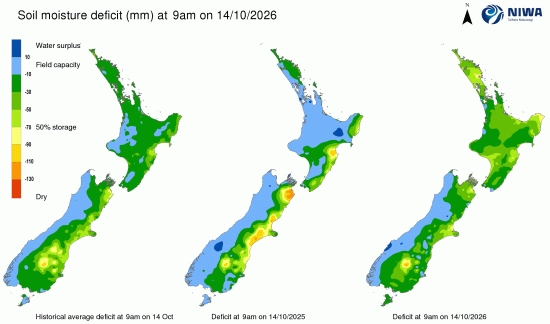
This soil moisture chart is animated here.
Keep abreast of upcoming events by following our Economic Calendar here ».
We welcome your comments below. If you are not already registered, please register to comment
Remember we welcome robust, respectful and insightful debate. We don't welcome abusive or defamatory comments and will de-register those repeatedly making such comments. Our current comment policy is here.