

Interest.co.nz ran a car insurance survey during March to dig deeper into the costs of having a vehicle.
As good as it can be to have a set of wheels that can drive you anywhere you please, the cost of car insurance can dim the joy of owning one.
Insurance premiums across the board are currently rising at a pace households are struggling to keep up with during a cost of living crisis.
Statistics New Zealand’s Consumer Price Index (CPI) data shows insurance generally up 14% in the year ended March 2024. This data is useful – but it’s also out of date.
Although official data confirms the swift increase in expenses, there’s still a lack of detailed information regarding specific types of insurance, such as car, contents, and home insurance.
In our survey, we only asked readers about prices and premiums. We were really interested in finding out which insurers were charging what, where, and how much premiums were going up.
We had 562 people participate in our survey with all responses anonymous.
Here’s some of the interesting things we found, out starting with the data.
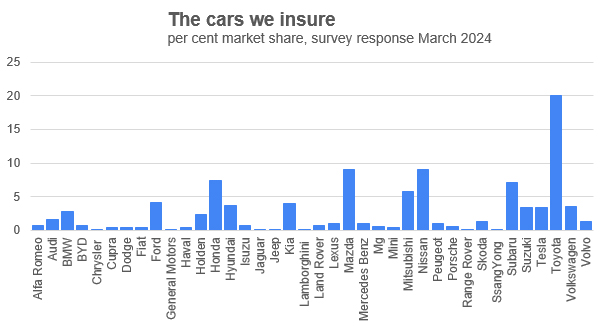
The most common car brand was a Toyota – 20.1% of survey respondents drive a Toyota. Mazda and Nissan drivers came in second equal at 9.1%.
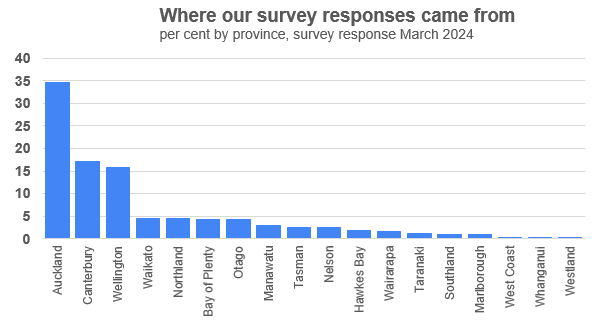
Auckland drivers made up the biggest percentage of the survey respondents – at 34.5%. Canterbury came second at 17% and Wellington third at 15.8%.
In terms of age distribution, 87% of respondents comprised drivers aged 25 and above, while the remaining 13% were under 25.
We also asked about motive power – we were curious to see what types of vehicles respondents were using. We found 66.4% of respondents were petrol vehicle users, 14.6% diesel, 10.7% pure electric vehicles (EVs) and 8.4% were driving hybrids.
Canterbury had the most diesel users – 24.4% – while Auckland had the most EV users – at 36.7% – and hybrid users – at 37.2% – which makes sense when considering the size of the city’s population.
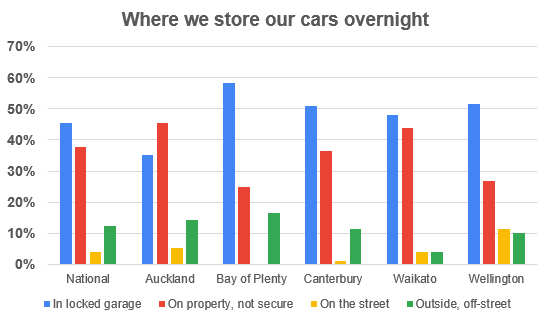
Where are people storing their vehicles? Well, 45.6% of survey respondents said they store their car in a locked garage.
Another almost 40% said they parked their cars on their property in either a carport or a parking space.
12.5% of respondents parked outside but away from the street, while the remaining 4.1% parked directly on the street.
Here’s what we learned from respondents’ comments.
People are moving to less expensive insurance cover
Due to the increasing premiums, many people mentioned they were shifting from comprehensive to third party car insurance cover.
“I am considering moving to third party only given the age of the car yet the premiums are rising - also sceptical about the agreed value being actually paid out in full if the car was written off,” one person commented.
“On fixed income, premium price increase last year created the need to reduce coverage away from comprehensive to third party, fire and theft," another individual remarked.
Some people surveyed said they were considering, or had decreased, the value of their vehicle in an effort to trim the costs of their rising premiums.
Others had gone down another route and upped the cost of their excess in an effort to bring the premium increase down to a more manageable cost.
“Previous increases were mitigated by an increase in excess from $500 to $1000, but this year no change to excess and the premium increased 22.6%,” one person said.
“My premium would have been $100 more if I hadn’t changed excess from $400 to $500,” another said.
A few people noted that the value of their car was decreasing but their premiums were increasing “substantially.”
Call for mandatory insurance
“Third party car insurance should be compulsory and the lack of this insurance should be punishable. No motor vehicle should be allowed to be used without this insurance,” a survey respondent said.
“Got to have it. Should be compulsory - no insurance, no reg. Even if only 3rd party,” another added.
New Zealand has never had a mandatory insurance law around vehicle insurance. The Crown-backed Accident Compensation Corporation (ACC) which began operating in 1978, is the country’s only nationalised insurance scheme and covers anyone who is injured in an accident.
ACC covers motor vehicle injuries which the Crown entity funds via its motor vehicle levy which charges drivers through their car registrations and at the petrol pump.
Satisfaction v dissatisfaction
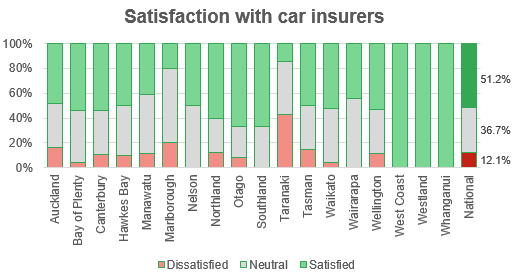
In our survey, we asked people to rate their satisfaction with their insurance provider from a scale that ranged from very satisfied to very dissatisfied.
Despite the strong commentary in some of the survey responses, satisfaction levels were pretty high.
Almost 16% said they were “very satisfied” and another 35.4% described themselves as “satisfied”. “Neutral” came in at 36.7%, “dissatisfied came in at 7.3% and “very dissatisfied” came in at 4.8%.
The cost of loyalty
Many people commented that there was no acknowledgement of loyalty to customers in the insurance market and it pays to shop around for the best deal – if you can find it.
“There’s generally no discount the longer you stay insured. Looking around for new prices doesn’t always work,” said another.
“You need to shop around or the insurance company will see you as a captive market,” one person surveyed said.
“Like most things there is a ‘loyalty penalty’,” another person said, adding that they'd saved $400 by moving to another insurance provider.
Premiums are rising – but the pace they’re rising has a wide range
The vast majority of those surveyed said their car insurance premiums have risen dramatically in the last year.
This isn’t surprising as insurers have been trying to recover from the damage the Auckland floods and Cyclone Gabrielle did to their books and hiking their premiums.
The news of these increases weren’t a surprise but the size of a lot of them was. It appears to be working if the recent financial results/the gross written premium growth (GWP) from IAG New Zealand and Suncorp New Zealand are anything to go by.
The majority of people who took the interest.co.nz survey reported a 20% to 30% car insurance increase. Some reported their premium increases climbing as high as 40% to 50% more than a year earlier.
“The 24.5% increase in premiums this year was on the top of a 14.7% increase last year. Our premiums are now 8% the value of the vehicle,” one person wrote.
“Has gotten too expensive for comprehensive insurance, massive premium hike of 30%+,” a person said.
“Necessary evil,” wrote another.
“In 2022 my car insurance was $852 and now it's almost double, has been increasing at 50%p/a. This is for a car that's worth $5,000 - $7,000,” another person said.
We’re digging into more detail around the rise in premiums we found in our survey with further articles to follow.
Thanks to all those who participated in our survey.
*This article was first published in our email for paying subscribers. See here for more details and how to subscribe.
We welcome your comments below. If you are not already registered, please register to comment
Remember we welcome robust, respectful and insightful debate. We don't welcome abusive or defamatory comments and will de-register those repeatedly making such comments. Our current comment policy is here.