
Here's my blogroll for the week. Have a good weekend all. A few games for you at the bottom if it's a rainy affair.
From the right
The way Labour's heading at the moment (tax the rich more, give the poor more - higher minimum wage), you could imagine something might be on the cards - say, tax gains on certain types of capital that are over X amount of dollars. 'The rich shouldn't be allowed to get away with all these untaxed capital gains' etc etc.
Labour are thought to be considering proposing a capital gains tax. If they do, and win the election, I predict great times for the tax industry as lawyers and accountants prosper.
I do believe a land tax has some merit, so long as it is not about increasing the overall level of taxation.
I had a good conversation with someone yesterday on Labour's minimum wage promise. All it is, this person said, was not a policy to win an election with, but rather a bribe or carrot to voters so that Labour didn't lose the election by so much, or lose voters to the Greens (who seem to be doing ok striking deals with National).
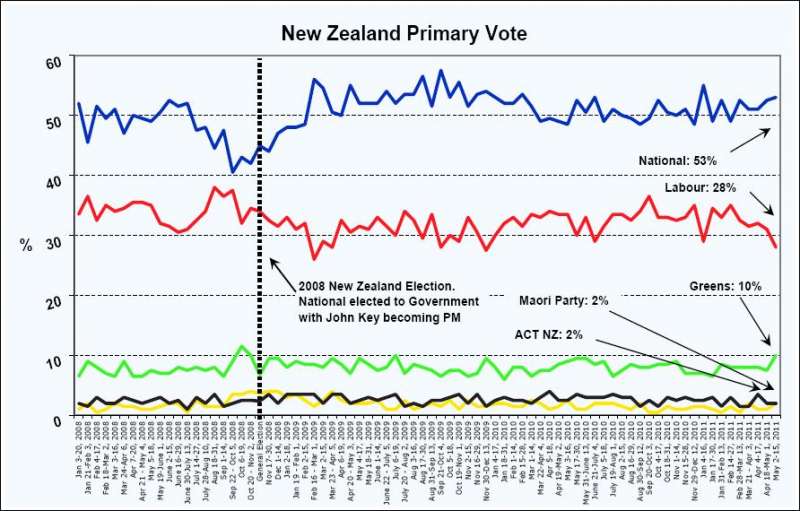
That could be applied to this ETS talk too. Labour do not want to lose votes to the Greens, who jumped in the latest Roy Morgan poll (before the budget) to 10%.
Labour’s tax-churn welfare for working people helped to disguise the parlous state of the economy from 2005.
They had raised taxes, increased the costs of employing people by adding a fourth week’s holiday and introduced other employer-unfriendly policies which at best did nothing to increase productivity and at worst hampered it.
Their tax and spend policies fuelled inflation and unsustainable consumption disguising the fact we were in recession.
Turning this around won’t be achieved by increasing the price of labour. The solution will come from policies which reduce costs and encourage sustainable growth.
3. Ha. See, having 30% lower wages than Australia can help. Adolf Fiinkensein at No Minister is positively gloating at news Heinz is shifting about 300 jobs from Australia to New Zealand because...guess what...well, one of the reasons is the cost of labour.
Remember when a few months ago Bill English was lambasted by Goff for suggesting Australian jobs might migrate to NZ?
What's the betting you don't see mention of this excellent news in your Antique Media?
And this from ABC News in Australia:
International food giant Heinz has announced the loss of 344 jobs across three factories in Australia as part of a company restructure.
The company announced it will shift its production of sauces, beetroot and other products to its facilities in New Zealand.
Mr Stefford says economic factors have forced Heinz to move its productions to New Zealand.
"The weight of the economics of the factory over what the costs are," he said.
"Also obviously the drought and then the floods... and the issues there and basically from a size and a capacity point of view that the company can do it better in New Zealand."
He says Heinz owns two other factories in Victoria and hopes the Girgarre workers will be relocated.
Heinz Australia's supply chain director, Mike Robinson, says the change is the result of a global productivity review, and is not a result of the strong Australian dollar.
"There is pressure on suppliers from customers and consumers. But there are a number of factors," he said.
"The cost of raw materials, labour, energy. All of these have pressure on suppliers which mean that we have to maintain competitiveness."
4. Kicking the bottom rungs out of the ladder. Libertarian Peter Cresswell takes aim at Phil Goff's minimum wage promise, saying there shouldn't even be a government legislated minimum wage. Labour don't want to lose votes to the Greens. They also don't want to lose votes to the Mana Party, who Unite Union head Matt McCarten is involved with.
Phil Goff has gone where common sense has feared to tread. Desperate for the attention of anyone, even Matt McCarten’s union, he told Labour delegates over the weekend that if he somehow found his way into Premier House in November, the first thing he would be doing is to price unskilled labour out of the employment market.
Which is exactly what raising the minimum wage to $15/hour would do. In fact, that’s what having a government-imposed minimum wage does. It sets a floor below which freely-agreed wage rates between employer and employee are made illegal, and would-be marginal employees are instead made depressingly unemployed.
It’s like kicking out the bottom rungs of the employment ladder, and telling the unemployed you’re doing it for their own good.
From the left
5. Treasury move to give happiness advice one of the best news stories ever. Greens MP Kennedy Graham says Treasury's decision to include stuff other than numbers and growth in policy advice is a great parting gift from Treasury boss John Whitehead.
This is one of the best news stories in my living memory. Why? Simply put, the way we define and measure progress goes to the very core of how we run our economy. Our singular focus on growing GDP has concealed the related decline in other measures of our prosperity, like the rapidly declining quality of water in our rivers and lakes, or the record growth in inequality within New Zealand. If we change the measure, we’re likely to change the outcome.
The draft Treasury paper, Working Towards Higher Living Standards for New Zealanders, is a good start and, if adopted, will help the Government make far better, longer-term policy decisions. However, the indicators they’ve initially chosen reflect the philosophical bias of Treasury towards traditional economic indicators of prosperity. The report is light on environmental measures; only four of the 46 indicators have anything to do with the environment. And, until the indicators are made mandatory, they won’t enjoy the status that GDP, inflation, and unemployment figures currently enjoy.

Remember when John Key was promising that he would seek a mandate from the people at the election before starting to sell public assets and cutting Kiwisaver. It was only a week ago. And he’s breaking his promises already: the Kiwisaver cuts actually kick in on July 1, and the privatisation process is underway.
The law that National slammed through Parliament last week making the Kiwisaver changes law means that your tax credits from this July will only be paid at half the old rate. National claims its OK because we won’t actually get the diminished payments until next July, after the election.
What rubbish. You see, your Kiwisaver member tax credits are accumulated throughout the year when you make contributions, but only paid out after the end of each financial year in July. It is this year’s tax credits you’re losing, even if it won’t be paid until next year. Your Kiwisaver has been cut without mandate.
In his barn-storming, even cocky, address to the House yesterday, John Key let slip what this budget was really all about - twice. Was it growing the economy? No, that's not the work of conservative governments. Was it saving jobs? Nope, that was last year's message. Was it savings, as he had promised it would be in his address to parliament in February? Not that either, as it turned out, as total national debt will hardly be touched by this strategy.
No, the PM never spoke a truer word when he said, "Phil Goff might not like it, but Stanard and Poor's does". Much of this budget was written to satisfy the credit ratings agencies.
And the second revelation. When Key ended by looking across at Goff, saying, "see you on the campaign trail". Because the other purpose of this budget was to satisfy voters just enough to ensure a second term.
So for me, the S&P headline sums it up. Bill English's third budget utterly political and just as utterly focused on keeping the feathers of the foreign money lenders unruffled. It is a Budget for the short-term.
8. KiwiSaver less skewed toward the rich? Keith Ng says there was nothing much in the budget.
This $1.2b isn’t all it’s cracked up to be. It’s coming out of money the government was pumping into private KiwiSaver accounts. This means less government debt, but it also means less money available for investment, and in the long-term it means people will have less saved. This isn’t a net negative, it’s just a net zero – nothing’s really changed.
But there is a distributional impact: The employers’ tax credit when mainly to high income earners. They made more money, so saved more, so their employers also contributed more and got more tax credits for it. So by cutting the employers’ tax credit, they’ve made KiwiSaver less skewed towards the rich.
That is all.
Good fun
We welcome your comments below. If you are not already registered, please register to comment
Remember we welcome robust, respectful and insightful debate. We don't welcome abusive or defamatory comments and will de-register those repeatedly making such comments. Our current comment policy is here.