
Treasury has outlined the economic impacts of seven possible government responses to COVID-19.
Its findings appear to make the case for more government support, in addition to the $20 billion already announced (for wage subsidies, benefit increases, tax changes, taxpayer-underwritten business loans, etc), as they show the extent to which this support would cushion the economic blow.
Only two of the scenarios model the economic impacts with this cushion.
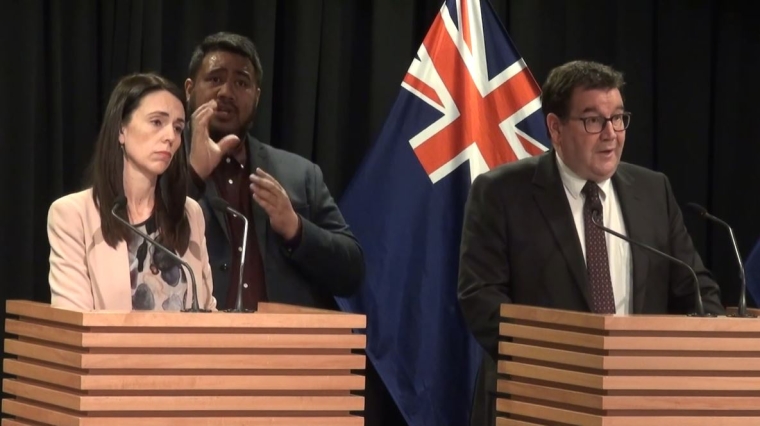
We will look at these scenarios first, as they are the most likely. Finance Minister Grant Robertson on Tuesday said: "Work on further significant Government investment to protect jobs, support cashflow, and prepare the economy for recovery is well advanced. The next steps in the Government’s plan to support businesses will be released later this week."
Furthermore, before entering lockdown, a law was passed enabling the Government to borrow up to $52 billion before the end of June for the COVID-19 response.
Scenario 1a: Shorter lockdown, less govt support
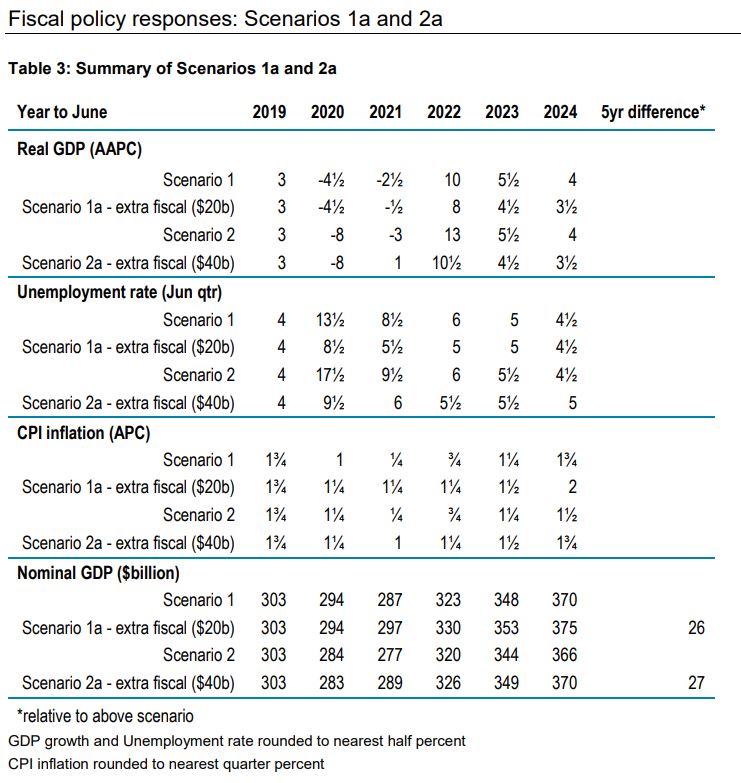
Under Treasury’s most optimistic “Scenario 1a”, New Zealand is at Alert Level 4 for a month, Level 3 for a month and Level 1 or 2 for 10 months. Borders remain closed to foreign visitors for up to 12 months. The Government injects another $20 billion into the economy (on top of the $20 billion already committed).
In this case, real gross domestic product (GDP) contracts by -4.5% in the year to June 2020 and -0.5% in 2021, before growing by 8% in 2022.
In nominal terms, GDP gets close to 2019 levels in 2021, and surpasses 2019 levels in 2022.
The unemployment rate increases from 4% to 8.5% in the June 2020 quarter and 5.5% in 2021. It falls back down to 4.5% in 2024.
Consumer Price Index (CPI) inflation falls from 1.9% to 1.25% in the year to June, before reaching 2% - the midpoint of the Reserve Bank's target range - in 2024.
Scenario 2a: Longer lockdown, more govt support
Under Treasury’s more pessimistic “Scenario 2a”, the country is at Level 4 for three months and Level 1 or 2 for nine months; the assumption being we dip in and out of Level 4.
In this scenario, Treasury assumes the Government provides much more support - an additional $40 billion (on top of the $20 billion already announced).
GDP contracts by -8% in the year to June 2020 before growing by 1% in 2021 and 10.5% in 2022.
Like the other scenario, nominal GDP gets close to 2019 levels by 2021, before surpassing this by 2022.
Unemployment climbs to 9.5% in the June 2020 quarter, 6% in 2021, 5.5% in 2022 and falls to 5% by 2024.
CPI is a bit weaker than in Scenario 1a and only lifts to 1.75% in 2024.
Comparing apples with pears
Treasury didn’t include scenarios whereby the same set of alert levels were compared to different amounts of government support. IE where only $20 billion of additional government support is applied to the more onerous alert levels of Scenario 2a, or a scenario where $40 billion of additional government support is applied to the less onerous alert levels of Scenario 1a.
More govt support vs no more govt support
Treasury did however project what would happen if no additional government support was provided.
Under a longer lockdown, the unemployment rate would skyrocket to 17.5% in the June 2020 quarter, 9.5% in 2021 and fall to 4.5% by 2024.
Here's a table comparing the two scenarios detailed in this piece that include more government support, with scenarios where there’s no additional support (“Scenario 1” and “Scenario 2”):
Treasury didn't include scenarios whereby New Zealand remained in lockdown for even longer and the Government provided more support. One of its seven scenarios considers six months at Level 4 and six months Level 3 without additional support. Yet there isn't a corresponding scenario applying additional government support to these alert levels.
Throughout its work Treasury assumed:
- Alert Level 1 reduces output by 5-10% from normal
- Alert Level 2 reduces output by 10-15% from normal
- Alert Level 3 reduces output by 25% from normal
- Alert Level 4 reduces output by 40% from normal
Secretary to the Treasury Caralee McLiesh said: "I must emphasise that these are indicative scenarios, based on assumptions and estimates subject to considerable uncertainty. They are not official Treasury forecasts or the Treasury’s view of what will happen...
"Actual outcomes will depend on a range of factors, including the success of containment measures and the economic response, both in New Zealand and internationally."
Unlikely scenarios including no more govt support
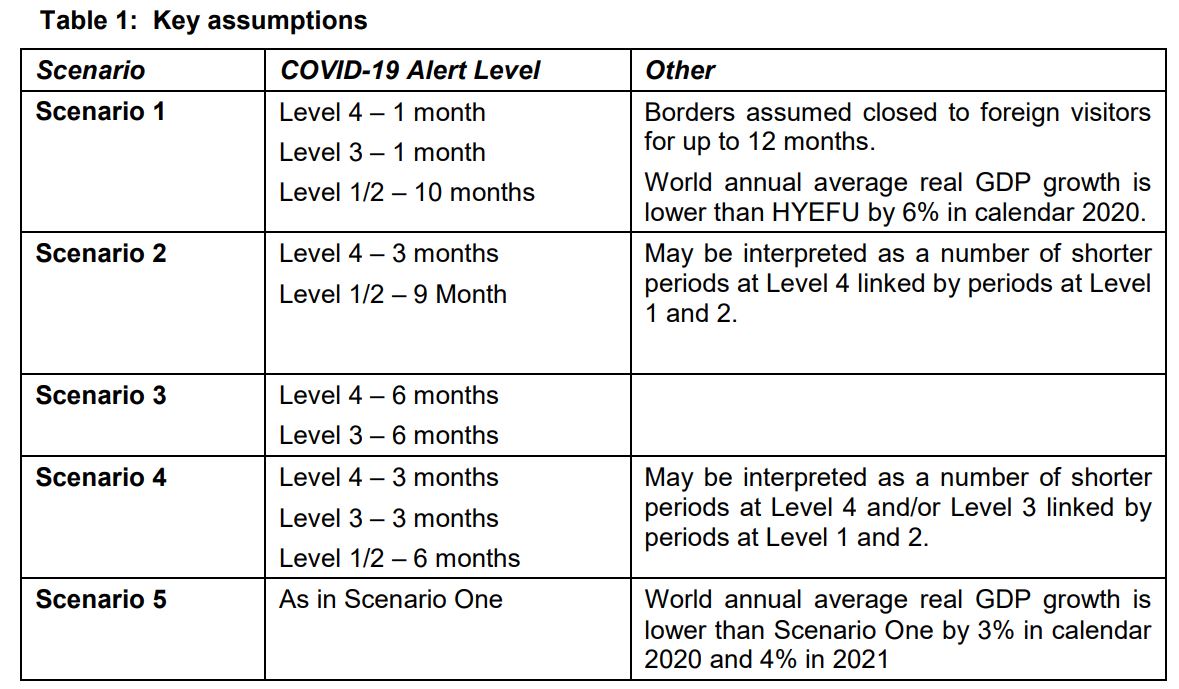
To turn to the unlikely scenarios that don't include more government support, this table summarises their assumptions:
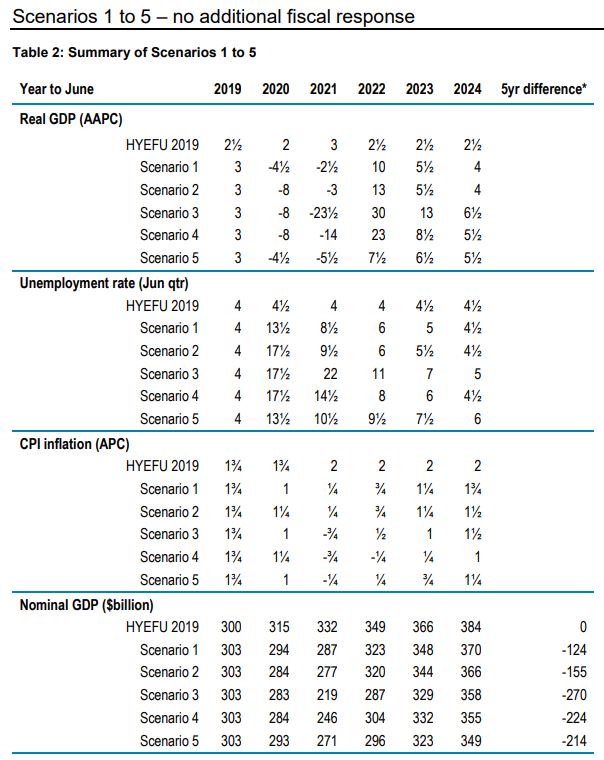
This table summarises the outcomes:
See Treasury's paper in full here.
We welcome your comments below. If you are not already registered, please register to comment
Remember we welcome robust, respectful and insightful debate. We don't welcome abusive or defamatory comments and will de-register those repeatedly making such comments. Our current comment policy is here.