

A Horizon Research poll suggests New Zealanders strongly support the Government's policy of trying to eliminate community transmission of COVID-19, and believe doing this will be better for the economy in the long run.
Horizon says its nationwide online survey was conducted between August 20 and 25 - during Auckland's current level 3 lockdown - and had 1,300 respondents aged 18 and over.
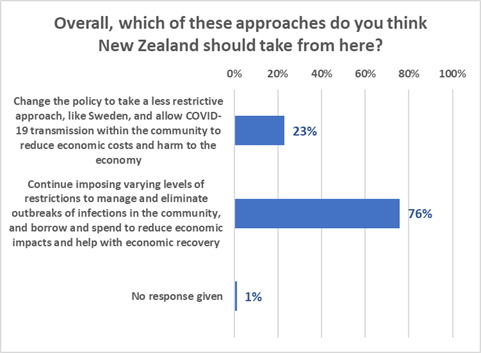
Horizon says 76% of respondents want to continue imposing varying levels of restrictions to manage and eliminate outbreaks of infections in the community, and borrow and spend to reduce economic impacts and help with economic recovery. Meanwhile, 23% of respondents would prefer the Government to take a less restrictive approach, like Sweden, and allow COVID-19 transmission within the community to reduce economic costs and harm to the economy.
"Respondents were given information about the approaches taken in Sweden and New Zealand, comparing levels of restrictions on people, economic impacts and forecasts, infection and death rates, and the cost of the elimination policy in New Zealand projected in the 2020 Budget," Horizon says.
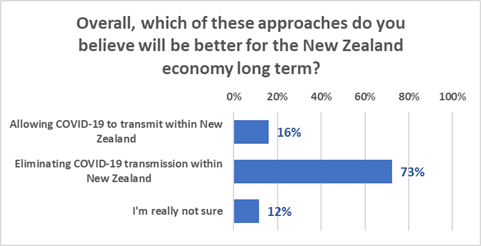
"The survey also asked overall, which approach people believed would be better for the New Zealand economy long term, and found: 16% thought allowing COVID-19 to transmit within New Zealand was best, 73% thought eliminating COVID-19 transmission within New Zealand was best, while 12% were really not sure."
Horizon says there was majority support across all age and gender groups for the current policy of imposing restrictions and borrowing and spending to reduce the economic impacts, with a majority of people currently employed in all industry sectors supporting the current policy.
"Every occupation group, including business proprietors and the self-employed, showed majority support for eliminating COVID-19 transmission in the community. A majority of those currently employed in all industry sectors support the elimination of COVID-19 community transmission. This includes 55% employed in tourism, 83% in the accommodation sector (including hotels and motels), 87% in cafes and restaurants and 76% in retail," says Horizon.
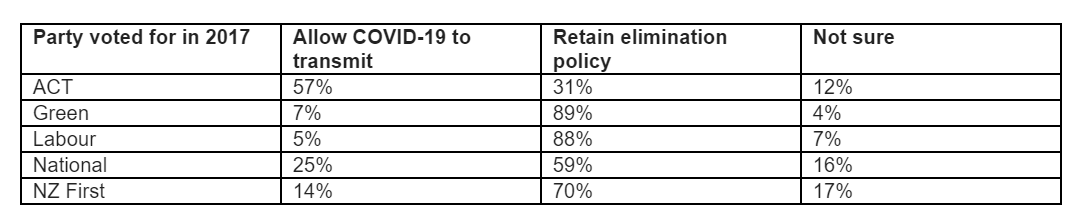
And among people who voted in the 2017 Election for parties currently in Parliament there was majority support for retaining the current policy, except among ACT voters.
Horizon says its sample is weighted on age, gender, highest qualification, personal income, employment status and party vote at the 2017 election. And at a 95% confidence level, the maximum margin of error is ± 2.7%.
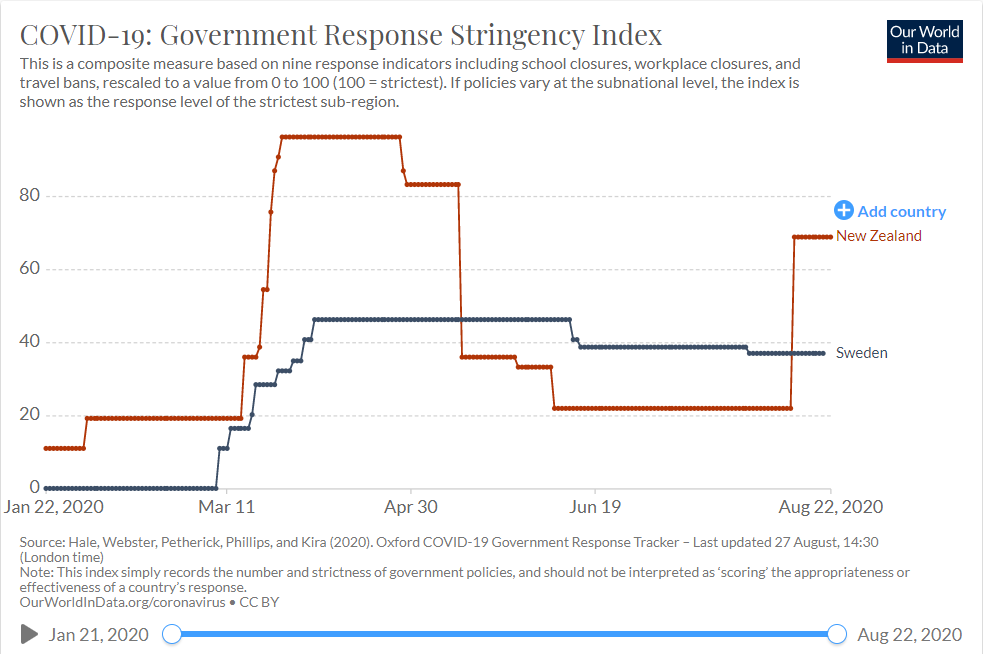
More detail on the Stringency Index below can be found here.
We welcome your comments below. If you are not already registered, please register to comment
Remember we welcome robust, respectful and insightful debate. We don't welcome abusive or defamatory comments and will de-register those repeatedly making such comments. Our current comment policy is here.