

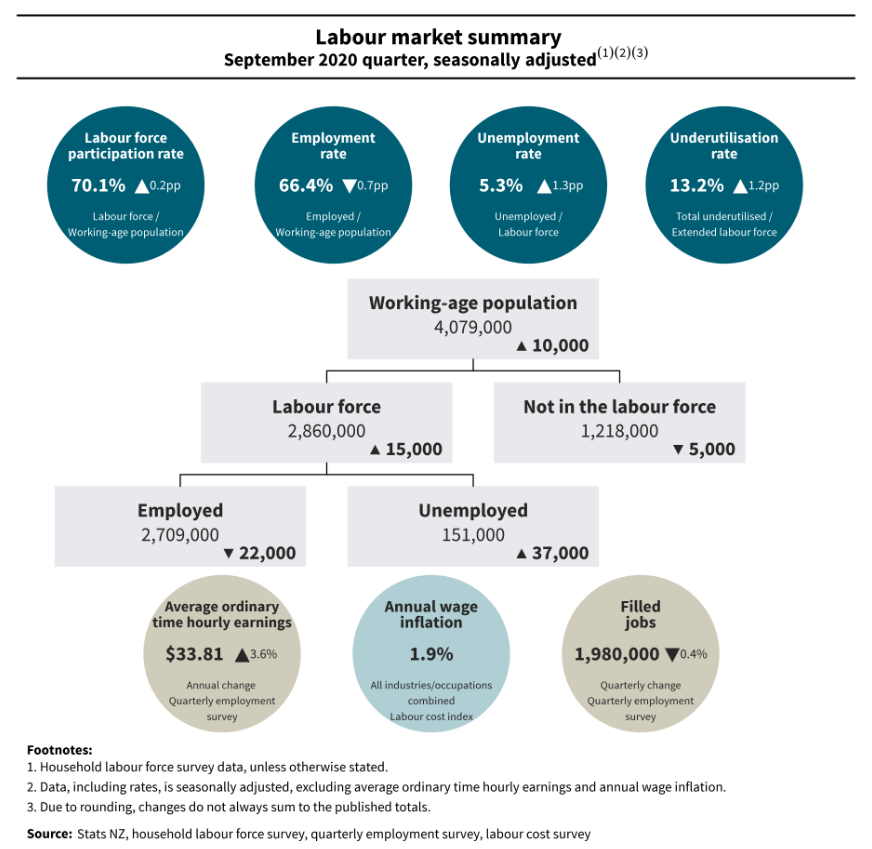
Unemployment surged in the September quarter to 5.3% from the recorded level of 4% in the June quarter, which was the biggest quarterly rise ever.
The rise in seasonally adjusted unemployed numbers - of 37,000 - to 151,000 was also a record for a quarter. Women have borne much of the brunt of the increase.
The underutilisation rate – a broader measure of spare capacity in the labour market - lifted again, to 13.2% from 12% in the previous quarter and 10.4% in March.
The increase in unemployment, while considerable, is pretty much in line with what economists were forecasting. And the 5.3% figure is much less than earlier forecasts. In the May budget Treasury had actually forecast a rate of 9.8%.
The 4% figure for June - which was actually a fall compared with March - had appeared to seriously under represent the true unemployment situation. This was due to the difficulties of Statistics New Zealand measuring the rate at a time when people were locked down. It meant that those locked down who might have lost their jobs could not be seen as actively seeking work.
Stats NZ's labour market and household statistics senior manager Sean Broughton said the latest figures demonstrated the continuing economic effects of Covid-19, and its associated border and business closure.
“151,000 is the highest number of unemployed people we have seen in eight years,” he said.
“Last quarter’s low unemployment rate of 4.0% was explained in part by people’s inability to be ‘actively seeking’ and available for work during the national lockdown that was in place for much of the quarter. This quarter’s increase in unemployment reflects a return to more normal job-hunting behaviours.”
The seasonally adjusted number of employed people fell by 22,000 this quarter. This is the third largest quarterly fall seen in employment since the series began in 1986.
Women more affected
The number of employed women fell 14,000 to 1,266,000, while the number of employed men fell 8,000 to 1,444,000. The employment rate for women was 61.2% and 71.8% for men. These figures again showed that female jobs are being more affected by Covid than male jobs.
Stats NZ said that according to the unadjusted employment figures, there was a 44,700 person decrease in employment between the March and September 2020 quarters, 24,200 of whom were women.
"Of this unadjusted decrease in employed women, 19,700 came from tourism-characteristic industries, such as accommodation, passenger transport, travel agencies, sightseeing operators, and cafés and restaurants. While these are seasonal industries, the size of this fall is unusual and is likely related to additional Covid-19-19-related factors," Stats NZ said.
Stats NZ gave the following highlights for the September 2020 quarter:
- There were 37,000 more unemployed people, an increase of 32.5% since the June 2020 quarter.
- Applications for the eight-week Wage Subsidy Extension were open until 1 September 2020 and until 3 September 2020 for the two-week Resurgence Wage subsidy.
- There were 22,000 fewer employed people this quarter than in the June 2020 quarter.
- The underutilisation rate rose to 13.2%.
- Hours worked nearly bounced back from record falls during lockdown.
This 37,000 rise is the largest quarterly rise in unemployment since the series began in 1986. The next largest rise in a single quarter was recorded in the June 2009 quarter during the global financial crisis, when the number of unemployed people rose by 18,000.
'More stimulus required'
Kiwibank economists said policymakers would view the latest unemployment report for what it is - "confirmation we're in a recession. More stimulus is required."
They highlight the fact that most of the job losses were women.
"Women are bearing the brunt of the burden, as there are more women in the hardest hit tourism industries. And what’s more worrying is the growing number of women leaving the workforce. The number of Maori women employed in tourism sectors fell a whopping 20% in the quarter."
The economists also noted the rise in underutilisation rate to 13.2% from 12% in the previous quarter and 10.4% in March.
"Slack is building in the labour market, and wages are softening. Wage growth eased to 1.6% from 2.4% at the start of the year. The outlook is soft, given the slack developing in the labour market."
We welcome your comments below. If you are not already registered, please register to comment
Remember we welcome robust, respectful and insightful debate. We don't welcome abusive or defamatory comments and will de-register those repeatedly making such comments. Our current comment policy is here.