
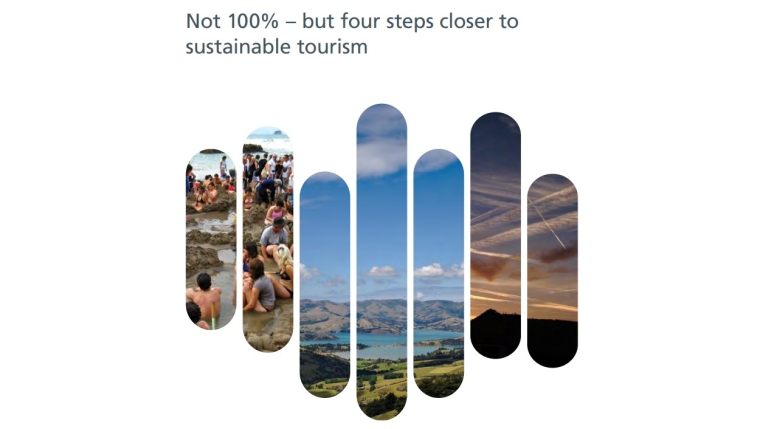
Simon Upton, the Parliamentary Commissioner for the Environment, is calling for the introduction of four policies to tackle the impact of tourism on the New Zealand environment.
In a new report Upton says the Government should take advantage of the COVID-19 induced pause in international tourism to change the sector into one with a significantly smaller environmental footprint.
Upton's four policy proposals include: Introduce a departure tax that reflects the environmental cost of flying internationally from NZ; Make any future central government funding for tourism infrastructure conditional on environmental criteria; Clarify and, where necessary, strengthen the tools the Department of Conservation can use to address the loss of wildness and natural quiet at some of NZ's most spectacular natural attractions. And; Strengthen the existing standard for self-contained freedom camping.
"Tourism is marketed as environmentally benign but it’s not. Greenhouse gas emissions from tourists flying to and from New Zealand, a loss of wildness and natural quiet in popular parts of our national parks, and pressure on wastewater networks and solid waste infrastructure in our towns and cities were increasing as millions of people visited our country every year," Upton says.
"Preventing a return to the status quo will require real changes to business models and individual tourist behaviour. To achieve this, the industry needs to set aside the language of marketing and engage instead with evidence, trade-offs and policy choices."
”These proposals are not 100% of the solution, but together, they just might make a difference,” says Upton.
In terms of the departure tax, Upton's proposing this be based on how far people travel, with different charges for short-haul flights to Australia and the Pacific, medium-haul flights to Asia and long-haul flights to the rest of the world. However, he stops short of recommending specific charges.
Upton's full report, Not 100% – but four steps closer to sustainable tourism, is here. And below is a press release issued by Upton.
Not 100% – but four steps closer to sustainable tourism
Parliamentary Commissioner for the Environment, Simon Upton, is urging the Government to take advantage of the pause in international tourism to transform the sector to one with a substantially smaller environmental footprint.
Covid-19 has brought international tourism activity to a halt, threatening the livelihoods and commercial viability of many of New Zealand’s tourism-related businesses.
But the discontinuity created by Covid-19 also offers an opportunity to address some of the long-standing environmental and social issues associated with New Zealand’s tourism industry.
“There is broad support for the idea that protecting tourism livelihoods in the short term should not morph into a slow but inexorable return to the status quo in the long term,” Mr Upton says.
The Commissioner presents a set of four policy proposals to combat some of the more pressing environmental challenges faced by tourism.
• Introduce a departure tax that reflects the environmental cost of flying internationally from New Zealand, and use the revenue to support the development of low-emissions aviation technologies and provide a source of climate finance for Pacific Island nations.
• Make any future central government funding for tourism infrastructure conditional on environmental criteria and aligned with mana whenua and the local community’s vision for tourism development.
• Clarify and, where necessary, strengthen the tools the Department of Conservation can use to address the loss of wildness and natural quiet at some of Aotearoa’s most spectacular natural attractions. This includes tightening up rules around commercial activity on conservation lands and waters.
• Strengthen the existing standard for self-contained freedom camping, improve oversight of the certifying process and require rental car agencies to play a greater role in collecting freedom camping infringement fees and fines.
”These proposals are not 100 per cent of the solution, but together, they just might make a difference,” he explains.
Any transition will require real changes to business models and individual tourist behaviour.
Tourists – and the tourism businesses that serve them – should be required to pay for the cost of the environmental services they use.
It is also essential that the wishes of communities and mana whenua are respected when decisions about new tourism developments are being considered.
“Tourism’s growth has been built on special attention and subsidies for decades.
“This has been followed by subsidies to cope with the pressures of that growth.
“It is time to consider measures that ask the industry and tourists to meet some of these costs and moderate demand for activities that deliver negative environmental outcomes.”
The Commissioner’s 2019 report Pristine, popular… imperilled? The environmental consequences of projected tourism growth found that tourism is less environmentally benign than it has often been made out to be.
Every time a tourist flies to, from or around New Zealand, we add to the stock of greenhouse gases that are driving climatic disruption.
Tourism contributes to significant claims on water and landscape modification for the extension and hardening of infrastructure to accommodate growing numbers.
There is also a loss of wildness and natural quiet that takes place when each additional tourist is introduced to iconic sites in national parks or special beaches.
“If we act now, we have the chance to transition the industry to one that is less environmentally harmful – as well as more resilient – than its predecessor.”
And here are a series of questions and answers released by Upton.
Not 100% – but four steps closer to sustainable tourism
Frequently asked questions
What is this report about?
New Zealand’s tourism industry has grown rapidly in recent decades. The Commissioner’s 2019 report, Pristine, popular... imperilled? The environmental consequences of projected tourism growth, set out how persistent tourism growth had resulted in serious environmental issues, and how forecast visitor numbers – at the time – would only make those issues worse.
This report puts forward four proposals that could make a real difference to those problems.
What are the environmental impacts of tourism?
Tourism is marketed as environmentally benign but it’s not. Greenhouse gas emissions from tourists flying to and from New Zealand, a loss of wildness and natural quiet in popular parts of our national parks, and pressure on wastewater networks and solid waste infrastructure in our towns and cities were increasing as millions of people visited our country every year.
Why make these proposals now? Hasn’t Covid-19 wreaked enough havoc on the tourism industry?
Covid-19 has brought international tourism activity to a halt, creating considerable hardship for those in the tourism industry. Many will argue that now is not the time to try and shift New Zealand’s tourism sector onto a more sustainable footing.
But there will never be a good time. While the near-term outlook for the sector is grim, international tourism will eventually return as vaccination rates increase and borders reopen. Rather than returning to business as usual, the Commissioner argues we should use this time to transition to a form of tourism that is less environmentally harmful – and more resilient – than its predecessor. International tourism should reopen on a new, more sustainable basis.
How can tourism have a lighter environmental footprint?
Preventing a return to the status quo will require real changes to business models and individual tourist behaviour. To achieve this, the industry needs to set aside the language of marketing and engage instead with evidence, trade-offs and policy choices.
Tourists – and the tourism businesses that serve them – should be required to pay for the cost of the environmental services they use and the environmental damages they impose.
Growth at all costs should not be the only driver. The wishes of communities and mana whenua should be a key input into decisions about tourism developments.
Tourism also needs to be treated the same as any other sector of the economy. In 2019 alone, the Government spent around $250 million on tourism-related initiatives, and in the wake of Covid-19, the industry received considerable financial support. Continuing to give it special attention and subsidy over the long term will only further entrench negative consequences of growth.
What does the Commissioner recommend?
• Introduce a departure tax that reflects the environmental cost of flying internationally from New Zealand, and use the revenue to support development of low-emissions aviation technologies and provide a source of climate finance for Pacific Island nations.
• Make any future central government funding for tourism infrastructure conditional on environmental criteria and aligned with mana whenua and the local community’s vision for tourism development.
• Clarify and, where necessary, strengthen the tools the Department of Conservation can use to address the loss of wildness and natural quiet at some of Aotearoa’s most spectacular natural attractions. This includes tightening up rules around commercial activity on conservation lands and waters.
• Strengthen the existing standard for self-contained freedom camping, improve oversight of the certifying process and require rental car agencies to play a greater role in collecting freedom camping infringement fees and fines.
Would a departure tax stop tourists coming to New Zealand?
The tax might result in some tourists choosing not to visit New Zealand – although any departure tax would be a tiny percentage of the cost of most trips. Beyond that, research conducted for this report indicates that New Zealand is something of a must-visit destination for many people, with demand not being overly sensitive to an increase in airfares. A climate-related tax could also enhance New Zealand’s reputation if we are seen as more sustainable than competing destinations.
What would a departure tax mean for my trip overseas? Would New Zealanders have to pay?
Yes. New Zealand tourists are no less responsible for generating aviation emissions than other international tourists. Exempting New Zealanders would reduce the effectiveness of the tax and be perceived as unfair and discriminatory towards foreigners.
The report proposes a departure tax based on how far people travel, with different charges for short- haul flights to Australia and the Pacific, medium-haul flights to Asia and long-haul flights to the rest of the world. The Commissioner is not recommending a specific charge but notes that the United Kingdom has a departure tax set at the equivalent of NZ$25 for short-haul trips and NZ$155 for long- haul trips.
Should central government continue funding tourism infrastructure?
The Government has provided significant funding for tourism infrastructure, often in the form of contestable funds such as the $100 million Tourism Infrastructure Fund. It is the Government’s prerogative on whether this should continue – no judgement has been made in this report.
But in any future involving increased tourism demand, building more infrastructure offers little more than a stopgap solution to place-based tourism pressures. Infrastructure itself has an environmental footprint – this is evident in the landscape change surrounding places like Queenstown and Wānaka.
Is building a new toilet block or car park even what communities want?
Government subsidies for the construction of toilets, wastewater networks, rubbish bins and car parks have helped relieve some of the tourism-based pressures in local areas. But better facilities encourage more tourists and building somewhere new simply shifts the environmental burden elsewhere.
More tourists aren’t always what communities want. The report found that in places like Akaroa, some locals benefit from tourism but others have had little say and feel imposed on. This is backed up by the 2020 Mood of the Nation survey that found that 42 per cent of New Zealanders think tourism puts too much pressure on New Zealand.
If the Government continues to fund tourism infrastructure, it should ensure that the infrastructure aligns with mana whenua and the community’s vision for tourism development – as set out in a local destination management plan. The infrastructure should also meet high environmental performance standards.
Are New Zealand’s wild areas becoming overcrowded by tourists?
No, not everywhere. But by 2019, thousands of people were visiting treasured places like Tongariro Alpine Crossing and Milford Sound each day during peak periods. It had become difficult to visit a number of Aotearoa’s premier natural attractions without encountering throngs of other visitors, noise from planes and helicopters, or the visual effects of cruise ships, buses and cars. The Department of Conservation’s management plans envisage limits but they have no way of enforcing them.
How can we protect the sense of wildness and natural quiet that people come to see?
In conservation lands and waters, the Department of Conservation has focused largely on accommodating visitor growth, either by increasing the carrying capacity of existing destinations or creating new destinations. The Commissioner believes the focus needs to shift to demand management to prevent the loss of wildness and natural quiet that occurs in places like Milford Sound spreading elsewhere.
For commercial activities, the Commissioner recommends imposing stricter environmental conditions on concessions, such as limiting noise and visual pollution from helicopter flights or restricting activities to certain times or days.
For visitor access to a small number of choke points, tools to restrict visitor numbers such as first-in first-served limits, reservations or access charges should be explored.
Wouldn’t access charges mean Kiwis have to pay to access their birthright?
Access charges are only one option. Simply limiting numbers is another. The Commissioner suggests that tools like these are only used to reduce strain at a handful of sites where visitor numbers approach undesirable levels. It’s not a blanket proposal across the entire conservation estate, or even for all times of the year.
If charges were considered, domestic and international visitors could be treated differently. Special consideration would have to be given to local iwi. Asking Māori to pay for access to lands that they have an ancestral connection to would arguably be inconsistent with the principles of the Treaty of Waitangi.
The Commissioner believes we shouldn’t be afraid to debate limits or charges. Rejecting any limits on numbers will simply see problems worsen.
Aren’t freedom campers the ones causing all the trouble? Why do we need more regulation?
Self-contained vehicles like your standard campervan have onboard toilets and wastewater facilities so can camp in a wide range of locations. Cars or vans without toilets or plumbing are usually restricted to camping only in areas with toilets. But many vehicles that barely meet the standards are getting certified as self-contained – like cars that have folding toilets that are unlikely to actually be used.
The Commissioner recommends strengthening the New Zealand Standard for self-containment of motor caravans and caravans to ensure that toilets are permanently plumbed, with separate holding tanks for grey and black water. The Commissioner also recommends making a government department or other national-level organisation responsible for these standards to guarantee consistency in certification, and creating an online database of compliant vehicles.
Who will these freedom camping proposals affect?
The main impact will fall on tourists who currently use small vans or people movers to camp in. Under a strengthened standard for self-containment, it may well be difficult for such vehicles to gain certification. That would leave those tourists facing a choice between staying at the smaller number of places reserved for non-self-contained vehicles, spending more money on a vehicle that could achieve the standard or using paid accommodation and camping grounds.
On the commercial side, the rental firms most likely to be affected would be those that specialise in budget ‘self-contained’ vans and people movers.
These recommendations put the onus back on those camping – if you want to camp, then you need to make sure you aren’t having a negative impact on your environment. Be a tidy Kiwi.
We welcome your comments below. If you are not already registered, please register to comment
Remember we welcome robust, respectful and insightful debate. We don't welcome abusive or defamatory comments and will de-register those repeatedly making such comments. Our current comment policy is here.