
By Alex Tarrant
The government's core tax revenue was NZ$1.1 billion or 8.2% lower than expected in the three months to September, indicating the economy is recovering more slowly from the recession than expected, Treasury said today when releasing the government's financial accounts.
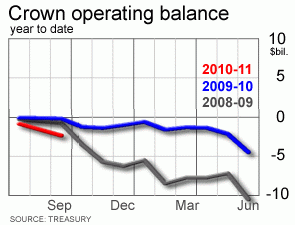
Coupled with unforeseen costs of around NZ$1.5 billion from the Canterbury earthquake in early September, the government ran an operating balance before gains and losses (OBEGAL) of a deficit of NZ$3.7 billion. This was NZ$2.2 billion higher than the NZ$1.5 billion deficit forecast in the May 2010 budget, Treasury said.
Meanwhile, Treasury did not include a provision for losses under the extended deposit guarantee scheme, which covers seven institutions with total deposits of NZ$2.3 billion.
'Due to more savings' - English
Finance Minister Bill English said the lower tax take was due to lower than expected consumer spending as New Zealanders paid down debt and saved more.
“New Zealanders understand our need to rebalance the economy away from debt and spending towards savings and investment," English said.
“While in the short term this increased saving means slightly lower growth and tax revenue, it is what the economy needs over the long term as we build our future on savings, productive investment and exports," he said.
English said that, in many ways, restraint in the public sector was only just starting.
"We still have a significant medium term challenge to get back into surplus as soon as possible. That is why the Government is committed to spending restraint for the foreseeable future," he said.
Tax take down
Core crown tax revenue of NZ$12.5 billion was down 8.2% from budget forecasts due to lower than expected GST revenue, and lower corporate tax revenues.
"GST revenue was NZ$0.6 billion (15.8%) lower than forecast, mainly due to a smaller than expected boost in consumer spending before October’s GST rate rise," it said in the accounts.
"It is possible that there will be some recovery in the December quarter, given that consumption was not brought forward into the September quarter as much as expected. Evidence suggests that spending in the September quarter continued to be subdued generally."
Treasury said corporate tax revenue was NZ$0.5 billion (22.4%) lower than forecast mostly due to lower than expected provisional tax assessments.
"This suggests that while corporate profits were higher than they were at the same time last year, they were still lower than anticipated."
Crown debt higher than expected
Treasury said gross crown debt was NZ$2.5 billion higher than anticipated, at NZ$59.1 billion.
"However, NZ$1.4 billion of this variance was due to a liability in relation to the Deposit Guarantee Scheme that was subsequently extinguished in October, without impacting net debt."
"Lower than forecast tax receipts contributed to net debt being NZ$0.9 billion higher than expected at NZ$33.8 billion."
Canterbury Earthquake
Treasury said Crown operating expenses included costs associated with the Canterbury earthquake, with the Earthquake Commission (EQC) recording an estimated net cost of NZ$1.5 billion for settling claims for damage arising from the earthquake.
“While the total cost incurred by EQC are likely to exceed this figure, EQC has reinsurance cover for costs above NZ$1.5 billion,” Treasury said.
However, Treasury said the government was committed, in addition, to reimburse a proportion of the restoration costs relating to critical local government infrastructure and certain other costs.
“These costs have not been included in the financial statements at this stage, as reliable estimates of the amounts concerned have not yet been established.”
PM Key doesn't think figures are that different from Budget forecast
Prime Minister John Key later said that at the end of the day New Zealand's economy was still on track for recovery, despite the figures. He did not think the numbers were significantly different from the May Budget forecasts, he said.
"It’s a NZ$180 billion economy - overall revenue from the Crown is in the order of NZ$63 billion or something form memory, the rest we borrow, so it’s not huge," Key said at his post cabinet press conference on Monday afternoon.
"These numbers always move around quite a lot," he said.
"It’s a complex issue, it’s one step at a time, and while it’s a difficult time for New Zealanders, I think we can rest assured that we’re doing a lot better than a lot of other countries, having grown more in the last nine months than in the last four years."
Key said the fall in corporate tax largely reflected business losses from the last year, do to the way the business tax cycle worked.
Will the recovery be slower like Treasury says?
"It depends," Key said.
"The IMF upgraded our growth numbers the other day, so it sort of depends on what number you want to choose.
"In broad terms I don’t think it was a million miles away from what their [Treasury's] prediction was in the budget documents.
Recovery not stalling
Key said there was no indication the recovery was stalling, unlike what the Labour Party had said.
"We saw unemployment falling from 6.9% to 6.4% when it was released last week. Participation rates were higher, we’ve seen business confidence numbers start to regroup," he said.
"What is true is that internationally it’s been slower than anyone predicted – you’ve seen a number of countries going through quite significant austerity packages, not just Greece, but obviously the United Kingdom.
"As we’ve seen in the United States of America, it’s been very stubborn in terms of unemployment numbers sitting at 9.6%. So I think it’s a difficult international environment, but relative to other countries, New Zealand is doing pretty well."
Business confidence
"If you look at the default rates in business, they’re running about a quarter of what they were in 1991 and 92, so in that regard we’re not doing too badly," Key said.
"In terms of confidence numbers, they always are about a prediction of what you think is going to happen in the next six months – they’re quite subjective, so not always the greatest of indicators, but they’re starting to come up a little bit," he said.
Here are Bill English's comments:
The Government remains committed to sound management of its finances and ongoing spending restraint as the economy continues to recover from recession, Finance Minister Bill English says.
Lower than forecast tax revenue alongside the fiscal impact of the Canterbury earthquake contributed to a larger than expected operating deficit before gains and losses of $3.7 billion in the three months to September 30.
"The $1.1 billion lower than forecast tax take is largely the result of lower than expected consumer spending as New Zealanders pay down debt and save more," Mr English says.
"Although the Treasury expects some of the lower tax take to reverse in coming months, it reinforces the need for ongoing fiscal discipline. We've made good progress on getting Government spending growth under control, but this must continue.
"In the past two years we've reprioritised about $4 billion of lower quality spending into more worthwhile inititatives and we've promised to cap future new Budget spending at $1.1 billion.
"However in many ways restraint in the public sector is only just starting. We still have a significant medium term challenge to get back into surplus as soon as possible. That is why the Government is committed to spending restraint for the foreseeable future.
Mr English says the trend away from consumer spending to increased saving contributed to the lower than forecast tax revenue.
“New Zealanders understand our need to rebalance the economy away from debt and spending towards savings and investment.
“While in the short term this increased saving means slightly lower growth and tax revenue, it is what the economy needs over the long term as we build our future on savings, productive investment and exports," Mr English says.
(Updates with PM Key's comments, more on earthquake, English comments.)
We welcome your comments below. If you are not already registered, please register to comment
Remember we welcome robust, respectful and insightful debate. We don't welcome abusive or defamatory comments and will de-register those repeatedly making such comments. Our current comment policy is here.