
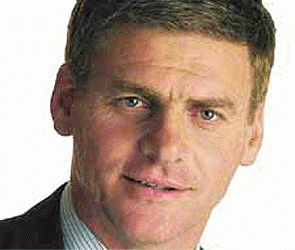
Finance Minister Bill English has poured more cold water on the prospects for recovery, saying the Canterbury earthquake, a lower than expected global outlook and a faster than expected adjustment by households away from consumption, will flow through into a lower growth forecast for the year to March 2011.
The government would therefore have to run higher than forecast budget deficits in the short-term, English said. The government is currently forecasting a NZ$13.3 billion cash deficit for the current financial year.
"Since 2008 the progress we've made has had a positive impact on the Government's books," English said in speech to Cullen Law this morning.
"However the weaker than expected global outlook and our faster than expected adjustment away from consumption is likely to flow into the next set of Treasury forecasts in the Half Year Economic and Fiscal Update on December 14," he said
"We've already seen tax revenue below expectations in the first three months of the financial year as people choose to save more. Slightly lower than forecast growth plus the effect of the Canterbury earthquake has flowed into slightly higher debt."
That was being partly offset by export growth, but it was likely those factors would flow into a lower growth forecast for the year to March 2011, before a rebound in the year to March 2012, English said.
Combined with the fiscal impacts of the Canterbury earthquake, this would mean higher forecast deficits in the short term, before improvements showed through, he said.
"As I've said, the Government cannot run large deficits indefinitely. That is why we are taking steps to contain debt accumulation, keep finance costs down, and make sure we are ready for the next shock," English said.
"We are committed to getting back to surplus by 2016. We still have a significant medium term challenge to achieve that, so in many ways restraint in the public sector has only just started," he said.
PSA to cost Govt NZ$25 million, industry NZ$25 million and growers NZ$25 million
Meanwhile later in the morning, Biosecurity Minister David Carter said the Government would provide NZ$25 million to help tackle the Psa kiwifruit disease subject to a dollar-for-dollar match from the kiwifruit industry, making it a NZ$50 million package. Carter said he was confident the industry would commit to its side of the deal, and that the industry was happy with the package.
The government's NZ$25 million would come from a contingency fund, which would be substantially reduced by this action, Carter said. He expected a considerable amount of this to be used in "the next month or two". He ruled out any further government contributions for the Psa issue.
On top of the NZ$50 million, Carter said he expected Kiwifruit growers themselves to have to absorb further costs of around NZ$25 million in lost earnings over the next two or three years, bringing total costs to around NZ$75 million.
Here is the release from English's office:
A sustainable economic recovery is underway and will pick up momentum next year as the Government continues to roll out its economic plan, Finance Minister Bill English says.
"The economy is growing, unemployment is dropping and our exports are increasing. About 40,000 more people are in jobs than this time last year," Mr English said in a speech to a Cullen Employment Law Firm breakfast.
"And all of this is happening as we rebalance our economy on to a more sustainable footing - away from borrowing and consumption, towards saving, investment and exports.
"This trend towards increased household saving creates a strong platform for faster economic growth in the medium and longer term. That is the only way we can create the jobs, higher incomes and the better living standards Kiwis deserve.
"However it means the recovery will not be driven by sectors like retail and housing, leading to a flatter domestic economy in the short term.
"That trend, alongside a weaker global outlook, is likely to flow into a lower growth forecast for the year to March 2011 in the Half Year Economic and Fiscal Update next month, before a rebound in the following year.
"Combined with the fiscal impacts of the Canterbury earthquake, it will mean slightly higher deficits in the short term before improvements show through.
"This reinforces the need for sensible financial management and ongoing discipline in Government spending if we are to get back to surplus by 2016. We still have a significant medium term challenge to achieve that.
"Over the past two years, we've moved nearly $4 billion of spending into frontline public services such as health, education and law and order, and all major departments will face significant change over the next four years, as we lift productivity growth in the public sector."
Mr English said the Government's first Investment Statement, which will be published with the half-year update, would help ensure discipline was applied equally to the Government's operating and capital spending.
"The Crown is the largest single investor in a capital constrained economy. It is therefore vital that the Crown invests its capital efficiently.
"The Investment Statement will clearly set out the Crown's assets and liabilities, identify emerging issues and state how the Government plans to manage its large and growing investment in taxpayers' assets.
"We believe this level of transparent information – in a regular publication - will allow the public to demand a much greater level of accountability from the Government and lead to significantly better decision-making across the public sector," Mr English said.
(Updates with more comments from speech, release & more on David Carter on Psa).
We welcome your comments below. If you are not already registered, please register to comment
Remember we welcome robust, respectful and insightful debate. We don't welcome abusive or defamatory comments and will de-register those repeatedly making such comments. Our current comment policy is here.