
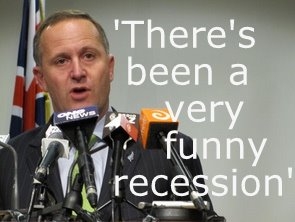
Prime Minister John Key says he thinks Budget 2011 moves next year by the government will indicate it "will return to surplus a little bit quicker than people think," he told media this morning.
The government's deficit, which is expected to be over NZ$13.3 billion this year, was larger than the government would want it to be, Key said.
"Firstly there’s some timing issues around tax – no doubt about that," Key said, referring to the business tax cycle that has seen revenue from corporate tax fall considerably in recent months. "The advice we’ve had is it will flow back in, but ultimately it’s off a lower base," Key said.
"Secondly we’ve had to account in the accounts for the Christchurch earthquake, so there are a number of factors in there," he said.
"Over time we want to return the books to surplus as soon as we physically can. I think you’ll see from us next year some moves which will indicate that we will return to surplus a little bit quicker than people think," Key said.
Government is currently forecasting it will return its books to surplus in 2016.
Key and Finance Minister Bill English announced yesterday a fresh review of government spending after Treasury figures showed the budget deficit was NZ$1.9 billion bigger than expected in the four months to October, partially because of slower than expected growth retail spending and GST recepits.
Key also said he expected the economy to recover quicker next year than Treasury had forecast and GST would recover somewhat next year. See more detail here.
Asked on Tuesday morning whether there would be an aggressive economic bounce back next year, Key said, "Look I don’t know, there’s been a very funny recession and internationally you’re still seeing reverberations of it".
"But the numbers I recently saw from Treasury was slightly lower growth numbers this year, and better growth numbers next year [of 3.5%]," he said.
Kiwis will spend more
Meanwhile, Key said he expected Kiwis to start spending again, although not at levels seen between 2002 and 2007.
Asked whether GST revenue would stay low if Kiwis had rebalanced their spending, Key said it would be good over a longer period of time if people consumed less.
“Because they are by definition saving more, and therefore we have less of a reliance on foreign lenders,” he said.
“Over time things will normalise. The reality is people probably will go back to spending a bit more. That’s probably what the pattern of behaviour [will be].
“But I don’t think it will be like it was in the 2002-2007 period. In that period you saw very high house prices, you saw huge consumption of debt and people then went out and spent that money in retail markets.”
Asked whether he expected the GST take to therefore rise, he said, “over time yes”.
Can't have it both ways
Responding to criticism from the Labour Party that the government had been too passive in its economic management, Key said you can't have it both ways. "Last time I looked they were the guys screaming form the other side of the chamber that we should be spending a whole lot more money back in 2009," he said.
"Actually I thought we held our nerve well, steered the economy through, took the rough edges off the recession, and I think that was important. At a time where otherwise New Zealanders would have really suffered, we held entitlements," Key said.
A return to surplus in 2016 was the current prediction, Key said. "It’s our intention, if we can get back quicker we will. That’s the focus [and] what we’ll have to look at in Budget 2011".
Resume contributions to super?
Key said the government could not resume contributions to the Super Fund with the current debt profile. "I really can’t make any sense of Phil Goff’s speech [yesterday]. I don’t know how he squares the circle," he said.
"He’s saying he wants to put NZ$2 billion into the Super Fund, he’s got to find NZ$250 million to take GST off fresh fruit and vegetables, so he’s in the hole for NZ$2.25 billion.
"He says he’s going to repay debt faster, he says he’s going to cut taxes on middle income New Zealanders, he sounds a bit like Santa Claus but has he got any answers? I haven’t actually seen any policies indicating how he’ll do that," Key said.
"If he wants to raise taxes on high income New Zealanders he has to go and actually look how far he would have to raise them to fund those issues. I’ll tell you what, you would have personal tax rates well in excess of what Rob Muldoon had – North of 66% if you wanted to try and fund those costs," he said.
Want to take pressure of interest rates, currency
On any pending government spending cuts, Key said government was "running a deficit that is really testing what our level of comfort would be".
"I think there’s been a good reason for that. We’ve had very little option, both in terms of the extent of the global financial crisis and because of the earthquake and other factors on our accounts. But there’s no question we want to take the pressure off interest rates, and make sure it stays off, and also off, ultimately, the currency. To do that we need to make sure we’re fiscally responsible," he said.
Key said there was a balancing act of not pulling stimulus out too early.
"I think we got it pretty right. We didn’t panic in 2009, we held our ground. We spent more money but we weren’t silly about it. In 2010 again we undertook major tax reform, but actually we ran a [deficit] because this is the time to use your balance sheet, when the rest of your economy is weak. But we don’t want to be running deficits forever," Key said.
"New Zealand’s got to get back to a point where it owes less to foreigners. Now the big part of that is coming from the private sector but the government’s got a role to play," he said.
Don’t the govt books show the tax switch wasn’t neutral?
With the government's books showing a lower-than expected tax take, Key said although it was down in the short term, in the longer term the tax package implemented earlier this year would be fiscally neutral. "If you go and have a look beyond the forecast period it starts picking up. Over a reasonable period of time we are actually neutral on it," he said.
"The reason we did that was because we wanted to make New Zealanders whole and better off. For the most part we believe we’ve done that, so we had to ebb a bit of revenue to do that. We think, because of the signals that were sent through the tax system that was the right thing to do.
"Phil Goff’s talking about middle income New Zealanders, well for middle income New Zealanders we’ve delivered a personal tax rate of 17.5%. For a family with two children earning NZ$50,000 or less, they’re paying zero tax. I think we’ve done a lot to try and do our best to support them," Key said.
(updates with more on spending cuts, comments on bounce back)
No chart with that title exists.
We welcome your comments below. If you are not already registered, please register to comment
Remember we welcome robust, respectful and insightful debate. We don't welcome abusive or defamatory comments and will de-register those repeatedly making such comments. Our current comment policy is here.