
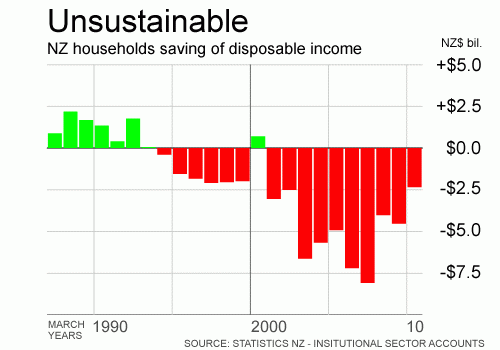
New Zealand households are still spending more than they earn, although their level of dis-saving fell in the year to March 2010 according to a new savings measure released by Statistics New Zealand.
"The household saving rate, expressed as a percentage of household net disposable income, has been mostly negative since 1999 but has improved in recent years, reaching negative 2.2 percent in the year ended March 2010. Household saving is calculated by subtracting expenditure from income received through salaries, wages, interest, and dividends," Stats NZ said.
The release comes the same day as the government-appointed Savings Working Group is set to deliver its interim report to Finance Minister Bill English on how to improve the level of national savings in both the private and public sector.
There have growing calls for New Zealand to improve its savings rate and decrease its exposure to global financial markets as they remain jittery about European and the US economies. An improved savings rate would also help lower the New Zealand dollar, Reserve Bank governor Alan Bollard said last week.
Finance Minister Bill English has previously said New Zealand's exposure to global markets was his biggest worry for the economy as the Euro sovereign debt crisis rolls on.
Here is the release from Stats NZ:
Household expenditure continues to outpace income, with New Zealanders showing a steady preference for investment in the property market, according to new saving statistics released today by Statistics New Zealand.
The household saving rate, expressed as a percentage of household net disposable income, has been mostly negative since 1999 but has improved in recent years, reaching negative 2.2 percent in the year ended March 2010. Household saving is calculated by subtracting expenditure from income received through salaries, wages, interest, and dividends.
"While improvements in the saving rate in recent years were due to rising salaries and wages, and farming income, the improvement in 2010 was mainly due to less income tax paid arising from decreases in personal tax rates effective from 1 Oct 2008,” economic statistics development manager Jude Hughes said.
From 1999 to 2008, New Zealanders continued to invest mainly in property, particularly in residential buildings. Mortgage interest paid also increased during this period. The official cash rate peaked at 8.25 percent in July 2007.
The government saving rate was negative in 2010, the first time in 17 years. This fall was due to lower income as a result of reduced personal tax rates and reduced resident withholding tax. In addition, social assistance benefits paid have increased from 2008 to 2010, consistent with the rise in the unemployment rate from a 21-year low of 3.7 percent to 6.4 percent for the year ended March 2010.
National saving, which is the sum of all the sectors in the economy, increased to $3.2 billion in the year ended March 2010 and is down from its peak ($7.9 billion) in 2004.
This is the first release of the official institutional sector accounts (1999–2008) for all sectors of the economy. Information contained within the accounts can be used to study the source and disposal of incomes, the origin of saving, the direction and method of transfer of saving from one sector to another, and the areas of the economy in which available funds are spent. Official accounts for the household and general government sectors are included to 2010.
We welcome your comments below. If you are not already registered, please register to comment
Remember we welcome robust, respectful and insightful debate. We don't welcome abusive or defamatory comments and will de-register those repeatedly making such comments. Our current comment policy is here.