
By Alex Tarrant
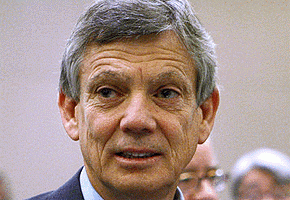
New Reserve Bank Governor Graeme Wheeler has left the Official Cash Rate (OCR) on hold at 2.50%.
In his first OCR review since taking over the job from former Governor Alan Bollard in September, Wheeler noted the high New Zealand dollar was undermining export earnings and encouraging consumption of imported goods and services.
Wheeler said the global economy remained fragile, with further recovery “heavily dependent on policy implementation.”
“That said, market sentiment has improved from earlier in the year, suggesting the risks to the global outlook are more balanced,” Wheeler said.
Domestically, New Zealand’s GDP continued to expand at a modest pace.
“Housing market activity is increasing as expected, and repairs and reconstruction in Canterbury are boosting the construction sector,” Wheeler said.
“Offsetting this, fiscal consolidation is constraining demand growth, and the high New Zealand dollar is undermining export earnings and encouraging substitution toward imported goods and services,” he said.
“While annual CPI inflation has fallen to 0.8 percent, the Bank continues to expect inflation to head back towards the middle of the target range.
“We will continue to monitor inflation indicators, such as pricing intention and inflation expectation data, closely over coming months,” Wheeler said.
“For now it remains appropriate for the OCR to be held at 2.5 percent,” he said.
What about that low inflation?
The decision to leave the OCR on hold follows figures showing annual fell to 0.8% in the year to September, below the Reserve Bank’s 1-3% medium-term target band. That reading prompted markets to indicate they expected a rate cut by the Reserve Bank sometime in the next year.
Local economists expect the Reserve Bank to keep the OCR on hold until July next year at the earliest, although acknowledge the case for a rate cut is growing. Increasing numbers of them are leaning towards a ‘lower for longer’ stance of no rate hikes until early 2014.
The Bank’s latest public forecasts, released in September, show the Reserve Bank is itself expecting to raise the Official Cash Rate at the end of 2013 or early 2014, going on its forecast 90-day bank bill interest rate track.
The OCR is the base for interest rates in New Zealand, and is most closely correlated to floating, or variable, mortgage rates. A move in the OCR is generally followed by a similar move in these rates.
The OCR is the Reserve Bank’s primary tool for the implementation of monetary policy. It is mandated to focus primarily on price stability, with price movements measured by annual Consumer Price Index (CPI) inflation figures released quarterly by Statistics New Zealand.
While annual inflation fell below the current 1-3% target band in the year to September, the Bank is required to try and keep the CPI within that band ‘on average,’ and over the ‘medium-term’. That allows the Bank some wriggle room outside the top and bottom of the band in the short term.
Wheeler said the Bank expected inflation to head back to the middle of that band – he has also been given a more specific inflation target of 2% to aim for – and said the Reserve Bank would monitor pricing intention and inflation expectation data closely over coming months.
The September quarter was the fifth consecutive quarter in which inflation was lower than the Reserve Bank had expected, and local economists are wondering whether the Bank might revise down its inflation forecasts in its December Monetary Policy Statement.
That would likely boost expectations for a rate cut, or at least push more into the ‘lower for longer’ 2014 camp.
Read the Reserve Bank statement below:
The Reserve Bank today left the Official Cash Rate (OCR) unchanged at 2.5 percent.
Reserve Bank Governor Graeme Wheeler said: “the global economy remains fragile, with further recovery heavily dependent on policy implementation. That said, market sentiment has improved from earlier in the year, suggesting the risks to the global outlook are more balanced.
“Domestically, GDP continues to expand at a modest pace. Housing market activity is increasing as expected, and repairs and reconstruction in Canterbury are boosting the construction sector. Offsetting this, fiscal consolidation is constraining demand growth, and the high New Zealand dollar is undermining export earnings and encouraging substitution toward imported goods and services.
“While annual CPI inflation has fallen to 0.8 percent, the Bank continues to expect inflation to head back towards the middle of the target range. We will continue to monitor inflation indicators, such as pricing intention and inflation expectation data, closely over coming months.
For now it remains appropriate for the OCR to be held at 2.5 percent.”
ANZ Economists' reaction
The RBNZ left the OCR unchanged at 2.5 percent today, as expected. The policy statement maintained the continuity of recent statements, providing a smooth transition to Governor Wheeler.
The statement was reasonably neutral, with a balanced risk assessment for the global outlook and a moderate outlook for domestic demand. The statement provided little indication of the direction or timetable for OCR moves.
The market was looking for dovish nuances and if anything the assessment surprised the other way. We consider the paring back in market pricing for rate cuts and the modest NZD lift to be a positioning squeeze: the market was simply looking too much for signals and trying to play the man as opposed to the ball.
Our central scenario for interest rates is up as opposed to down: cutting the OCR in the midst of a city rebuild is a tall ask, with a case for unwinding some policy support once the rebuild gets some critical mass. A rate cut cannot be ruled out, but there remains a high hurdle to this.
We continue to expect an extended period on the sidelines, with the OCR on hold until 2014, with domestic rebuild momentum balanced by what we consider will remain a turbulent international environment with Europe the epicentre, and dichotomised performance out of the local labour market.
ASB Economist Nick Tuffley's reaction:
We interpreted the inflation parts of the statement as the RBNZ being slightly more wary about the risks of inflation remaining lower than the RBNZ has anticipated, hence slightly more prepared to respond/wait. Accordingly, we have slightly increased our probability of an OCR cut over the next 12 months from 20% to 30%. But, like most people, the RBNZ is more comfortable that the risks of a major Eurozone financial calamity have receded.
Last week we changed our OCR view and retain that view after this statement. That view is: we expect the RBNZ with lift the OCR 25 basis points at each of the September and December 2013 Monetary Policy Statements (MPS). We then expect the RBNZ to pause for 6 months to assess the impact of recent rate hikes on households and businesses. We then expect a further two 25-basis point rate hikes at the June and September 2014 OCR announcements, followed by another 6-month pause, and the final two 25-basis point increases at the March and June 2015 OCR announcements. We continue to expect a terminal cash rate of 4%, which will return retail lending rates to just below historical-average levels.
Market reaction
Despite what appeared to be a slightly more dovish statement in our view, the NZD lifted on the back of the statement, and short-term interest rates have lifted (as the market has removed some of the rate cuts priced in) seeing the yield curve flatten. The tone of the statement may have been seen as more upbeat by those who were expecting rate cuts in the near term, particularly as the RBNZ was slightly more encouraged on the global outlook, noting the risks to the global outlook are more balanced.
BNZ Economist Stephen Toplis' reaction
It came as a surprise to no-one that the Reserve Bank of New Zealand left its cash rate unchanged at 2.5% today.
However, it may have surprised some that the general tenor of the OCR review remained consistent with the RBNZ being on a tightening bias. In fact, one might even conclude that it was slightly more hawkish than the September Monetary Policy Statement.
Looking forward, the RBNZ will continue to monitor everything that moves with slightly more attention paid to international developments, the NZD, construction and housing market activity. And, in case you’d forgotten, there was also a reminder from the Bank that it is inflation that matters most so “pricing intention and inflation expectation data” will also be looked at very closely in the near term.
Those looking for insight as to how new Governor Graeme Wheeler might behave will be disappointed. It was always our opinion that it would have been madness, for a man who has been at the helm for such a short period of time, to reveal his spots. He hasn’t. The December 6 MPS might be a different story, though even this might be a tad early.
There was absolutely nothing in today’s statement to change our view of the world. Formally, we have our first rate hike in December 2013. But let’s not get too cute about this. The real message is we see little reason for rates to move in either direction for some time.
First NZ Economist Chris Green's reaction:
On the whole, there is little in the way of new information in the October OCR Review commentary, reinforcing that the RBNZ remains comfortable with current monetary policy settings. Perhaps the most surprising feature is the absence of a slightly more dovish tone from Governor Wheeler. However, this likely reflects a combination of a general reluctance to signal major changes in tone while the new Governor familiarises himself with the role, together with the absence of a comprehensive forecast review undertaken at the time of MPS releases.
We retain our expectation that the RBNZ is likely to wait until the December 2013 quarter – at the earliest - before raising the OCR by 25bps to 2.75%. However, reflecting recent signs of some softening in the surveyed pace of domestic economic activity over the September 2012 quarter, the prospect of a cut to the OCR has increased. We currently assess around a 30-40% probability of a cut in the OCR over the year ahead.
(Updated with ASB economists' reaction, BNZ economist's reaction, ANZ Economists' reaction, First NZ Economist's reaction)
We welcome your comments below. If you are not already registered, please register to comment
Remember we welcome robust, respectful and insightful debate. We don't welcome abusive or defamatory comments and will de-register those repeatedly making such comments. Our current comment policy is here.