
By Bernard Hickey
The Reserve Bank of New Zealand has held the Official Cash Rate at 2.5% as expected, but has increased its forecast for short term interest rates over the next two and a half years by a further 10 basis points.
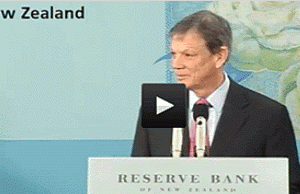
Governor Graeme Wheeler said he expected the OCR to rise 2.25% over the next two and a quarter years.
The bank forecast in its December quarter Monetary Policy Statement the 90 day bank bill rate, which is a proxy for the Official Cash Rate and variable mortgage rates, would rise from 2.7% now to 4.8% by the beginning of 2016.
The rate track implies hikes will start near the end of the March quarter of next year and that rates would rise by around 100 basis points by the end of 2014. This expecation for 2014 was slightly less than market expectations before the statement, but the slight rise in the forecast for 2015 and 2016 saw the currency rise around half a cent. Wholesale interest rates didn't move much.
"The 90 day interest rate is projected to rise over the next few years by slightly more than we envisaged in the September quarter Monetary Policy Statement. This reflects the view that the terms of trade and domestic demand are somewhat stronger than foreseen in September. The effect of these factors is partially offset by a higher exchange rate than was assumed at the time of the September statement," the bank said in its full statement.
This is slightly more hawkish than Reserve Bank Governor Graeme Wheeler's comments in recent months that the bank expected mortgage interest rates to rise from under 6% now to as high as 8% by early 2016.
The bank said the expansion in the New Zealand economy was gaining "considerable momentum" as its terms of trade hit a 40 year high, household spending was rising and construction activity was lifting in Canterbury and Auckland.
The bank said continued government spending restraint and a high New Zealand dollar were partly offsetting the strength in domestic demand.
"The high exchange rate is a particular head wind for the tradeables sector and the bank does not believe it is sustainable in the long run," Governor Graeme Wheeler said.
He noted high house price inflation in Auckland because of low interest rates and rising net inward migration. The bank said its high Loan to Value Ratio (LVR) speed limit should help slow house price inflation, but the data seen to date was limited.
"We will continue to monitor outcomes in the housing market closely," Wheeler said.
The bank forecast inflation to increase to around 2%, the middle of its 1-3% target band, by early 2015.
"The extent and timing of such (inflation) pressures will depend largely on movements in the exchange rate, changes in commodity prices, and the degree to which momentum in the housing market and construction activity spills over into broader cost and price pressures," Wheeler said.
"The bank will increase the OCR as needed in order to keep future average inflation near the 2% target midpoint."
Here's is the bank's full summary statement issued with the decision.
The Reserve Bank today left the Official Cash Rate unchanged at 2.5 percent.
Reserve Bank Governor Graeme Wheeler said: “Growth remains moderate but mixed for New Zealand’s main trading partners. Nevertheless, export prices for New Zealand’s main commodities, and especially dairy produce, have continued to increase.
“New Zealand’s GDP is estimated to have grown at over 3 percent in the year to the September quarter and the expansion in the economy has considerable momentum. New Zealand’s terms of trade are at a 40-year high, household spending is rising and construction activity is being lifted by the Canterbury rebuild and the response to the housing shortage in Auckland.
“Continued fiscal consolidation and the high exchange rate will partly offset the strength in domestic demand. The high exchange rate is a particular head wind for the tradables sector and the Bank does not believe it is sustainable in the long run.
“House price inflation is high in Auckland and other regions due to the housing shortage, and demand pressures associated with low interest rates and rising net inward migration. Restrictions on high loan-to-value mortgage lending, introduced in October, should help slow house price inflation. Data to date are limited on the effects of these restrictions. We will continue to monitor outcomes in the housing market closely.
“Annual CPI inflation increased to 1.4 percent in the September quarter and inflation pressures are projected to increase. The extent and timing of such pressures will depend largely on movements in the exchange rate, changes in commodity prices, and the degree to which momentum in the housing market and construction activity spills over into broader cost and price pressures.
“The Bank will increase the OCR as needed in order to keep future average inflation near the 2 percent target midpoint”.
Economist reaction
ASB Chief Economist Nick Tuffley said he continued to expect a March start to rate hikes and that the Reserve Bank's forecasts suggested a March/April start.
"The end point for the 90-day outlook is marginally, but not significantly, higher (4.8% vs. 4.7%). The added emphasis the RBNZ has put on achieving the 2% target band mid-point, which led to the lower inflation forecasts, likely contributed to this upward revision at the margin given the extra wiggle room the higher TWI outlook gives the RBNZ," Tuffley said.
"The RBNZ has already incorporated into its forecasts two factors we saw that could delay the start of the OCR cycle: a later pick-up in residential constructions and a lower peak in house price growth. We continue to expect the OCR to reach 4% by December 2015," he said.
ANZ Chief Economist Cameron Bagrie said the Reserve Bank had upgraded its interest rate outlook, but not as much as the market had priced in. He said he was not convinced the inflaiton outlook was as demure as the Reserve Bank had forecast through 2014.
"Despite our expectations there is some upside risk surrounding the near-term outlook for inflation we believe we’ll see an OCR profile that is milder over time given the global backdrop of low rates for an extended period," Bagrie said. "Our central scenario is still for the OCR to nudge up with three 25bps moves in the first half of 2014 and more in 2015," he said.
Bagrie noted the Reserve Bank had made no attempt to talk the New Zealand dollar down. "While the Bank do see justifications for exchange rate strength, the simple fact that the MPS was less upbeat than market expectations does, in our view, pose downside risks to the NZD," he said.
Westpac Chief Economist Dominick Stephens said markets had gone in to the statement pricing in the chance of a January hike, but the tone of the statement made that unlikely. He said the Reserve Bank's view looked similar to Westpac's own view of 100 bps of hikes over 2014.
"The remaining risk is the timing of the RBNZ's hikes. Our own call at present is that the first OCR hike will occur in April. However, we will adjust this call according to the risks outlined above, particularly next week's GDP figures," Stephens said.
TD Securities Economist Annette Beacher said the New Zealand had initially risen on the slight increase in the 90 bill forecast.
"However, as the Bank already expects cash rates to rise by +100bp next year, there is little room for pricing more aggressive hikes given the sticky exchange rate, and hence the scope for further NZD appreciation is limited in our view," Beacher said.
" Further, with a few hints at “wait and see” in the document, we encourage pricing out of any January hikes in the bill strip. Our OCR base case is +100bp to 3.5% by end-2014, starting March, and +100bp to 4.5% by end-2015, a return to the new neutral cash rate. The risks in our view are towards reaching the neutral rate sooner, not that rates need to go higher," she said.
Political reaction
Green Party Co-leader Russel Norman said the Reserve Bank's warning about interest rate hikes next year meant New Zealand would be the first OECD country to hike rates, putting pressure on the exchange rate.
“Higher interest and exchange rates will effectively cost jobs, exports, and raise the cost of living for all those with mortgages," Norman said.
“Once again, New Zealand’s economic recovery is betraying the same underlying structural weaknesses of the last one; National has materially failed to rebalance our economy away from borrowing and consumption towards savings, investment, and exports," he said.
“National’s failure to address the Auckland housing shortage with a mixture of demand and supply-side measures are forcing the Reserve Bank to hike rates, hurting the real economy," he said.
“National’s failure to introduce a comprehensive capital gains tax (excluding the family home) has meant property speculators will continue to be rewarded at the cost of the productive economy and all those seeking to buy their own home."
(Updated with currency rise, economist reaction, political reaction)
We welcome your comments below. If you are not already registered, please register to comment
Remember we welcome robust, respectful and insightful debate. We don't welcome abusive or defamatory comments and will de-register those repeatedly making such comments. Our current comment policy is here.