
Here's my summary of the key news overnight to keep you up-to-date over these holidays.
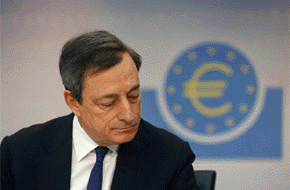
The European Central Bank has kept its benchmark interest rate at a record low of 0.25%, following its surprise cut from 0.5% in November. However, Mario Draghi spent so much time talking in his press conference about low inflation and being "determined to maintain the high degree of monetary accommodation", his dismissal of deflation as a serious risk were unconvincing.
The Bank of England followed, making no change to its settings this morning as well.
In China, the latest data on inflation suggests they have it under control. It came in at +2.5% in December although food prices were up +4.1%. China's problem with prices isn't at the consumer level, it is at the producer level where they have been stuck in a deflationary trend for years.
Worldwide, food prices were lower in 2013 than 2012, according to the UN-FAO.
Markets however are focused on the American non-farm payrolls report out tomorrow. It is widely expected to be a 'good' improvement, encouraging the Fed to push on with its tapering. That has financial markets nervous - they want to see the drug of free money continue longer yet, but Janet Yellen may have other ideas.
We will get the December CPI data for the US next Friday, and the New Zealand inflation number the following Tuesday.

New data out shows the Chinese are traveling in huge numbers; the increase in international travel is astounding and last year there were almost 100 million Chinese who traveled overseas. That is many more than the Americans, and they are outspending the Americans as well.
But it is not helping Qantas. Across the ditch, Qantas faces a further increase in the cost of new borrowings after the second of the big two credit ratings agencies downgraded it to junk status, citing a ''sharp deterioration'' in its key domestic business.
The American oil boom has put European refineries out of business and undercut West African crude suppliers. Now its domestic drillers threaten to roil Asian markets and challenge producers in the Middle East and South America. All this new production is lowering the price of crude, and today the benchmark US price fell to under US$92/barrel, levels it was at three years ago. Natural gas and heating oil prices are also falling. Brent crude prices are down too.
The price of gold is basically unchanged on the day, as in the yield on benchmark UST 10yr bonds - they are still not over 3%.
The NZ dollar starts today slightly lower at 82.4 USc, 92.8 AUc, and the TWI is at 78.2.
The easiest place to stay up with today's event risk is by following our Economic Calendar here »
No chart with that title exists.
We welcome your comments below. If you are not already registered, please register to comment
Remember we welcome robust, respectful and insightful debate. We don't welcome abusive or defamatory comments and will de-register those repeatedly making such comments. Our current comment policy is here.