
Mike Lee is one of three Auckland councillors who last week voted against the bail-out package for the City Rail Link project.
The former Auckland Regional Council (ARC) chairman says he has always supported the project, but couldn’t agree to signing off an extra $500 million in funding without more detailed information on the costs.
The project is being jointly funded by the Government and Auckland Council and was originally expected to cost $3.4 billion and scheduled for completion in 2024. But last month City Rail Link Limited (CRL Limited) chief executive Sean Sweeney confirmed the new revised estimate for the project had ballooned out to $4.4 billion and said it will have to ask the Government and Auckland Council to cover the shortfall.
On Thursday the Auckland Council voted to approve its $500 million share of the $1 billion cost increase after a marathon six and half hour session. But councillors Greg Sayers, Christine Fletcher and Mike Lee voted against it.
Lee says making such a major decision based on information gleaned from a report by PwC that was paid for by CRL Limited isn’t good enough.
CRL Limited hired PwC to update its economic assessment of the benefits of the project originally prepared as part of the 2015 business case. This was to reflect new parameters, a revised delivery schedule, and using up-to-date transport modelling. The analysis was included as part of the report to council prepared by council officers.
“PwC said it was worth paying because the cost-benefit ratio was still positive. But normally Treasury is the agency which should make those sorts of calls, not somebody for hire,” Lee says.
He says it was hardly independent advice.
“Let’s be realistic, consultants will tell you what you want to hear," Lee says. "PwC’s report was paid for by CRL Limited and the CRL Limited chairman [Brian Roche] worked for PwC.”
And he says the council’s report lacked any detailed information on why the CRL project’s costs had gone up. He says there was one table showing the original estimates, alongside the revised estimates, which included making the stations bigger to accommodate nine car trains.
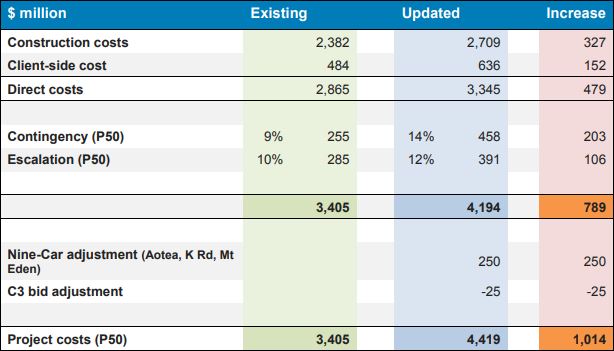
The Auckland Council report states:
“In late 2018, as a matter of good infrastructure project practice, CRLL’s Board and management initiated a reforecast of the total project cost. This reflected a view that market conditions had changed substantially since the 2014 forecasts, with increases in materials and labour costs as a result of significant competition for projects in the Australasian projects market, and a fall in the value of the New Zealand dollar.
“Cost forecasts, and peer reviews of those forecasts, are important because they can be used to inform a purchaser as to whether bids they have received are priced appropriately, both as a whole and in their individual components. CRLL asked its cost estimators to update the 2014 cost forecasts and had this work independently peer reviewed by another company. These cost forecasts have been benchmarked against similar projects internationally. CRLL and the sponsors also used the sponsors’ assurance managers (Advisian) to provide a third view on the revised cost forecasts.”
But Lee says the real detail was still lacking.
“It’s not our money to play with. We have to be prudent and careful and not just sign off a decision on the flimsiest evidence,” Lee says. “All this is doing is inflaming the market. We’re saying to companies you can overshoot your costs and inflate your price and then you can go back to the politicians and they will rubber stamp it. I’ve been a long term advocate of this project from when I was in charge of the ARC, we started the business case for it.
“But I thought it would be totally immoral to vote on a half a billion dollar bail-out without proper information,” he says. “There are limits and we have to be fiscally responsible. We can’t just rubber stamp any proposal put before us.”
CRL Limited chief executive Sean Sweeney says PwC was asked to update the economic assessment undertaken as part of Auckland Transport's 2015 Business Case.
"PwC was responsible for undertaking this earlier assessment for Auckland Transport, which is why it was asked by CRL Limited to provide the updated assessment. PwC had greater knowledge of the project, and the ability to complete the update more quickly than other organisations," Sweeney says. "The 2019 update provided by PwC was quite limited, mainly adjusting base benefit values to 2018 dollars (from 2014 dollars) and reflecting recent changes in patronage projections."
He says the role of Treasury wasn't to undertake the economic assessment, but to review the work provided by the agency (CRL Limited) seeking funding.
"PwC's economic assessment was undertaken in strict compliance with the NZ Transport Agency's guidelines for the economic assessment of transport projects and has been acknowledged to be conservative."
Councillor Greg Sayers also voted against the $500 million funding package and says the Government should be shouldering the burden of the CRL project's cost increase.
“The ratepayers shouldn’t have to pay a cent more and the Government should be stepping up to the plate,” Sayers says.
During the debate Mayor Phil Goff said he had asked the Government for more funding to cover the shortfall, but he’d been told it wasn’t interested in revisiting the deal. But Sayers he thinks the council should have driven a harder bargain and renegotiated its share of the project’s costs.
“I think we've lost a golden opportunity. I think it would be naïve to think that the money being spent on the CRL project isn’t going to affect local projects and core council services.”
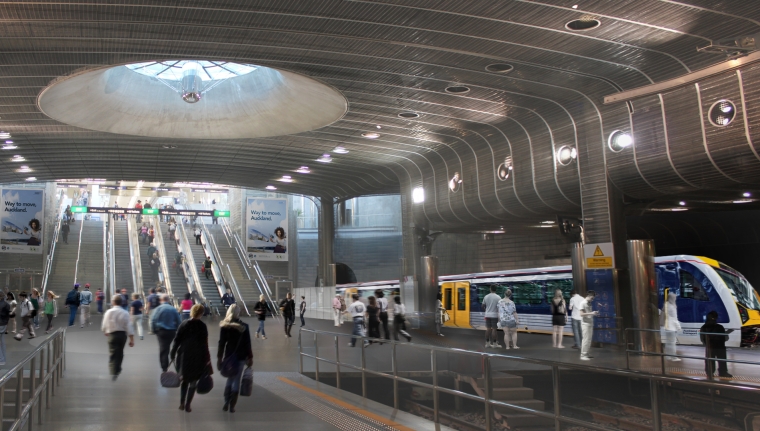
The CRL project is a 3.45 km twin-tunnel underground rail link which will connect the Britomart Transport Centre with new stations at Aotea Square and Karangahape Road.
It will make Britomart a through station and will provide quicker travel times for many people and will also allow better access for train users to parts of the city centre with the new stations near mid-town and Karangahape Road. The CRL project will allow the rail network to at least double it existing capacity. CRL Limited was formed in 2017.
We welcome your comments below. If you are not already registered, please register to comment
Remember we welcome robust, respectful and insightful debate. We don't welcome abusive or defamatory comments and will de-register those repeatedly making such comments. Our current comment policy is here.