
By Chris Trotter*
Over Queen's Birthday, a Northern-Ireland-born friend of mine e-mailed me his take on the social disorder engulfing the United States. The real problems begin, he wrote, not with the eruptions of anger from long-down-trodden communities. It is when the dominant groups retaliate in kind that the strife becomes intractable. “It was the Orangemen who made the troubles happen in earnest by burning people’s houses down.” In his judgement, the period of maximum danger will be the next few days and weeks while the American Far-Right debates whether the collective efforts of local police officers and National Guardsmen have inflicted sufficient punishment upon the protesters/rioters. If they decide more extreme measures are required, then the United States really will be in trouble.
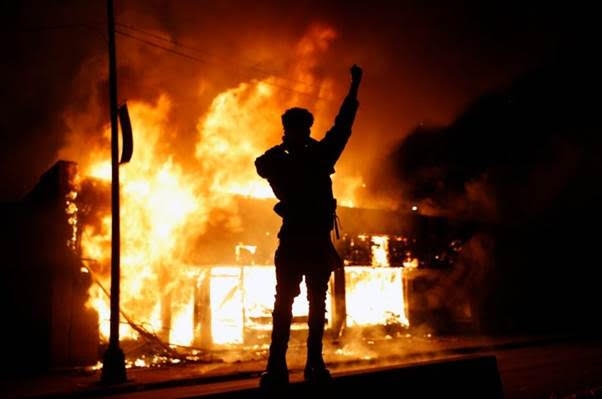
And it matters. What happened to George Floyd appalled the world. But it was the explosive reaction to his death, beneath the knee of a disturbingly unperturbed Minneapolis cop, that caused the rest of the world to furrow its brow. As if 100,000+ Covid-19 fatalities and 42 million applications for unemployment relief weren’t enough to worry about, civil disorder on a scale not seen since the late-1960s was exposing astonishing levels of social and political division.
New Zealand, a tiny nation at the bottom of the world, has long assumed that if push came to shove (as it did in 1942) Uncle Sam would always have its back. Culturally and ideologically, Kiwis have automatically included themselves, along with Americans, in the same global English-speaking family. Yes, the United States has its fair share of vices, but, historically, US virtues have consistently outweighed them.
In his first inaugural address (1861) President Abraham Lincoln made reference to America’s “better angels”; and ever since, no matter how dark the skies, the light of those angels has never failed to illuminate American virtue’s forward path. It was Republican President Dwight Eisenhower who in 1957 federalised the Arkansas National Guard to enforce the landmark desegregation decision of the US Supreme Court. Eight years later, President Lyndon Johnson, a Democrat, responded to vicious white supremacist violence in Selma, Alabama, by reassuring millions of African-Americans that in passing the Voting Rights Bill “we shall overcome”.
Until Vietnam.
If there was one terrible event which has darkened the path of US politics – perhaps irredeemably – it is the Vietnam War. It was in the same year that he drove the Voting Rights Bill through Congress, 1965, that Johnson ordered American conscripts to South Vietnam. It was a decision that would unleash forces that, even after 55 years, continue to deform American society. Though the war in Indo-China ended in 1975, the “culture wars” it inspired continue to rage.
Vietnam divided not only American society, it also opened a seemingly permanent gulf between the parties of the left and the right in New Zealand. Without Vietnam there would have been no early recognition of China; no frigate to protest French nuclear testing at Mururoa Atoll; no nuclear-free New Zealand; no refusal to join Uncle Sam and his Aussie mates in the invasion of Iraq. The long shadow of that tragic war has played a critical role in the development of NZ-US relations.
Those unconvinced by this argument will object that none of these events would be up for discussion without Donald Trump. It is Trump, they say: that Black Swan of American politics; that has deranged the US system so profoundly. But even Black Swans come from somewhere. Trump is merely the latest chapter (perhaps the final chapter) of a political narrative which began with Johnson’s embrace of the African-American cause.
Johnson knew it would cost the Democratic Party the American South. So did Richard Nixon. The Republican Party’s “Southern Strategy” fundamentally rearranged the tectonic plates upon which US politics had rested for 100 years. After 1968, nothing would ever be the same. Over the course of the next fifty years the values of the slave-owning Confederacy defeated in the American Civil War would conquer enough of the United States’ electorate to give Donald Trump his extraordinary Electoral College victory.
To understand the huge impact of the party of Abraham Lincoln embracing the unreconstructed white supremacism of the old Confederacy, try imagining that instead of narrowly losing the 2005 general election, Don Brash had narrowly won it. The National Party would have found itself electorally trapped in the raw ideology of John Ansell’s “Iwi/Kiwi” billboards. Increasingly resistant to the appeals of “progressive” politicians, Pakeha voters would have dragged all of the main parties further and further to the right. New Zealand politics would have been realigned fundamentally. The view from our “Overton’s Window” would have become increasingly reminiscent of Alabama.
The strength of the political realignment unleashed by the Republicans’ turn to white supremacy and the Christian Right is demonstrated by the fact that neither the election of Bill Clinton nor Barack Obama could weaken it for more than a single congressional term. Since 1968 (the last time cities across America burned) there have been no more Dwight Eisenhowers, no more Lyndon Johnsons. America’s “better angels” have been missing in action.
It is with undeniable trepidation, therefore, that the English-speaking family, their European friends, and the government of the USA’s principal twenty-first century rival, the Peoples Republic of China, await the outcome of the next few days, and weeks.
There are very few good outcomes upon which those who still believe in “the indispensable nation” can rely. If Trump declines to take the lead in punishing and repressing the African-American-led protests against racist law enforcement, then the same sort of illegal interventions that gave birth to the Northern Ireland “troubles” should be anticipated. The Internet is awash with references to “Boogaloo” – the outbreak of a no-holds-barred race war across the United States. Given George Floyd’s fate, the general willingness of US law enforcement to protect African-Americans from the “Boogaloo Boys” is, to say the least, questionable.
If, however, Trump and his dutiful Attorney-General, William Barr, should follow-through on their threats to designate the anarchists of the “Antifa” (anti-fascist) movement, or, God forbid, the activists of “Black Lives Matter”, as terrorists, then the chances of the past weekend’s water-bottles and firecrackers being replaced by bullets and IEDs are distressingly high. The slow spiral into the action-reaction sequence that gave rise to internment without trial, troops firing on protesters, political jails, and quasi-official police death-squads in Northern Ireland will likely unfold much faster under Trump than it did under Harold Wilson, James Callaghan and Margaret Thatcher.
If history is any guide, however, five nights of watching America burn is highly unlikely to rebound to the electoral advantage of the Democratic Party. It sure as hell didn’t in 1968!
Our political leaders need to be aware that a New Zealand determined to preserve its strategic relationship with a United States driven not by its better angels, but by its worst demons, will find itself altered by the experience. Any government opting to dine with such a devilish administration will require a spoon at least as long as the distance between Washington and Wellington.
*Chris Trotter has been writing and commenting professionally about New Zealand politics for more than 30 years. His work may be found at http://bowalleyroad.blogspot.com. He writes a fortnightly column for interest.co.nz.
We welcome your comments below. If you are not already registered, please register to comment
Remember we welcome robust, respectful and insightful debate. We don't welcome abusive or defamatory comments and will de-register those repeatedly making such comments. Our current comment policy is here.