
The Productivity Commission has released its draft report on frontier firms. The following is an overview of this.
New Zealand’s disappointing productivity performance has held back its standard of living for many years. This fact is widely documented and acknowledged. In simple terms, productivity can be thought of as working “smarter” rather than “harder”. For the last 25 years or more New Zealand’s income per person has stayed at about 70% of that in countries in the top half of the OECD. New Zealand’s position among OECD countries would be even weaker if not for the relatively long hours (on average) that people in New Zealand work. Improvements in labour productivity (output per hour worked) have made only a weak contribution to aggregate economic growth. In short, New Zealand has been working harder rather than smarter.
This position has puzzled many, because New Zealand follows good practice in most widely accepted policy fundamentals. It mostly has good institutions and laws, a well-educated population, low levels of corruption, and is making progress in achieving a bi-cultural partnership between its indigenous and settler communities. Factors such as the ease of doing business, and the quality of regulations all compare well internationally. Given that policy makers attended to these fundamentals in the 1980s and 1990s, many expected New Zealand would catch up with its competitors. While New Zealand has had broadly similar growth in income per head to high-income OECD countries, there has been no evidence of this “catch up” to them.
This inquiry focuses on a central aspect of New Zealand’s productivity performance – the economic contribution of its most productive (or “frontier”) firms. Lifting the performance of New Zealand’s frontier firms is a key part of turning around New Zealand’s aggregate productivity performance. If frontier firms are large enough, they can lift the economy’s performance directly. Frontier firms can also influence firms behind the frontier by setting benchmarks in technology, business methods, and marketing, and by setting standards in quality and efficiency in the inputs they purchase from other firms.
Improving productivity isn’t a silver bullet. New Zealand has problems with housing affordability and inequality, and must take on the challenge of dramatically lowering its greenhouse gas emissions. This inquiry acknowledges these are serious issues and work on them must continue. However, lifting New Zealand’s productivity will make solving these problems easier. Maximising the contribution from frontier firms is central to that vision.
The disadvantages of a small domestic market and geographic distance
A significant part of the explanation for New Zealand’s weak productivity performance and underperforming frontier firms is the small size of its domestic market and its distant location from large international markets. Weak international flows in trade, capital and knowledge, and “soft” competition in domestic markets are symptoms of these disadvantages. Other troubling symptoms of New Zealand’s underpowered economic performance are that businesses are typically capital shallow (ie, workers have limited equipment and other capital goods to work with) and not enough businesses produce innovative goods and services that command a premium in export markets.
These symptoms partly reflect the high upfront costs and risks of expanding into overseas markets. Entering international markets can involve many years of research and planning, including work to understand target markets, develop supply chains, build in-country partnerships and tailor product offerings. And because of the small size of the domestic market, New Zealand firms that wish to grow beyond domestic borders must begin exporting when they are still small firms by international standards. This makes expanding overseas even more difficult, expensive and risky.
Together with New Zealand’s remote location, these high fixed costs partly explain why New Zealand has relatively few large, established and successful exporting firms. Distance from international markets also makes it difficult and therefore quite rare for New Zealand firms to participate in high-value-added parts of global supply chains. This contributes to the absence of distinctive and specialised products in New Zealand’s export mix and to a low overall level of exports to GDP.
Geography is not destiny: New Zealand can do better
However, the Commission does not accept that geography is a life sentence condemning New Zealanders to lower living standards. An opportunity exists for New Zealand to change key aspects of the status quo and lift performance. It is not about tearing things down and starting again. In many ways New Zealand is already an innovative place, but it needs to get much better at turning those good ideas into world-leading firms.
Learning from other small advanced economies
Other small advanced economies (SAEs) also face the constraints of small domestic markets and some are relatively remote. Successful SAEs can therefore provide more relevant lessons for New Zealand than larger economies. SAEs are different. They are not just scaled-down versions of larger economies, but have specific characteristics that shape their performance. For SAEs, the standard policy prescription is necessary, but not sufficient for success.
Successful SAEs are located mostly in Europe (eg, Sweden, Denmark, Ireland, Netherlands) but also in the Middle East and Asia (eg, Israel and Singapore). When benchmarked against other SAEs, New Zealand’s frontier firms are (on average) less likely to be world class in their respective sectors than those from successful SAEs. While New Zealand does have examples of world-leading firms, it does not have enough of them. Successful SAEs also have a much greater proportion of specialised, distinctive products in their export mix and higher ratios of exports to GDP, compared to New Zealand. It is timely for New Zealand to learn from other SAEs.
Exporting at scale is the way to reach for the global frontier
The SAEs of Europe mostly have some large firms with outstanding records of exporting specialised and distinctive goods and services. Their frontier firms operate at the global frontier; in other words, they are world leading. Around each of them exists an ecosystem of many smaller businesses supplying complementary products or specialised inputs. Supporting them are researchers and innovators in both public and private employment, a pipeline of highly educated graduates and post-graduates, investment in enabling infrastructure and regulations, and investors with deep knowledge and understanding of the industry.
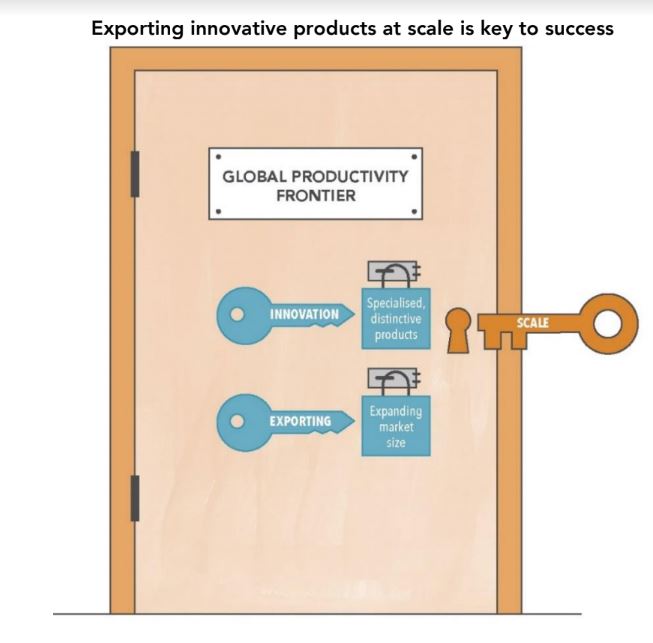
A major finding of this inquiry is that New Zealand should seek to have more frontier firms of this type to boost its economic performance. Fundamental to the success of any developed economy – unless it is richly endowed with natural resources that can be easily sold for good prices – is innovation that produces specialised and distinctive internationally tradeable goods and services. For a long time, New Zealand has grown by increasing the volume of products made from its natural resources; but, given environmental limits, that path to growth cannot continue.
Therefore, innovation is essential to New Zealand’s economic future. With it, a country has a chance to gain and retain a world-leading competitive advantage in some markets. Without it, products and production processes become standardised, widely understood and therefore open to competing production in lower-wage economies. Such competition is a natural, market-led phenomenon that benefits living standards in emerging economies. But it puts pressure on developed countries to play to their competitive advantage – which is their ability to innovate, and bring together highly skilled people and specialised technologies in ways that are hard to replicate.
Innovative, knowledge-intensive products typically have high upfront development costs, followed by low marginal costs once the products are fully developed. This creates strong scale economies – meaning that increasing the scale of production drives down unit costs and increases productivity. The high fixed costs of expanding into overseas markets reinforces the need for scale.
The Commission therefore believes that having more frontier firms that export at scale can provide disproportionate benefits in terms of raising New Zealand’s standard of living.
Increasing the rate and extent of innovation will lift performance
Innovation is complex, cumulative, risky and path dependent
Firms, and frontier firms in particular, play a leading role in innovation. Yet an individual firm may not invest in innovation unless other firms and the government make complementary investments. Turning this around, a firm that tries something new in an economy is carrying out an experiment that has valuable learnings for others. Unless this is recognised and rewarded, the outcome will be too little innovation for the country’s good.
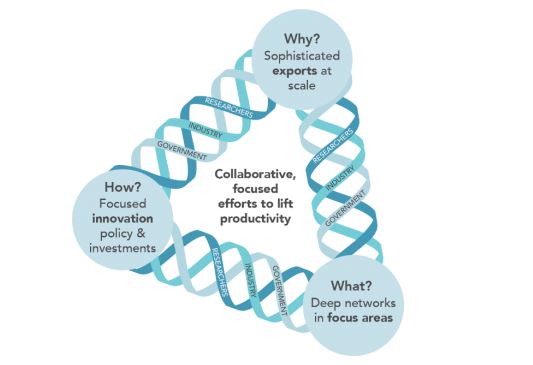
The outcomes of innovation effort are uncertain and risky. These features increase the benefits of collaboration across firms and researchers to spread the risk; and increase the potential value of government support in helping to get the ball rolling.
Successful innovation involves much more than a firm applying a bright idea or piece of research to produce a new good or service, or an existing product at lower cost. This is just one aspect of innovation that is interrelated with many others, such as branding, marketing, distribution, and supply chains.
Government support helps capture the wider benefits of knowledge spillovers
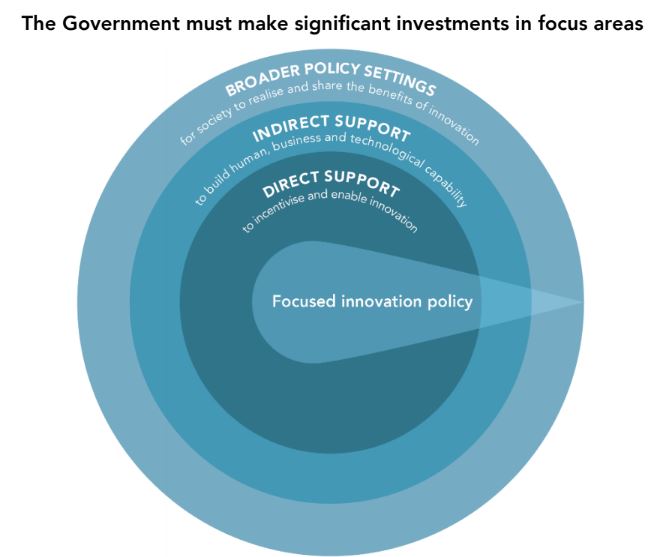
An innovation ecosystem includes the capabilities that are held by individual firms, workers and researchers, and reflected in the network of relations among firms (including international links), and with research centres. Governments also have a role in innovation ecosystems. They contribute to innovation capabilities through:
direct support to incentivise and enable innovation – such as funding for basic and applied research and development, business R&D tax credits, intellectual property regulation, and governance and ownership of key research bodies;
indirect support – such as building workforce skills (through education and training, and migration policy), providing physical and digital infrastructure, and regulating the business environment and financial system; and
broader policy settings for society to realise and share the benefits of innovation – such as health services and income redistribution (which influence the health and wellbeing of workers and their families). Direct government supports for innovation should be targeted at activities and investments that have the clear potential to provide knowledge spillovers and demonstration effects, or to solve coordination problems that are holding back collaboration. The evidence considered by the Commission shows that New Zealand’s innovation ecosystem is not currently working well for actual and potential frontier firms. The Government must develop a clear innovation strategy and take deliberate policy steps to upgrade New Zealand’s innovation ecosystem. The private sector, researchers and government must be effective partners on the journey.
Collaborative, focused efforts are needed to lift productivity
Government should focus on areas of the economy with rich possibilities for innovation
Small economies are “doomed to choose”, as they will have only a limited number of areas that can get to critical mass and support sustained world-class competitive performance. As a complement to broad-based innovation policies, finite government resources need to be deliberately focused on a small number of high potential areas rather than being thinly spread in what Skilling terms “sub-therapeutic doses”. These areas should reflect existing and emerging strengths and capabilities. They may not reflect standard industry classifications; but may instead involve particular technologies with broad application (eg, digital technologies), or a set of diverse technologies that focus in a particular area of production (eg, agritech).
In target areas, the Government should also take a more proactive and targeted approach to attracting multinational corporations (MNCs) that are knowledge-intensive, oriented to exporting and a source of spillover benefits. The approach should seek both to create conditions that act as a magnet for MNCs and to develop and action attraction programmes to directly attract MNCs, similar to those used successfully in some SAEs.
Focusing on particular areas of the economy is not a matter of the Government “picking winners”. Rather, it is about coordinating investments to “back winners” by getting behind sectors that are demonstrating promise – the aim being to get the ball rolling faster and overcome bottlenecks and barriers.
Implementing focused innovation policy
Many efforts have been made to lift innovation and economic performance in New Zealand. The country has a history of small-scale, sector-focused initiatives that often fade away without any clear idea of what they have achieved. While the Government has an ambitious draft research, science and innovation (RSI) strategy, this strategy gives little indication of how it will be implemented and on what scale the various initiatives will be resourced. Further, the areas of focus for innovation policy are not consistently defined. The current initiatives risk meeting a similar fate to previous efforts.
The Government has an important role in supporting firms, through facilitating and co-funding innovation processes. To make progress, the right materiality of investment is required. The Government will need to make significant investments in infrastructure, research and people, in a small number of focus areas, to complement the efforts and investments of the business sector. It will also need to be patient and stay the course, as innovative effort requires time to play out and demonstrate success. It will be a long road, but one that will reward persistence and the right vision.
Smart strategies alone will not be sufficient; execution is critical. The Government should partner with other stakeholders to put in place effective arrangements for governance, resourcing, implementation, monitoring and evaluation to provide confidence that the strategy will deliver on its objectives. Governance and implementation arrangements need to have a life beyond an electoral cycle, consistent with the long timeframes often needed for successful innovation in specialised exporting.
Senior political leadership is required, to unlock resources from across government agencies. Government contributions to innovative investments should be guided by where private firms are prepared to risk their own investments. Transparency in the extent and destination of government support reduces incentives and opportunities for unproductive rent-seeking.
Innovation policy needs to have a relentless focus on supporting world-leading ecosystems of firms. This requires an adaptive approach with a tolerance for experimentation and failure (another reason for insulating its operation from day-to-day political decision making). At the same time, the Government and its partners need to discontinue clearly unsuccessful initiatives. This requires rigorous, independent and transparent monitoring and evaluation. Arrangements and funding for monitoring and evaluation should be built into investments from the outset.
Other priority government actions for supporting innovation
Implementing policy targeted at a few areas requires more than just funding for R&D. It requires coordinated effort across government – ranging from regulation and procurement to skills and infrastructure. In the course of this inquiry, the Commission undertook a series of case studies, to explore the performance of some significant New Zealand industries where productivity improvements could materially help to lift New Zealand’s overall productivity performance. The Commission selected four exporting industries of significant size, and/or with high-growth potential: dairy (both farming and processing), horticulture (with a focus on kiwifruit and wine), health technology (healthtech) and software products and services. As part of these case studies, examples came to light of regulatory or policy changes that are needed to unlock productivity gains in these important industries and more broadly across the economy.
Refocus migration policy settings
Over time, successive changes to New Zealand’s migration policy settings have seen the skill levels of permanent migrants fall, and the skills of temporary migrants increasingly at or below the New Zealand average. This has encouraged firms to continue to rely on low-cost migrant labour and inhibited productivity-boosting investment in capital and innovation. The current border closures due to Covid-19 present an opportunity to review and reset migration policy. The Government should focus migration policy more on lifting productivity, by having a principle of primarily accepting only highly-skilled migrants, and over time reducing the inflows of low-cost temporary workers. The Government will need to work with those industries currently reliant on low-cost migrant labour, to consider the transition path away from reliance on such labour and the role of government in supporting that transition.
Improve competition in the dairy industry
The Dairy Industry Restructuring Act 2001 (DIRA) permitted the creation of the dominant Fonterra dairy cooperative, which initially purchased 96% of the milk supply from New Zealand farmers. DIRA regulated Fonterra’s monopoly power by guaranteeing the fair rights of farmers to enter and exit supply contracts with Fonterra, and by regulating the supply of milk to other processors and manufacturers. The act has opened dairy processing to greater competition and freedoms to innovate in products, supply chains, international connections, ownership, corporate form and business models.
However, the July 2020 amendment to DIRA removes the right of farmer-shareholders of Fonterra to leave the cooperative and return on similar terms. By removing this right, Fonterra’s power to deter farmers from leaving will increase. This change risks detrimental effects on competition when Fonterra is still dominant. It will likely deter new entry and innovation in dairy processing, at a time when these are needed more than ever in the face of environmental limits to further expansion of land in dairy. The Government should reverse this feature of the July 2020 amendment.
Provide a consumer data right
In the modern economy, consumer data is a valuable asset in its own right. Yet consumers cannot access their data from data holders such as banks, and power and telecommunication utilities. Access to this data and the right to transfer it would give consumers greater choice and control. This in turn would open opportunities for innovative digital businesses to devise new products and services that can lift productivity and enhance consumer wellbeing.
The Government should introduce a consumer data right that would enable consumers and businesses to access their data from a variety of data holders and transfer it at their discretion to trusted third parties. The regulation should be consistent with Australia’s sectoral-designation regime. Banking should be one of the initially designated sectors, to facilitate the development of efficient and effective open banking in New Zealand.
Review the regulatory restrictions on genetic modification
New Zealand’s regulation of genetic modification (GM) is more than 20 years old. Then, the country chose to regulate it strictly, but the science has come a long way since then. Developments like gene editing are more precise than early-generation GM and can produce changes that are indistinguishable from naturally occurring processes, and from techniques that are exempt from regulation. Many trading partners are evolving their rules around new techniques like these, on the basis that they pose no greater risks than conventional breeding techniques.
GM research is an important pathway to innovation in New Zealand, particularly in its biological economy. It offers opportunities for lifting productivity, reducing biosecurity threats and responding to climate-change risks effectively and efficiently. The Government should review the regulation of GM, in order to bring the legislation up to date and enable New Zealand to grasp the opportunities from new GM technologies in a safe and timely manner.
Improve the incentives on DHBs to participate in the healthtech ecosystem
District Health Boards (DHBs) are hugely important in and to New Zealand’s health system, yet most are inactive in supporting healthtech innovation. As a result, opportunities for mutual benefits for the healthtech sector and productivity and accessibility of the health system are being lost. The main reasons for DHBs’ lack of support are their lack of mandate to participate in innovation, the lack of targeted innovation funding, and rigidities in their procurement processes. Also, the centre provides no coherent strategy on innovation and learning to guide DHBs. The ensuing variety of independent approaches raises a further barrier for healthtech firms.
The final report of the health and disability system review, published in March 2020, recommended major reforms to the health system. In pursuing any major reform, the Government should improve the mandate, funding and incentives for DHBs to work collaboratively with healthtech companies as part of their innovation ecosystem.
Fostering and learning from Māori frontier firms
Many of the distinctive features and characteristics of Māori firms present both challenges and opportunities. Examples of leading Māori firms show that these entities have been able to turn challenges into strengths and opportunities, as they find ways to work around them or use them to their advantage.
For example, the desire to serve multiple bottom lines (such as commercial, environmental, social and cultural objectives) can be a strong driver of ambition, which can also flow through to expectations on suppliers. Further, high shareholder ambition, together with a long-term view, can spur innovation and experimentation, provided the underlying assets are not put at risk. This appetite for innovation is reflected in statistics which show that rates of innovation and R&D are higher for Māori firms, compared to all New Zealand firms.
The governors of Māori firms managing collectively-owned assets are accountable to multiple owners and shareholders. Governors in these entities do not necessarily see multiple ownership as detrimental to the strategy, objectives or innovation in their business. Rather, they may see multiple ownership as a strength because it drives transparency around decision-making and the impact of decisions.
Māori cultural values help differentiate Māori goods and services and provide added brand value overseas. The values also closely align with the growth in consumer demand for products with strong environmental and social credentials. This presents growth opportunities for kaupapa Māori firms. Common values and features also help bring Māori firms together around shared goals. Formal and informal networks among Māori firms are important mechanisms for diffusing knowledge, exploring innovations and enabling collaboration
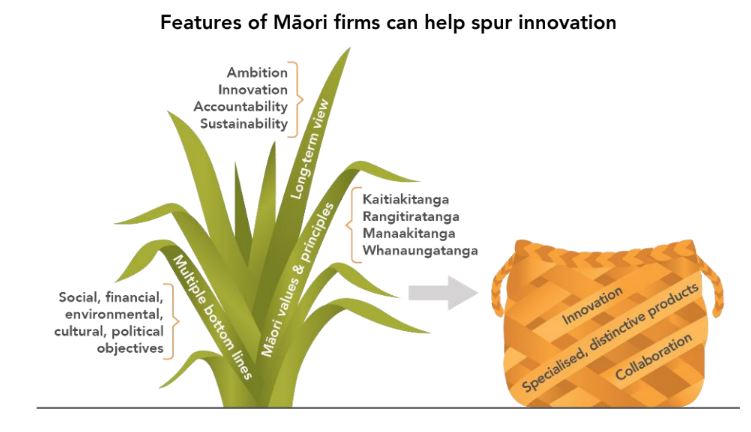
The successes of Māori frontier firms build the confidence and ambition of these firms, and can help light the way for other Māori firms. Māori firms also offer valuable lessons for other New Zealand firms. Taking a long-term view and managing multiple bottom lines do not need to be seen as trade-offs to innovation and productivity. Rather, they are complementary. Long investment horizons are important for supporting experimentation and innovation, and long-term value creation. This contrasts with a short-term focus on financial performance and shareholder returns that can dominate the focus of company boards and management. Further, innovation is key to serving multiple bottom lines, as innovative solutions are required to solve many of the environmental and social challenges facing New Zealand.
Building dynamic leadership capabilities
Firms with more strategic ability – “dynamic capabilities” – are able to identify areas of competitive advantage and then seize opportunities in these areas by innovating while identifying and effectively managing risks. Dynamic capabilities foster radical innovations that can push out the productivity frontier. These include innovations in business models, structures and processes, distribution channels, branding and marketing, as well as product offerings.
Firms primarily, but supported by government, will need to deploy dynamic capabilities to identify areas of competitive advantage for New Zealand, understand risk, and drive innovation to push out the productivity frontier. Building the entrepreneurial and leadership capability in management and boards is therefore critical for lifting the performance of New Zealand’s frontier firms.
For example, boards with strong dynamic capabilities can spur innovation, through supporting calculated risk-taking, and bringing a long-term view to strategic investments. Directors with international commercial experience can help firms avoid common missteps when expanding overseas. Commercially experienced directors can also help firms access needed capital.
Many of the dynamic capabilities needed for effective leadership are built through commercial experience rather than formal training. If New Zealand is able to grow or attract more large, internationally focused firms, then over time this will assist the development of dynamic capabilities through on-the-job experience and the movement of these skilled people between firms. Another way for New Zealand firms to access these skills, as well as build links into international markets, is to tap into the global Kiwi diaspora. Both these routes also grow the opportunities for upskilling through coaching and mentoring. The accelerated uptake and normalisation of digital communication technologies due to Covid-19 can help firms access knowledge and skills, and build networks in destination markets. This is removing some of the disadvantages of distance, but may require greater investment in skills and management to allow businesses to make the most of these technologies.
Supporting inclusive and sustainable economic growth and recovery
Maximising the contribution of New Zealand’s frontier firms will involve growing or attracting large exporting firms that can generate the necessary scale to deliver aggregate productivity gains. Innovation is key to gaining and retaining a competitive advantage in the selected focus areas. The evidence considered by the Commission shows that New Zealand’s innovation ecosystem is not currently working well for New Zealand’s actual and potential frontier firms. The Commission’s recommendations for change are consistent with supporting sustainable and inclusive economic growth and recovery from Covid-19. Innovation-led productivity improvements will be key to delivering inclusive prosperity and making the transition to a low-emissions economy.
We welcome your comments below. If you are not already registered, please register to comment
Remember we welcome robust, respectful and insightful debate. We don't welcome abusive or defamatory comments and will de-register those repeatedly making such comments. Our current comment policy is here.