
Chris Trotter*
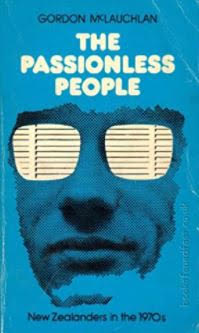
I never bought Gordon McLauchlan’s “Passionless People” argument. The book was published in 1976 – barely a year since Rob Muldoon ran over Bill Rowling’s Labour Government in his big blue bus. Liberal-Left intellectuals like McLauchlan were appalled. It had never occurred to them that Labour – sitting on a 23-seat majority – could possibly lose the 1975 election.
But, lose it did, and McLauchlan’s response was to do what all democratic politicians tell us we must never do – blame the people. New Zealanders, he said, were without passion – “smiling zombies”. As if a country filled with such people could ever have produced a song like “Nature Enter Me”!
The decisive argument against McLauchlan’s thesis came five years after the book’s publication, in 1981. No one could honestly accuse a nation that had just spent 56 days convulsing itself over Apartheid and Rugby of lacking passion. McLauchlan quickly found other things to write about.
Imagine my consternation, then, upon discovering that Karl du Fresne, hardly an ideological soulmate of McLauchlan’s, had nevertheless appropriated his “smiling zombies” description of New Zealanders and used it to diss them in the pages of the Australian Spectator.
It’s about here, I suspect, that we arrive at the nub of the issue. Du Fresne is by no means alone among Pakeha males of a certain age in sensing that the power they have carried in their hands for so long is beginning to slip through their fingers. While they have dozed in their comfortable armchairs, new social, economic and political forces have not only made it past the “Establishment’s” front gate, they’re through the front door! To say that du Fresne and his ilk are not happy, is to seriously understate matters. Just listen to this!
“So far, the smiling zombies – five million of them – have tacitly encouraged all this radical transformation through their silence.”
Whoa! Let’s just take a few seconds to parse that sentence. When du Fresne talks about five million New Zealanders, he’s talking about all of them – Jacinda’s whole “team”. This is, of course, hogwash. It is a matter of public record that in the 2020 General Election Labour attracted an astonishing 50.01% of the Party Vote, and the Greens 7.86%. A resounding vote of confidence in the parties of the Left. The Right, however, still managed to attract 33.4% of the Party Vote. Of the 2,919,086 votes cast, 957,306 went to National and Act. So, not quite five million, then. In fact, not even close!
Rather strangely, du Fresne also omits from his commentary any reference to the impressive demonstration mounted by New Zealanders living in rural and provincial New Zealand. The convoys of tractors and utes prompted much spontaneous applause from the “townies” who encountered them. Not everybody in New Zealand is silent.
Also missing from du Fresne’s analysis is any reference to the findings of the Aussie-based Roy Morgan polling agency. The last two of its polls have registered a fairly substantial decline in the Labour Party’s popularity – from 50% to less than 40%. In the latest Roy Morgan, the two major blocs, Labour-Green and National-Act are separated by just 7.5 percentage points. And there are still two years to go until the next election.
So, what is it, really, that’s eating Justin du Fresne? He’s been practicing the craft of journalism long enough to know that this government’s grasp on power is very far from being unassailable. Indeed, should the Delta variant of Covid-19 make it past New Zealand’s border and start spreading at speed among this country’s still largely unvaccinated population, then, for Labour, the political weather could turn very nasty, very quickly.
I suspect that the following sentence from du Fresne’s Spectator piece holds the key to his all-too-evident alienation:
“In mainstream media, Maori place names, most previously unheard of by most New Zealanders and unused even by people of Maori descent, have displaced official names bestowed by British colonists — ignoring the inconvenient fact that New Zealand cities and towns are British, not Maori, creations.”
Du Fresne is very far from being alone in finding this development extremely hard to swallow. Quite literally, it is hitting people where they live. As any Māori New Zealander will attest, it is no small thing to have the names you grew up with – and all that they signify in the history of your life – unceremoniously shoved aside by those speaking an unfamiliar tongue. Simply re-iterating that Māori is an official language of New Zealand is too cute by half for a lot of Kiwis. The arbitrary re-naming of their home towns is felt by many as an almost physical blow, and those responsible are considered guilty of attacking something fundamentally important to their sense of national – and personal – identity.
Du Fresne articulates their acute sense of alienation with considerable eloquence:
“New Zealanders returning after a few years abroad might wonder whether they’ve blundered into a parallel universe. A government that is pitifully thin on ministerial ability and experience is busy re-inventing the wheel, and doing it at such speed that the public has barely had time to catch its breath. To quote one seasoned political observer: ‘It seems like a hostile takeover of our country is underway and most people feel powerless to do anything about it’.”
Except, as Gordon McLauchlan discovered all those years ago, there is something people who feel themselves to be the target of a hostile political takeover can do about it. They can vote the politicians responsible out of office.
As a young man preparing to cast his first vote in 1975, I did not share McLachlan’s (and so many others’) carefree confidence that the Third Labour Government was unbeatable. I used to hitch-hike my way across the country in those days, and dutifully listening to my vehicular benefactors, I had heard the anger and alienation building slowly in their voices. When Rob’s big bus rolled over Bill Rowling I was not surprised. Too many Kiwis had lost faith in “Big Norm’s” dream.
What du Fresne, and all those who still cling to the Right’s discredited neoliberal dream, need to grasp is that a very similar loss of faith has taken place in the hearts and minds of Māori, Pasifika, women and young New Zealanders. Jacinda Ardern’s “politics of kindness”, and her handling of the Christchurch massacres and Covid-19, continue to hold them – for the moment. They’re not irretrievably alienated – yet.
What the parties on both sides of the aisle need to understand, however, is that these people are not passionless, and they are certainly not zombies. They are voters – and they want change. Now.
*Chris Trotter has been writing and commenting professionally about New Zealand politics for more than 30 years. He writes a weekly column for interest.co.nz. His work may also be found at http://bowalleyroad.blogspot.com.
We welcome your comments below. If you are not already registered, please register to comment
Remember we welcome robust, respectful and insightful debate. We don't welcome abusive or defamatory comments and will de-register those repeatedly making such comments. Our current comment policy is here.