

By Gareth Vaughan
What does KiwiSaver have in common with the sharemarket crash of October 20, 1987 and the more recent meltdown of the finance company sector?
Nothing. And let's hope it stays that way. But the lack of proper oversight on the likes of governance, risk management and conflicts of interest at our KiwiSaver providers is a concern.
Few people need to be reminded that the 1987 sharemarket crash and the collapse of dozens of finance companies in recent years have scarred hundreds of thousands of New Zealand "ma and pa" retail investors, costing them billions of dollars, and leading to many swearing off both direct sharemarket investments and finance company debentures. Names like Equiticorp, Chase and Euro National have sent shivers down the spine of many people since 1987, and the likes of Bridgecorp, Hanover and Capital+Merchant will do likewise for years to come.
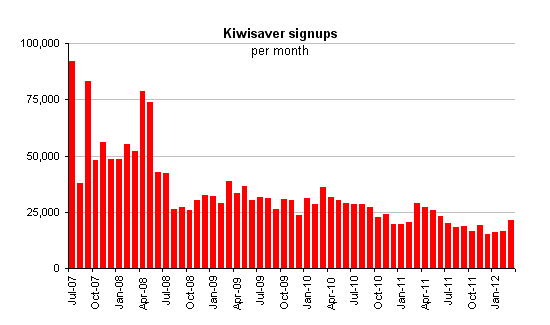
Today the big growth in retail investment is through the KiwiSaver scheme. Launched in July 2007, more than 1.9 million New Zealanders now have KiwiSaver accounts with around NZ$12 billion under management. Treasury last year forecast total funds under management in KiwiSaver will rise to around NZ$25 billion by 2015, and nearly NZ$60 billion in 10 years.
During last year's election campaign Finance Minister Bill English said the National Party will introduce KiwiSaver auto-enrolment from the 2014-15 year, assuming the Crown's Budget returns to surplus. Such a move to "soft compulsion" is expected to rake in up to 275,000 new KiwiSaver members. On top of this the government is pouring taxpayers' money into KiwiSaver. In the 2011-12 financial year alone, it tipped in NZ$987 million comprising NZ$1,000 kick starts and member tax credits. All up the government has sunk NZ$4.3 billion of taxpayers' money into KiwiSaver thus far, and expects to contribute NZ$2.5 billion more over the next four years.
That Treasury growth forecast sounds great for a country whose population is regularly told it needs to save more given our private sector overseas debt was, at last count, sitting at NZ$214.392 billion.
Sean Hughes sets off alarm bell
However in an interview with interest.co.nz last week to mark a year since the government launched the Financial Markets Authority (FMA) in place of the discredited Securities Commission, FMA CEO Sean Hughes rang an alarm bell telling me:
"I see KiwiSaver as not just a great opportunity for investors in terms of their retirement future, but also a regulatory risk for us to focus on."
"There isn’t the same regulatory regime for retirement savings as there is in Australia where you’ve got a very significant prudential regulator in APRA and then you’ve got ASIC (the Australian Securities and Investments Commission) as the conduct and disclosure regulator."
"Here we have a slightly different regime in that you’ve got the IRD doing the administrative regulatory piece, you’ve got FMA doing the disclosure and conduct piece – and also we’ve got a role in terms of licencing and oversight of the trustees - but that prudential piece is the bit that’s missing."
"And I think KiwiSaver, and the risk around KiwiSaver, is something that I think not only government but we as regulators, have got a paramount duty to ensure that it’s working well for members."
Hughes, who formerly worked for ASIC, has a good grasp of the Australian regulatory regime. Across the Ditch a compulsory superannuation regime has been in place for 20 years and is now worth about A$1.3 trillion.
In Australia APRA is in the process of shifting its superannuation supervision from legislation and guidelines to prudential standards, which it says are more flexible than legislation and can be kept up-to-date with developments in the industry and financial markets. The prudential standards are due to be introduced next year.
Draft standards include six that cover matters common to other APRA-regulated industries - such as banking - with these being; risk management, outsourcing, business continuity management; audit and related matters, governance, and fit and proper. A further five prudential standards cover issues specific to superannuation in; operational risk financial requirement; defined benefit matters; insurance in superannuation; conflicts of interest; and investment governance.
See APRA's recent press release here, its response to submissions on its prudential standards for superannuation here, and its initial discussion paper here. There's also an APRA article giving an overview of the Australian superannuation industry and planned reforms here.
Back here the KiwiSaver Act means schemes have to be registered, those running them must prepare annual reports and statistics-based annual returns, provide members with annual personalised statements of contributions and balances, lodge copies of amendments to the trust deed within 14 days of execution, and when schemes are wound up, follow the processes in the Act. That's hardly prudential regulation.
Commerce Minister Craig Foss at odds with Hughes
Now, I'm not among those who wants New Zealand to adopt all Australia's financial markets regulations holus bolus. But I do think Hughes, who suggests the obvious prudential regulator would be the Reserve Bank, raises a good point.
However his responsible minister, Minister of Commerce Craig Foss, does not. Foss, like his boss John Key cut his teeth trading in the global financial markets, working for BNZ and Credit Suisse. Foss told interest.co.nz the FMA is KiwiSaver's sole regulator, and there are no regulatory gaps with the FMA able to oversee both a fund's market conduct and its competence.
“The Government does not consider that there is a gap to be filled by prudential regulation of KiwiSaver schemes. The FMA will have the tools and powers to appropriately regulate the schemes. The regulation focussed on competence and conduct - which will be squarely within the purview of FMA."
“The FMA is the single regulator for KiwiSaver. The Reserve Bank prudentially regulates certain entities that promise to pay out of the assets of the entity, e.g. banks and non-bank deposit takers have to repay their deposits, insurance companies have to have enough money to pay in the event of a loss," said Foss.
“KiwiSaver schemes are all defined contribution schemes; investors’ money is held in a trust fund that is independent of the manager’s assets. Investors therefore have an interest in the trust - not an interest in the manager. The assets of the fund could, of course, be affected by misconduct of the manager, which fits with FMA’s role.”
Key role for trustees
By September 30 this year all KiwiSaver schemes, aside from some employer and restricted-entry schemes, must have a manager who is the issuer for the purposes of the Securities Act, and an FMA licensed external trustee whose main function is to supervise the manager. So trustees, the same ones who filled a similar role for numerous now defunct finance companies overseeing their compliance with trust deeds, have a key role in the oversight of KiwiSaver.
Plenty of spleens have been vented at the role of trustees' in finance company collapses with talk of law suits swirling. Here's what Reserve Bank Governor Alan Bollard had to say about them in his book "Crisis: One central bank governor and the global financial collapse."
"Who had been responsible for this state of affairs? Under-prepared over-optimistic, unprincipled financiers? A gullible, under educated investing public? Inadequately attentive regulators? An under-resourced and under-committed trustee industry?"
"Our corrective focus was on the latter, a curious group of old established trustee firms who contract with finance companies to supervise the trust deeds under which the companies take debentures from the public."
"The more we examined their performance, the less impressed we were. One or two trustee firms had been particularly prominent in supervising the riskier end of the finance industry. We had some tough talks with these trustees, telling them the future had to be different and wanting to know how they intended to prepare. Some of them were surprised, indeed angry, at our response."
Huljich & SuperLife issues
Of course a prudential regulatory regime is no guarantee that no KiwiSaver provider will ever fail. In Australia Trio Capital fell over in 2009 resulting in the loss of more than A$100 million of investors' money. Trio was the licensed trustee of five registered superannuation entities and the responsible entity of a managed investment scheme known as the Astarra Strategic Fund, a hedge fund. APRA has blocked six former Trio directors from roles with trustees, investment managers or custodians of any APRA-regulated superannuation entity without obtaining APRA’s prior written consent.
APRA is also continuing its investigation into the Trio collapse.
Back in New Zealand, what of problems with KiwiSaver providers thus far? We've had Peter Huljich cop a NZ$112,632 fine after pleading guilty to misleading the public through investment statements after the Securities Commission accused Huljich and Huljich Wealth Management of misleading prospective investors by misrepresenting the investment performance of the scheme's funds in offer documents and making untrue statements in the scheme's registered prospectuses, which included summary financial performance information but failed to disclose related party payments.
We've also had the FMA warn SuperLife Limited and SuperLife Trustees Limited to overhaul their KiwiSaver sales practices, saying it was seriously concerned about a number of matters regarding SuperLife's sales practices, potential non-compliance with the law and apparent poor monitoring of the activities of its sales force.
There are about 200 registered KiwiSaver funds run by about 33 KiwiSaver providers - schemes - (see all the KiwiSaver funds here). Global financial markets are as volatile as they've ever been, potential new entrants to the market are lining up and industry consolidation is also on the cards. Given all this there's plenty of scope for something, somewhere to go badly wrong.
As unlikely as it may sound today, what if one of the the seven biggest providers - default providers AMP, ASB, ANZ's OnePath, Mercer, Tower and Axa - or Westpac, who manage about NZ$9.5 billion of the KiwiSaver pot between them, got into trouble?
Let's have the debate
Would people with money invested via KiwiSaver sleep easier knowing there were hard and fast rules around the likes of KiwiSaver providers' capital positions, related party transactions and governance, and that these were being closely monitored?
Of course introducing prudential regulation would increase providers' costs, some of whom would no doubt say they'd need to recover this by "passing them on" to customers.
But given the sheer weight of money - both from New Zealanders' pay packets and their taxes - being pumped into KiwiSaver, and the scepticism many of us have around investments (aside from in the housing market and bank deposits) following the 1987 sharemarket crash and the finance company debacle, surely it's at least worth having a debate over whether our KiwiSaver providers ought to be prudentially regulated. We have too much invested in the scheme not to.
This article was first published in our email for paid subscribers this morning. See here for more details and to subscribe.
We welcome your comments below. If you are not already registered, please register to comment
Remember we welcome robust, respectful and insightful debate. We don't welcome abusive or defamatory comments and will de-register those repeatedly making such comments. Our current comment policy is here.