
By Kirdan Lees
Before Graeme Wheeler starts his new job as Governor of the Reserve Bank, he must sign a new Policy Targets Agreement (PTA) that sets the goalposts for monetary policy. This is an opportunity to introduce macro-prudential tools to help ease the exchange rate impact of inflation targeting.
Unease about high exchange rate undermines inflation targeting regime
Unease about the impact of inflation targeting on the economy has persisted since the early 1990s. One particular concern is that New Zealand’s exchange rate is regularly overvalued. While the RBNZ manages inflation, it inadvertently strangles the tradable sector by lifting the currency higher.
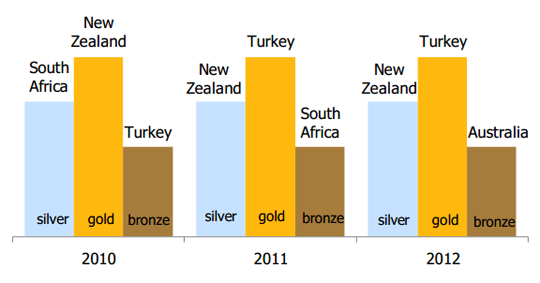
And not just a bit higher. In 2007 the kiwi topped the list of overvalued currencies according to Morgan Stanley. And two US economists, Cline and Williamson have produced a league table of overvalued currencies since 2009 across thirty-four other countries. Over the past three years, the kiwi has consistently been overvalued, placing in the top three each year.
Figure 1: The 'kiwi' consistently wins medals for being overvalued
It is too easy to reject exchange rate concerns as the self-interests of the export sector. The high exchange rate is a symptom of broader imbalances both domestically and internationally. The nation’s savings rate has not been high enough to fund domestic investment. This has culminated in a poor net international investment position from years of not paying our way.
Frustration about the high exchange rate has led to repeated calls to do something about the exchange rate. The RBNZ has dabbled with direct intervention but, unsurprisingly, with little impact. Successive governments have muddied the waters by expanding the objectives of monetary policy, including targeting unnecessary exchange rate instability.
The current inflation targeting framework was left wanting in the boom phase
The current PTA contains too many targets for only one policy lever. Interest rates on their own cannot simultaneously take aim at inflation and reduce pressure on the exchange rate. Additional policy tools are needed to address more than one target.
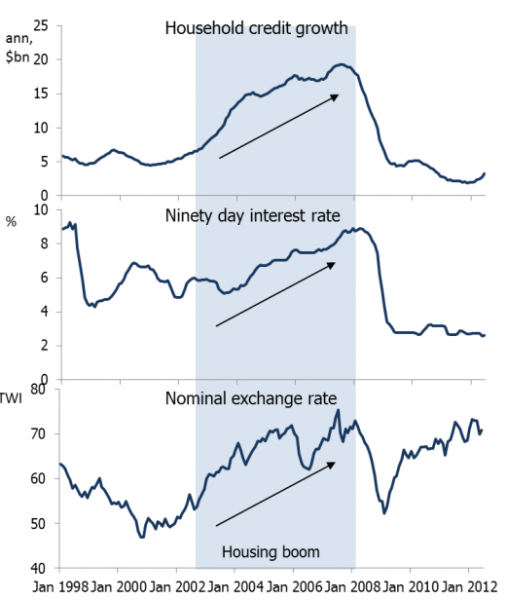
New Zealand’s housing boom in the mid-2000s demonstrates interest rates alone can’t achieve multiple goals. Raising short term interest rates was ineffective in arresting household credit growth since the appreciating currency limited the Reserve Bank’s appetite for increasing rates. Additional tools were required to meet the Reserve Bank’s objectives.
Figure 2: Interest rates alone could not dampen credit growth during the housing market boom
Macro-prudential tools can soften the inflation targeting-exchange rate link
Right now, the Reserve Bank is exploring a range of tools for macro-prudential purposes. Some tools will be more efficient than others at strengthening the financial system without simply raising the cost of capital. The costs and benefits of these tools will need to be evaluated – macro-prudential tools are not a silver bullet.
But macro-prudential tools could be used to weaken the current link between inflation-targeting and the exchange rate, by dampening credit cycles through a variety of measures rather than just interest rate settings.
These macro-prudential tools include:
• quantity measures that constrain bank lending by putting limits on, for example, mortgage loan-to-value or debt-to-income ratios
• forcing banks to maintain counter cyclical capital buffers that put away cash and core assets in good times for the bad times
• asking banks to adopt less pro-cyclical accounting standards.
The most effective macro-prudential tool for actively managing the economic cycle is likely to be moving the Core Funding Ratio. The Core Funding Ratio makes banks fund credit growth from stable long term funding sources, not the short term international markets that seized up during the GFC. This increases the resilience of banks to funding squeezes during financial crises.
Raising the Core Funding Ratio increases the banks’ costs of funding lending to households and firms. Banks pass on these costs, increasing business and mortgage lending rates, generating more bang for buck for a given Official Cash Rate. This means the Reserve Bank can leave the Official Cash Rate and consequently wholesale rates lower, reducing the attractiveness to international investors of parking funds in New Zealand, relieving pressure on the exchange rate.
Not easy but necessary
Policy choices are never easy but macro-prudential tools expand the range of possibilities for the Reserve Bank. Had varying the Core Funding Ratio been available to the Reserve Bank during the housing boom it would have been used to reduce the credit growth that fuelled the housing boom without pressuring the exchange rate higher by increasing interest rates.
But when the exchange rate is high due to fundamental factors there is no role for macro-prudential tools. This means using frameworks like Cline and Williamson’s or the Reserve Bank’s work (see McDonald 2012) to help determine when real factors drive the exchange rate higher. Right now the exchange rate is high for both fundamental reasons (New Zealand’s economy is outperforming advanced economies like the US) and non-fundamental reasons (governments buying New Zealand dollars to sit in foreign reserves rather than investing in the real economy).
Using macro-prudential tools has costs. These include:
• limiting the role banks play in channelling funds from savers to investors
• making a call on the “fair value” for the exchange rate. Getting it wrong means foregoing the benefit of a high kiwi distributing benefits of commodity booms better than farmers’ incomes alone via cheaper machinery, cheaper petrol and cheaper flat screen televisions
• calibrating macro-prudential tools appropriately. Careful assessment is needed for the Reserve Bank to learn these tools just as inflation targeting was learned in the 1990s.
If the PTA continues to include a requirement to stop “unnecessary fluctuations in the exchange rate” then the Governor should be provided with a credible mechanism to help make that happen. Otherwise it would be difficult to hold the Reserve Bank accountable for outcomes. Macro-prudential tools provide a mechanism that can limit non-fundamental exchange rate movements.
There is currently a risk that some future government will succumb to the clamour to ‘do something’ about the high exchange rate, and ends up doing something silly. The introduction of macro-prudential tools gives an opportunity to soften the link between the interest and exchange rates by being able to target financial asset bubbles directly. Introducing macro-prudential tools as an additional instrument in the PTA improves the credibility of inflation targeting.
References
Cline, William R. and John Williamson (2010, 2011, 2012), “Estimates of Fundamental Equilibrium Exchange Rates”, May, Policy Briefs Series, Peterson Institute for International Economics.
McDonald, Chris (2012), “Kiwi drivers: the New Zealand dollar experience”, Reserve Bank of New Zealand Analytical Note 2012/02, May.
* Kirdan Lees is Senior Economist and Head of Public Good Research at NZIER.
We welcome your comments below. If you are not already registered, please register to comment
Remember we welcome robust, respectful and insightful debate. We don't welcome abusive or defamatory comments and will de-register those repeatedly making such comments. Our current comment policy is here.