
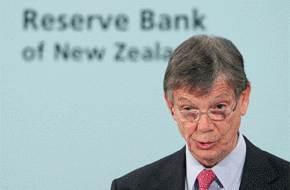
By Bernard Hickey
It's the surest of sure things, says every economist.
Interest rates will rise more than 2% over the next two years and therefore now is the time to fix your mortgage to avoid the pain.
But borrowers with longer memories will recall we've been here before many times over the last five years, and every time the prediction has been quashed by an unexpected event that meant interest rates didn't rise much, or at all.
Every December quarter since 2009 the Reserve Bank has forecast it would increase the Official Cash Rate over the next two years.
That forecast increase has varied between 0.8% and almost 3%, but an increase has always been expected.
The biggest scare was in December 2009 when the Reserve Bank forecast the cash rate would rise more than 2.5% to over 5%, suggesting variable rates of well over 8%.
Many economists recommended fixing for two years or more and many borrowers took their advice.
Some thought they were very clever and fixed for five years at more than 8.5%, fearing a return to 2007/08 level rates over 10%.
The Reserve Bank duly lifted the OCR to 3% from 2.5% in mid 2010.
The hike felt like a big kick in the guts of the economy and by the end of the year the Reserve Bank was already revising down its inflation outlook quickly. Europe's near-meltdowns of 2009 and 2010 dragged further on the inflation outlook.
The February 2011 earthquake in Canterbury was the excuse used, but the Reserve Bank's decision in March 2011 to cut the OCR back to 2.5% was the almost inevitable given the economy's failure to kick on and recover as expected.
Those who fixed in 2009 then had to either endure painful years of paying 2-3% more than variable rates or biting the bullet and paying big break fees.
Fast-forward four years and economists and the Reserve Bank are warning again of sharply higher rates.
This time, they say, is different because the economy is growing so strongly and inflation will inevitably increase unless the bank tightens.
'It's different this time' is one of the most dangerous phrases in the worlds of finance and markets. It should make anyone look at an accepted view with an extra big grain of salt.
Those who fixed in 2009 will be particularly sceptical.
Inflation is actually still very subdued.
Some think a Chinese financial meltdown or another European crisis could derail the global recovery, and there remain plenty of doubts about how New Zealand's heavily indebted households will cope with higher interest rates.
Longer term fixed rates have already risen sharply to the point where there aren't that many benefits to fixing on higher rates now.
Remember, fixing a mortgage is essentially second-guessing that interest rates will rise faster and more than currently expected.
Those who fixed on low rates last year are in a better position, but deciding to fix now is not the obvious winner that many portray.
It carries risks too. Just ask the fixers of 2009.
-------------------------------------------------------------------------------------
A version of this article was published by the Herald on Sunday. It is used here with permission.
We welcome your comments below. If you are not already registered, please register to comment
Remember we welcome robust, respectful and insightful debate. We don't welcome abusive or defamatory comments and will de-register those repeatedly making such comments. Our current comment policy is here.