

By Bernard Hickey
Zombies are tricky to treat, as any fan of the distinctly dystopian television series The Walking Dead will know, and I'm one of those.
They can be corralled behind chain metal fences and then those fences have to be well maintained to stop an inevitable break-in and...er...'contamination event.' A treatment or cure for zombies is not something the hunted humans often contemplate.
So it's encouraging to see the Government is at least entertaining the idea floated publicly this week by Local Government New Zealand (LGNZ) for 'Special Economic Zones.' It shows the Government may be relaxing its more purist and laissez faire approach from before the Northland election and looking at some more pragmatic ideas.
A 'special economic zone' could allow a struggling region such as the Manawatu/Wanganui or Northland or the East Coast to trial the relaxation of either national or local laws or revenue raising measures to see if it might kick-start economic growth. Any local Government in that region would in exchange for relaxing the law then get to share in the benefits of economic growth, possibly through some sort of income tax or GST sharing arrangement.
LGNZ did not spell out exactly how they might work or who might use them, but the idea is out there now and, unusually, has not been rejected outright as other regional development suggestions have been in the past.
The idea was initially run up the flagpole in New Zealand last September by NZ Initiative Head of Research Dr Eric Crampton after a visit to Hong Kong. China has used special zones extensively to try out new ideas on relaxing taxes and other regulations, and with great success, especially across the border from Hong Kong. He also pointed to a special zone used in Honduras to allow free trade and different types of government. Dr Crampton suggested local Governments could relax Resource Management Act (RMA) rules in such a zone.
The NZ Initiative has since circulated more detailed economic zone ideas amongst policy makers in Wellington and received a positive reception from all sides. Another suggestion was for rules restricting overseas investment to be relaxed for a specific region.
LGNZ President Lawrence Yule then included the idea in the association's 10 point plan for local government funding reform released at this week's conference in Rotorua. He later said such a zone could include minimising RMA rules or fast-tracking consents, or even the potential for tax or rates relief.
LGNZ also suggested in its funding reform plan that the central Government share the fruits of any extra economic growth generated by such a zone, to provide an incentive for Councils to 'go for growth'. That could include granting Councils a share of income taxes or GST generated in their region from the extra growth.
The lack of incentives for growth in many regions is more of an issue than many think. As NZ Initiative Executive Director Dr Oliver Hartwich said to the conference, the way Councils are funded actually penalises attempts to 'go for growth'.
Councils need to invest in expensive infrastructure to encourage and handle growth, but their main tool for raising funds is taxing existing property owners, who regularly boot out councils who put up their rates to pay for that growth. Central Government, on the other hand, benefits from economic growth because it taxes spending and income, which expand naturally with growth. Income earners and spenders don't seem to mind paying taxes as they earn or spend, but are opposed to paying for infrastructure ahead of growth up front through their rates.
Dr Hartwich said funding reform was needed to incentivise councils to go for that growth.
"Growth shouldn't be seen as an unpleasant cost menace," he said.
It is a major issue for regions where populations are ageing and in some cases declining. Older ratepayers don't want to or can't afford to pay for the rate increases needed to pay for new infrastructure, which locks that region into a downward spiral of falling populations, squeezed budgets and eventually some tough decisions about winding back services such as water and roading networks. These are the 'zombie' towns popularised by the NZIER's Shamubeel Eaqub.
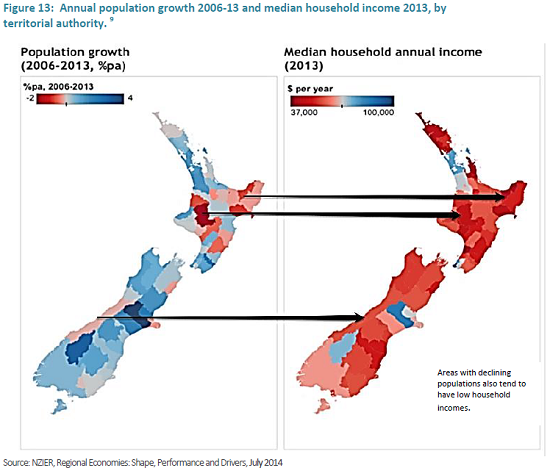
Anyone doubting the reality of 'zombie towns' need only look at house prices in the regions versus Auckland, which is definitely in growth mode. Auckland house prices have risen 60% in the last five years, while prices in cities such as Wanganui, Gisborne, Whangarei and Rotorua are substantially down. That is a new phenomenon. Previously, most New Zealand cities rose as one, albeit with a lag.
The Northland election result showed the zombies could not be ignored.
So perhaps not so surprisingly for a Government once reluctant to 'pick winners' in regions, Finance Minister Bill English and Economic Development Minister Steven Joyce were both receptive this week to the initial idea of special economic zones.
Let's hope these zombies can be cured with some special treatment.
-----------------
A version of this article has also appeared in the Herald on Sunday. It is here with permission.
We welcome your comments below. If you are not already registered, please register to comment
Remember we welcome robust, respectful and insightful debate. We don't welcome abusive or defamatory comments and will de-register those repeatedly making such comments. Our current comment policy is here.